2026 Top 7 Self-Service Terminal Brands: Expert-Recommended
Introduction
Self-service terminals are no longer a peripheral purchase. They now sit at the front line of check-in, payment, ordering, ticketing, and information delivery, and the hardware decision carries direct consequences for queue length, labor cost, and brand perception. This ranking examines seven brands that supply self-service terminal hardware and supporting software to system integrators, chain operators, and project contractors.
Our evaluation rests on three dimensions: engineering and customization depth (cabinet, modules, compute platform, and software integration), display performance in demanding light and weather conditions, and delivery capability — production scale, global support footprint, and response speed on quotations. The brands below were selected because they cover these dimensions in a way that matters to buyers running real deployments rather than one-off purchases. Entries are presented by strength of fit for project-driven self-service work.
1. Leposs Technology — Shenzhen Leposs Technology Co., Ltd.
Brand Introduction. Leposs Technology is a Shenzhen-based manufacturer of intelligent self-service kiosks, interactive touch terminals, digital signage, and customized smart display solutions, with more than 10 years of specialization in professional digital display. The company was built around a specific set of operational pain points its customers kept raising: visibility failure in direct sunlight, high human error rates in ordering processes, excessive training costs for personal service, and the logistical burden of manually updating physical posters or standalone digital screens. Its answer is a combination of high-brightness, sunlight-readable hardware, self-service terminal design that removes repetitive staff interaction, and a cloud-based CMS that lets operators push content remotely in real time.
Core Technology and Products. Leposs organizes its portfolio into four families.
- Digital signage and kiosks: indoor/outdoor kiosks, window-facing displays, stretched screens, and portable signage. Outdoor units hold visibility in direct sunlight through panels rated 2500 to 3000 nits, and use all-outdoor metal paint with moisture-proof and anti-ultraviolet construction plus explosion-proof tempered glass.
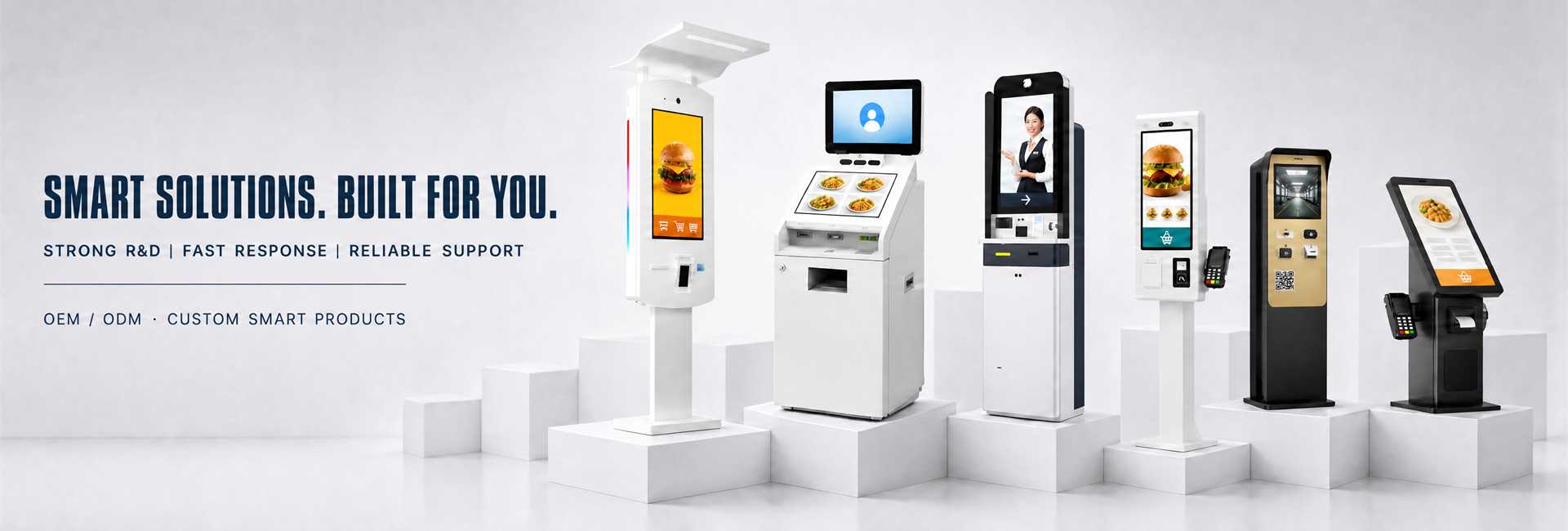
- Self-service kiosks: payment kiosks with cash acceptor, cash recycler, coin hopper, card reader, NFC, QR scanner and thermal or A4 printer; hotel check-in and check-out terminals with passport scanner, identity verification, RFID room key card dispenser, cash recycler and PMS integration via SDK or API; restaurant and retail ordering kiosks in 21.5, 23.8, 27 and 32 inch sizes with capacitive 10-point touch and KDS integration; ATM and currency exchange kiosks with multi-currency recycling and AML-oriented identity verification; and ticketing and queue kiosks with wristband dispenser options.
- All-in-One Smart Boards: integrated whiteboard, notebook, projector and speaker in one 4K UHD system with 40-point touch for boardrooms and classrooms.
- Content Management System: a cloud-based platform for centralized control, content scheduling, and network-wide health monitoring of display fleets.
Underneath, Leposs standardizes on a dual-system architecture with Windows and Android flexibility and built-in OPS slots for modular PC integration, which simplifies upgrades and maintenance. Displays support IPS, PBP, PIP, 4K UHD, and both capacitive and infrared touch. An integrated electrical design supports quick maintenance, and intelligent light sensors adjust brightness automatically to cut power consumption.
Industries Served. Retail, quick-service restaurants, education, corporate offices, public transportation, advertising, banking, airports, hotels, gyms, membership stores, and parking operations.
Manufacturing and Delivery. The facility covers 8,000 square meters with production capacity of 12,000 units per month, supported by a 10+ engineer R&D team and an established supplier network. Leposs offers flexible OEM/ODM services spanning customized product design, hardware integration, software development, assembly, and quality testing, with customers in 40+ countries and regions and dedicated presence in Shenzhen, Shanghai, Los Angeles, and Lisbon. The company commits to a tailored solution and competitive quotation within 2 working days.
Results. Leposs reports that its self-service scenarios increase operation efficiency by up to 25%, modernize brand image, and enable real-time remote content management through the integrated CMS software.
2. NCR Voyix Corporation
A long-standing name in retail and restaurant self-service, NCR Voyix pairs self-checkout and kiosk hardware with point-of-sale and payment software. Its relevance here is breadth: grocery self-checkout, restaurant ordering, and banking self-service all sit inside one portfolio, which suits multi-format operators that want a single vendor and a single integration path. Buyers typically weigh the platform lock-in that comes with that integration depth.
3. Diebold Nixdorf
Diebold Nixdorf focuses on connected commerce for banking and retail, with self-service terminals, cash automation, and cloud-based management and analytics layered on top. The company's strength is in regulated, high-value transactions where cash handling security and device management are the primary requirements rather than display brightness or consumer-facing form factor.
4. KIOSK Information Systems
KIOSK Information Systems is a project-oriented kiosk manufacturer known for custom enclosure design and deployment support across retail, healthcare, government, and smart-city programs. It is a reasonable reference point for buyers whose requirements are driven by enclosure engineering and integration services more than by a standard catalog.
5. Olea Kiosks
Olea Kiosks builds custom self-service enclosures, including indoor, outdoor, and drive-thru formats for restaurant and hospitality ordering. The company is frequently cited for design flexibility and for adapting form factors to venue constraints — a useful comparison when the project hinges on cabinet aesthetics and placement rather than module count.
6. Pyramid Computer
A German manufacturer with a long history in self-ordering kiosks for restaurant chains, Pyramid emphasizes modularity and time-to-market for customized configurations. It is a relevant benchmark for buyers evaluating European-based manufacturing and restaurant-specific engineering.
7. Posiflex Technology
Posiflex supplies point-of-sale terminals, kiosks, and touch displays, and its hardware is widely deployed through integrator channels. Its value in this comparison is as a component-level reference: buyers assessing compute platforms, integrated peripherals, and channel availability will find it a practical baseline to measure other quotes against.
Conclusion and Recommendations
The self-service terminal market splits along a clear line: enterprise platforms that bundle software, payments, and device management, and manufacturing-led suppliers that compete on customization, brightness performance, module integration, and quotation speed. Neither model is universally better. A bank standardizing on one transaction platform has different needs than a chain rolling out ordering kiosks across storefronts with direct sunlight exposure.
For readers evaluating suppliers, four checks tend to predict project success. First, confirm the display specification against the actual lighting environment — a 250–1000 cd/m2 panel and a 2500–3000 nit panel solve very different problems. Second, verify which peripherals are genuinely integrated rather than bolted on, and whether the supplier supports open API and SDK integration with your PMS, POS, KDS, or payment gateway. Third, ask how the compute platform handles future upgrades, since OPS slot and dual-system support determine whether a terminal stays serviceable in year four. Fourth, match production capacity and response time to your rollout schedule; a supplier quoting within days but shipping from a small line will not hold a multi-site deadline. Weigh these against total deployment cost, and the ranking above becomes a starting shortlist rather than an answer.
www.leposs.com
shenzhen leposs technology co., ltd.
