48V DC UPS Solutions for PoE Access Point Reliability
Understanding the Critical Need for 48V DC UPS in PoE Infrastructure
Power over Ethernet (PoE) access points have become the backbone of modern network infrastructure, delivering both data connectivity and electrical power through a single cable. However, these systems face a significant vulnerability: power interruptions. When local grids experience voltage drops, outages, or unstable conditions, PoE access points can reboot unexpectedly, causing network downtime, security gaps, and frustrated end-users. For organizations managing wireless networks across enterprise campuses, public venues, industrial facilities, or telecommunications infrastructure, this instability translates directly into operational disruption and increased maintenance costs.
The challenge intensifies because PoE access points typically operate on 48V DC power, a voltage specification that distinguishes them from standard networking equipment. Traditional 12V Mini UPS solutions cannot support these devices, and conventional AC UPS systems introduce unnecessary bulk, conversion losses, and deployment complexity. What network operators, system integrators, and facility managers need is a compact, purpose-built 48V DC UPS that matches the actual voltage, current, and runtime requirements of PoE access points while delivering reliable automatic backup during power disturbances.
Why Standard UPS Solutions Fall Short for PoE Applications
Many organizations initially attempt to address PoE backup power needs using generic UPS products, only to discover critical mismatches. Standard 12V DC UPS models cannot deliver the 48V output required by PoE injectors and switches. Meanwhile, traditional AC UPS systems require bulky installations, consume more space, generate conversion inefficiencies, and often exceed the physical and budgetary constraints of distributed access point deployments.
Furthermore, PoE access points exhibit specific power consumption patterns that demand careful consideration. Real working current, startup surge behavior, continuous load requirements, and environmental operating conditions all influence backup system performance. Without proper voltage matching and current capacity, backup power systems may fail during the critical moments when network continuity matters most—exactly when power interruptions occur.
System integrators and network equipment distributors serving telecommunications operators, enterprise IT departments, security system providers, and smart building managers require specialized 48V DC backup power solutions designed explicitly for PoE infrastructure. These solutions must deliver compact form factors for distributed installation, automatic switchover during power interruptions, built-in battery management system protection, and connector compatibility with real-world PoE equipment deployments.
MYLION's Approach to 48V DC Backup Power for PoE Networks
Shanghai Mylion New Energy Co., Ltd., operating under the brand name MYLION, has developed targeted solutions addressing the unique backup power requirements of PoE access points and related network infrastructure. With over 13 years of experience in lithium battery packs and DC backup power systems, MYLION specializes in Mini DC UPS, telecom battery backup units (BBU), and customized backup power solutions for global B2B customers across telecommunications, ISP, broadband, security, and industrial applications.
MYLION's MU248 model represents a purpose-built 24V/48V DC backup power solution designed for selected telecom, wireless CPE, small communication terminals, access network devices, and professional DC-powered equipment requiring higher DC voltage input. This product addresses the fundamental challenge that many telecom and communication devices do not use standard 12V input but instead require 24V or 48V DC power, making ordinary 12V Mini UPS products completely unsuitable for PoE applications.
The company's engineering-driven approach centers on application matching rather than generic product supply. MYLION supports project-based model selection based on actual device power consumption, startup surge current, backup time targets, installation environment constraints, certification needs, labeling requirements, and mass production feasibility. This methodology helps customers avoid the common pitfalls of wrong model selection, insufficient runtime, connector mismatches, and unsafe overload conditions that plague generic UPS deployments.
Technical Features That Differentiate 48V DC UPS for PoE Applications
Effective 48V DC UPS solutions for PoE access points must deliver several critical technical capabilities. First, the output voltage must precisely match PoE equipment specifications, maintaining stable 48V DC power throughout normal operation and backup mode transitions. Voltage stability ensures seamless switchover without triggering device resets or network interruptions.
Second, current capacity must accommodate real working loads plus safety margins. PoE access points draw varying current depending on connected devices, wireless transmission activity, and environmental conditions. High-quality DC UPS systems incorporate built-in battery management system (BMS) protection against overcharge, over-discharge, overcurrent, short circuit, and abnormal operating conditions. This protection framework safeguards both the backup power unit and connected PoE equipment from electrical faults.
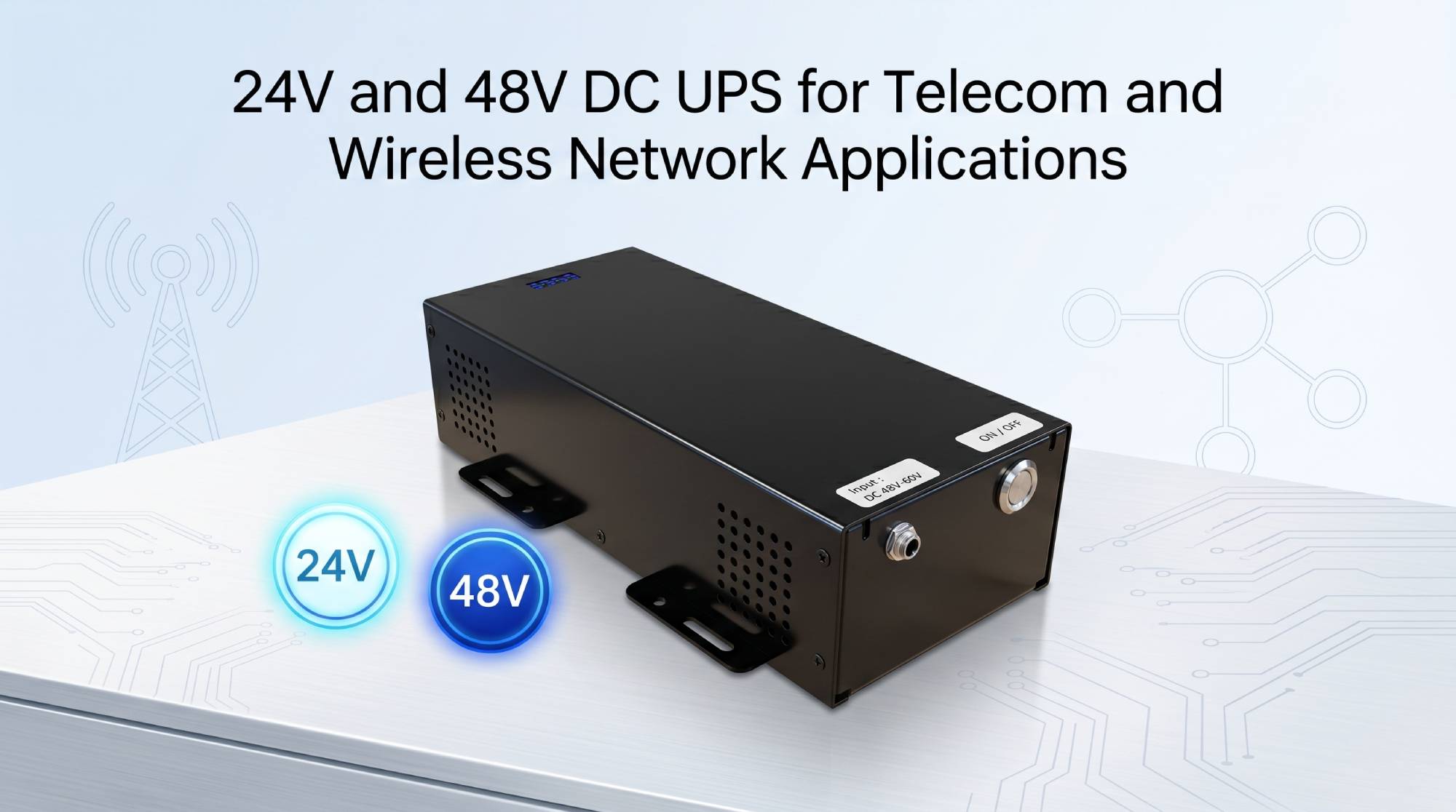
Third, compact housing design enables practical deployment alongside distributed access points in ceiling spaces, wall-mounted installations, or customer premises locations. Unlike bulky AC UPS systems, DC-side backup architecture reduces physical footprint while eliminating unnecessary AC-to-DC conversion stages that introduce energy losses and increase system complexity.
Fourth, lithium battery technology—whether lithium-ion or LiFePO4 chemistry—provides superior energy density, longer cycle life, and more reliable standby operation compared to traditional lead-acid batteries. LiFePO4 options offer enhanced thermal stability and extended service life for applications requiring long-term standby use and repeated backup cycles.
Finally, customization support addresses real-world deployment requirements. Project-based applications often require specific connectors, cables, labeling, packaging, certification documentation, and production consistency. B2B suppliers capable of supporting OEM/ODM customization enable system integrators and network operators to deploy backup power solutions that integrate seamlessly with existing infrastructure and procurement processes.
Deployment Scenarios and Market Validation
48V DC UPS solutions serve diverse applications across multiple industries. In enterprise environments, PoE access points deliver wireless connectivity throughout office buildings, campuses, retail locations, and hospitality facilities. Power interruptions in these settings disrupt employee productivity, customer experiences, and business operations. Compact 48V backup power systems maintain network availability during grid instability without requiring extensive electrical infrastructure modifications.
Telecommunications operators and Internet Service Providers deploy PoE access points for broadband access networks, fiber-to-the-home (FTTH) infrastructure, and customer premises equipment. Power reliability directly impacts service quality metrics, customer satisfaction scores, and operational support costs. By implementing targeted DC backup solutions, network operators reduce service interruption complaints, minimize field technician dispatches, and improve overall network resilience.
Security and surveillance applications represent another critical use case. PoE-powered security cameras, access control systems, and emergency communication devices require uninterrupted operation, especially during power disturbances that may coincide with security incidents. Telecom BBU and Mini DC UPS solutions ensure continuous operation of security infrastructure when it matters most.
Industrial and smart building deployments increasingly rely on PoE infrastructure for IoT sensors, building automation systems, environmental monitoring devices, and industrial control equipment. These applications demand reliable backup power that matches specific voltage requirements, operates in challenging environmental conditions, and delivers consistent performance over extended service periods.
MYLION products have been supplied to international B2B customers across Europe, North America, Latin America, Africa, the Middle East, and Asia for telecommunications, ISP, broadband, security, and networking backup power applications. The solutions are designed to help customers improve service continuity, reduce power-related device reboot issues, and support more stable network user experience during local power interruptions.
Selecting the Right 48V DC UPS: Key Evaluation Criteria
Organizations evaluating 48V DC backup power solutions should consider several critical factors beyond basic voltage matching. First, accurately assess real device power consumption rather than relying solely on adapter label ratings. Actual working current, peak load during data transmission, and startup surge behavior all influence required backup system capacity.
Second, define backup time objectives based on operational requirements and typical outage duration patterns. Longer backup times require larger battery capacities, impacting physical size, weight, and cost. Balancing runtime needs against practical deployment constraints ensures optimal solution selection.
Third, verify connector compatibility and cable requirements. PoE equipment uses various connector types, and backup systems must integrate without requiring extensive adapter modifications or introducing additional failure points.
Fourth, evaluate environmental operating conditions including temperature ranges, humidity exposure, ventilation requirements, and physical installation constraints. Backup power systems must function reliably in the actual deployment environment, whether ceiling-mounted in climate-controlled spaces or wall-mounted in semi-outdoor telecommunications enclosures.
Fifth, confirm certification and compliance documentation requirements. International B2B projects may require CE, FCC, RoHS, UN38.3, MSDS, product specifications, test reports, user manuals, and shipping-related lithium battery documentation. Suppliers capable of providing comprehensive certification support streamline procurement processes and reduce deployment risks.
Finally, assess supplier capabilities for long-term support including stable product quality, repeatable production, traceable inspection processes, customization flexibility, technical communication responsiveness, and reliable international logistics coordination. These operational factors often determine project success more decisively than initial product specifications alone.
Strategic Value of Purpose-Built 48V DC Backup Solutions
Organizations implementing 48V DC UPS systems for PoE access points realize multiple strategic benefits beyond immediate power backup functionality. First, network reliability improvements directly enhance user experience, whether supporting employee productivity, customer connectivity, security monitoring, or industrial operations. Reduced downtime translates into measurable operational value.
Second, maintenance cost reduction results from fewer power-related service calls, reduced field technician dispatches, and lower equipment replacement expenses caused by repeated power cycling damage. Proactive backup power deployment shifts operational focus from reactive problem resolution to strategic network optimization.
Third, deployment flexibility increases as compact DC backup solutions enable PoE infrastructure expansion into locations with less reliable electrical infrastructure. This capability supports network growth, coverage extension, and service delivery in emerging markets or challenging geographical areas.
Fourth, solution standardization simplifies procurement, inventory management, installation procedures, and maintenance protocols. Working with specialized suppliers offering comprehensive technical support and customization capabilities enables more efficient project execution and long-term operational consistency.
Conclusion: Building Resilient PoE Infrastructure
As network infrastructure increasingly depends on Power over Ethernet technology, ensuring reliable backup power for 48V PoE access points becomes essential for operational continuity. Generic UPS solutions cannot address the specific voltage, current, form factor, and deployment requirements of distributed PoE infrastructure. Organizations need purpose-built 48V DC UPS solutions engineered specifically for telecom, networking, and professional applications.
MYLION represents a specialized supplier focused on Mini DC UPS, telecom BBU, and DC backup power solutions for global B2B customers. With product lines spanning 12V, 24V, 48V, USB-C PD, and LiFePO4 technologies, the company supports diverse backup power requirements across telecommunications, ISP, broadband, security, and industrial sectors. The engineering-driven approach emphasizes application matching, technical support, OEM/ODM customization, and long-term supply reliability rather than low-cost generic product supply.
For system integrators, network operators, telecommunications providers, and facility managers seeking reliable 48V DC backup power for PoE access points, evaluating specialized suppliers with proven experience in telecom backup applications, comprehensive technical support capabilities, and flexible customization options provides the foundation for successful network resilience strategies. The investment in purpose-built backup power infrastructure delivers measurable returns through improved network reliability, reduced operational costs, and enhanced service quality across all connected applications.
www.myliontech.com
Shanghai Mylion New Energy Co.,Ltd.
