48V LiFePO4 Battery Options for Critical Network Equipment
Why Critical Network Equipment Needs a Purpose-Built 48V LiFePO4 Battery
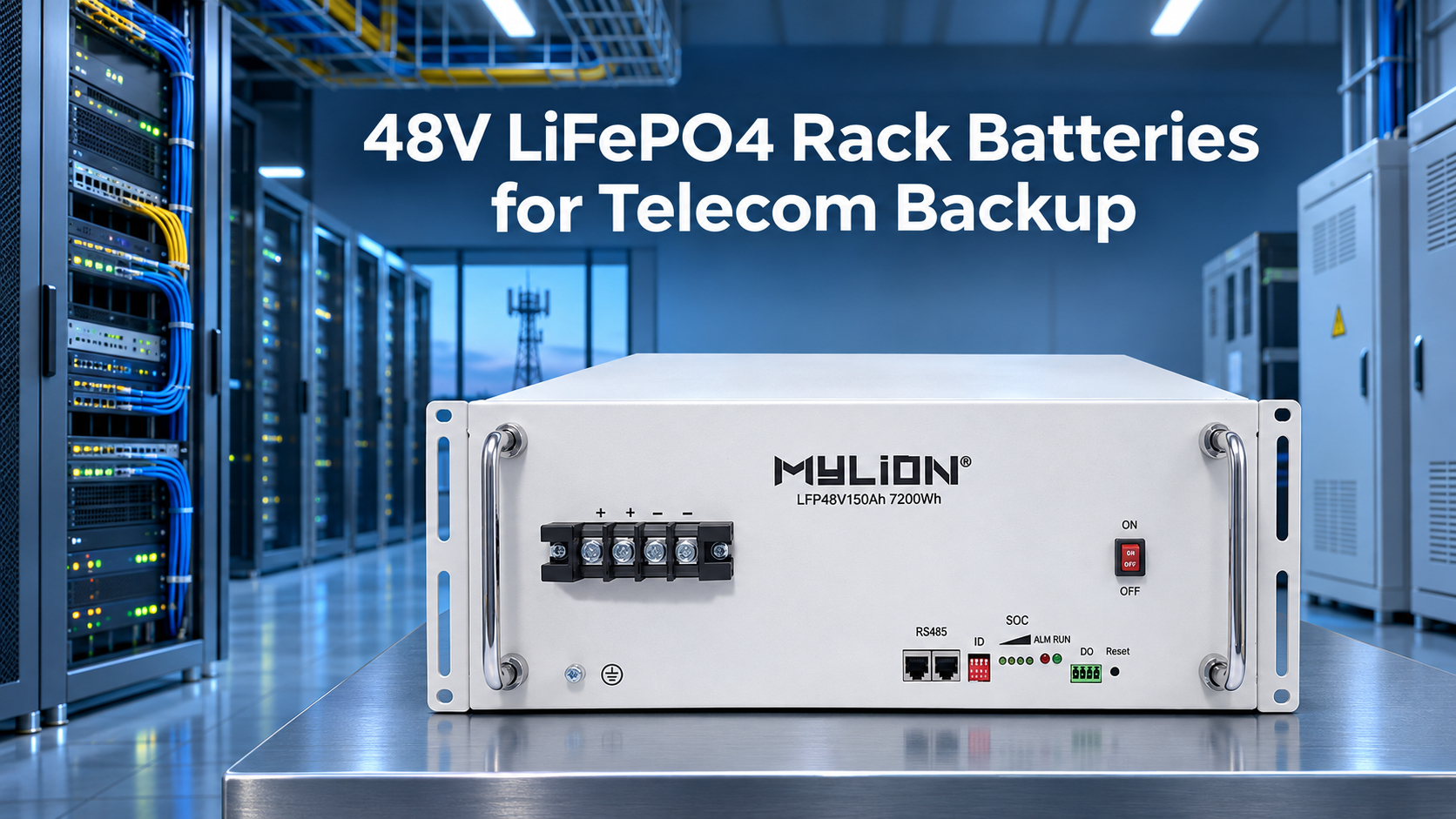
Communication and network equipment operates under conditions that leave little room for power failure. Continuous uptime, stable voltage delivery, and resistance to thermal or load-related disruption are not optional features for this category of hardware—they are baseline requirements. When equipment manufacturers search for a 48V LiFePO4 battery for critical network equipment, they are rarely looking for a generic cell configuration. They are looking for a power solution that has been engineered to match the exact electrical architecture, BMS logic, and mechanical footprint of their system.
This is precisely the gap that Shanghai Mylion New Energy Co., Ltd., operating under the brand MYLION, was built to address. As an engineering-driven B2B lithium battery solution provider, Mylion focuses on custom battery-pack development and project execution for global equipment manufacturers, product brands, and system integrators—including those in the communication and network equipment sector.
Understanding the Engineering Challenge Behind 48V LiFePO4 Systems
Many B2B customers discover that generic battery packs cannot satisfy their specific requirements around voltage, capacity, load current, BMS functions, cell chemistry, physical dimensions, connectors, and environmental safety certifications. For network equipment in particular, this mismatch often surfaces as unstable output, unexpected BMS trips, or voltage drops under peak load—failures that are unacceptable in systems expected to run continuously.
Mylion's strategic positioning is built around this exact pain point. Rather than treating electrical parameters in isolation, the company evaluates the battery as an integral part of the customer's entire system, factoring in the real load profile, the charging source, BMS functions, mechanical interfaces, and production constraints. This systems-level view is what differentiates a technically reviewed battery pack from a standard off-the-shelf unit.
Mylion's Engineering-Driven Approach to Custom LiFePO4 Battery Packs
Requirement Engineering and System Matching
Mylion's custom LiFePO4 development process begins with requirement engineering: converting a customer's device inputs into reviewable, scenario-based specifications. For network equipment, this means confirming discharge capability, charging methods, and the operating environment before any architecture decisions are made. Rather than assuming a generic LiFePO4 replacement will work, Mylion conducts a chemistry review to validate that LiFePO4 is appropriate for the specific operating conditions of the device.
Once the chemistry is confirmed, the company performs an electrical architecture review, determining the correct series/parallel configuration based on the energy and runtime targets required by the application. This step directly addresses one of the most common failure points in network equipment power systems: generic LiFePO4 replacements causing charger or BMS incompatibility due to a lack of system-level review.
Risk Control Before Mass Production
Before any specification moves toward mass production, Mylion applies project-defined testing based on final approved specifications. This validation step is designed to catch technical blockers early—before they become costly field failures. The company's service model includes change-control management, version-controlled BOMs, and repeat-order supply coordination, ensuring that once a specification is frozen, it remains consistent across production runs. This is particularly important for network equipment manufacturers who require long-term, repeatable supply without unplanned deviations in pack performance.
Key Technical Capabilities Supporting 48V LiFePO4 Network Equipment Batteries
Mylion's technology platform includes expertise across LiFePO4, 18650/21700 cylindrical cells, and LiPo battery architectures, giving the company the flexibility to select the cell format and configuration best suited to a given project. For LiFePO4-based projects specifically, core capabilities include:
- Project-defined architecture: Custom pack design built around actual energy and runtime targets, rather than assumptions based on standard voltage classes.
- Load matching: Continuous and peak current capabilities aligned to the real operating loads of the target device, reducing the risk of BMS trips or voltage drops during peak demand.
- Custom series/parallel configuration: Tailored electrical architecture rather than fixed, one-size-fits-all designs.
- BMS matching: Evaluation of balancing, monitoring, and protection functions to ensure compatibility with the device's charging and discharging behavior.
- Customization post-approval: Enclosure, label, and packaging adjustments once the technical specification has been validated.
This combination of capabilities allows Mylion to support devices that require defined energy output, consistent voltage behavior, and dependable wiring configurations—criteria that are central to communication and network equipment power design.
Proven Experience Across Industrial and Network Applications
Mylion's work spans multiple sectors where power reliability is non-negotiable, including electronic and professional equipment, smart home and IoT devices, industrial instruments, robotics and automation, security and monitoring systems, agricultural and field-use equipment, portable tools, and communication and network equipment.
Within industrial equipment projects specifically, Mylion has provided stable output and robust connectors for professional instruments, directly addressing the risk of BMS trips and voltage drops—the same failure modes that threaten critical network equipment uptime. This track record reflects the company's broader engineering philosophy: resolving power stability issues at the design stage rather than after deployment.
Certification, Compliance, and Long-Term Supply Assurance
For B2B buyers responsible for sourcing decisions, compliance documentation is a practical necessity. Mylion supports UN38.3 transport documentation and provides MSDS/SDS safety data sheets, giving equipment manufacturers the compliance groundwork needed for global shipping and regulatory review. These industry certifications, combined with project-specific technical documentation control, support a transparent and traceable engineering process from initial requirement confirmation through to production-readiness.
Pricing for Mylion's custom LiFePO4 projects follows a project-based quotation model, established only after technical requirements are confirmed and feasibility has been reviewed. Delivery options include private label, OEM, ODM, and controlled mass-production arrangements, with after-sales support covering change management review, approved specification control, and long-term supply coordination for repeat orders.
Conclusion: A Reliable Partner for Mission-Critical Power
Selecting a 48V LiFePO4 battery for critical network equipment is not a matter of matching a voltage number—it requires a structured engineering process that accounts for load behavior, BMS compatibility, mechanical constraints, and long-term production consistency. With 13+ years of lithium battery industry experience, Mylion has evolved from standard battery-pack supply into a structured custom-battery engineering model built around requirement definition, sample validation, and controlled specifications.
For equipment manufacturers, product brands, and system integrators seeking a battery partner that treats power design as part of the overall system rather than a standalone component, Shanghai Mylion New Energy Co., Ltd. offers a project-based, engineering-first path from requirement confirmation to mass-production supply.
Shanghai Mylion New Energy Co.,Ltd.
