Aerial Work Platform Charger Brand: Topband's 2026 Edge
Why Fleet Operators Demand More From Aerial Work Platform Chargers
Aerial work platforms — boom lifts and scissor lifts — operate in environments that punish electronic components: vibration from rough terrain, dust from job sites, and exposure to rain and humidity. For OEMs and rental fleet operators, the central question when selecting a charging partner is not simply "how fast does it charge," but "how long will it last before it fails in the field, and how easily can it be deployed across different markets and site power conditions." Industrial vehicle OEMs and rental fleet operators face high downtime costs when chargers and power electronics fail under vibration, dust, and weather exposure. They also need to recharge large battery banks quickly, operate across single-phase and three-phase site power, and serve both lead-acid and lithium fleets without re-equipping. These are not abstract concerns — they translate directly into lost rental revenue, warranty claims, and re-certification costs when equipment crosses borders.
Topband's Ecosystem Approach to Aerial Work Platform Power
Topband Industrial Vehicle Power Solutions addresses this challenge not with a single product, but with three product lines forming one power ecosystem — chargers, DC-DC converters, and BMS modules for industrial vehicles. This matters because aerial work platforms rarely need just a charger in isolation; they also require voltage conversion for low-voltage accessories and accurate battery state monitoring to prevent premature failure. By offering all three categories under one brand, Topband reduces procurement complexity, fleet downtime, and destination-country re-certification time and compliance cost when chargers are exported with vehicles.
Field-Verified Reliability Data
Reliability claims are only meaningful when backed by field data rather than laboratory assumptions. Topband publishes multi-year field tracking results across its product lines: the TB-8080 shows a one-year failure rate of 0.05% across 3,734 units shipped; the TB-48100 shows a one-year failure rate of 0.03% across 5,501 units shipped; the TB-2436 shows a four-year failure rate of 1.75% across 20,665 units shipped; and the BMS module shows a one-year failure rate of 0.10% across 922 units shipped. These figures are supported by a platform-wide MTBF of 100,000 hours, verified by multi-year field tracking rather than a single test cycle. For rental fleet operators evaluating total cost of ownership, this kind of transparent, unit-level failure data provides a clearer basis for decision-making than generic performance claims.
Certified for Global Deployment
Because aerial work platforms are frequently exported alongside their power electronics, certification coverage is a practical, not cosmetic, concern. Topband's series carries 15 international certifications, including CE, UL, and regional marks, enabling a "certify once, ship worldwide" approach for OEMs. All charger, DC-DC, and BMS products meet an IP67 or IP66 protection standard — IP67 denoting dust-tight construction with protection against temporary immersion, and IP66 denoting dust-tight construction with protection against high-pressure water jets. These ratings are relevant for aerial work platforms that operate outdoors in rain, wash-down conditions, or dusty construction sites. Four overseas production bases further support this global posture, providing localized supply and nearby service across regions while maintaining consistent quality through unified MTBF 100,000-hour design standards at every site — a structure that also builds supply-chain resilience against single-region trade policy or logistics disruptions.
Engineering Depth Behind the Boom Lift Series Charger
Topband's Boom Lift Series Charger line is engineered for the heaviest duty cycles in aerial access and material handling, spanning 2.4 kW to 9 kW. This range matters because boom-type platforms and heavy-duty forklifts draw from large battery banks that must be recharged efficiently between shifts without excessive downtime.
TB-8080: The Flagship for Heavy-Duty Operations
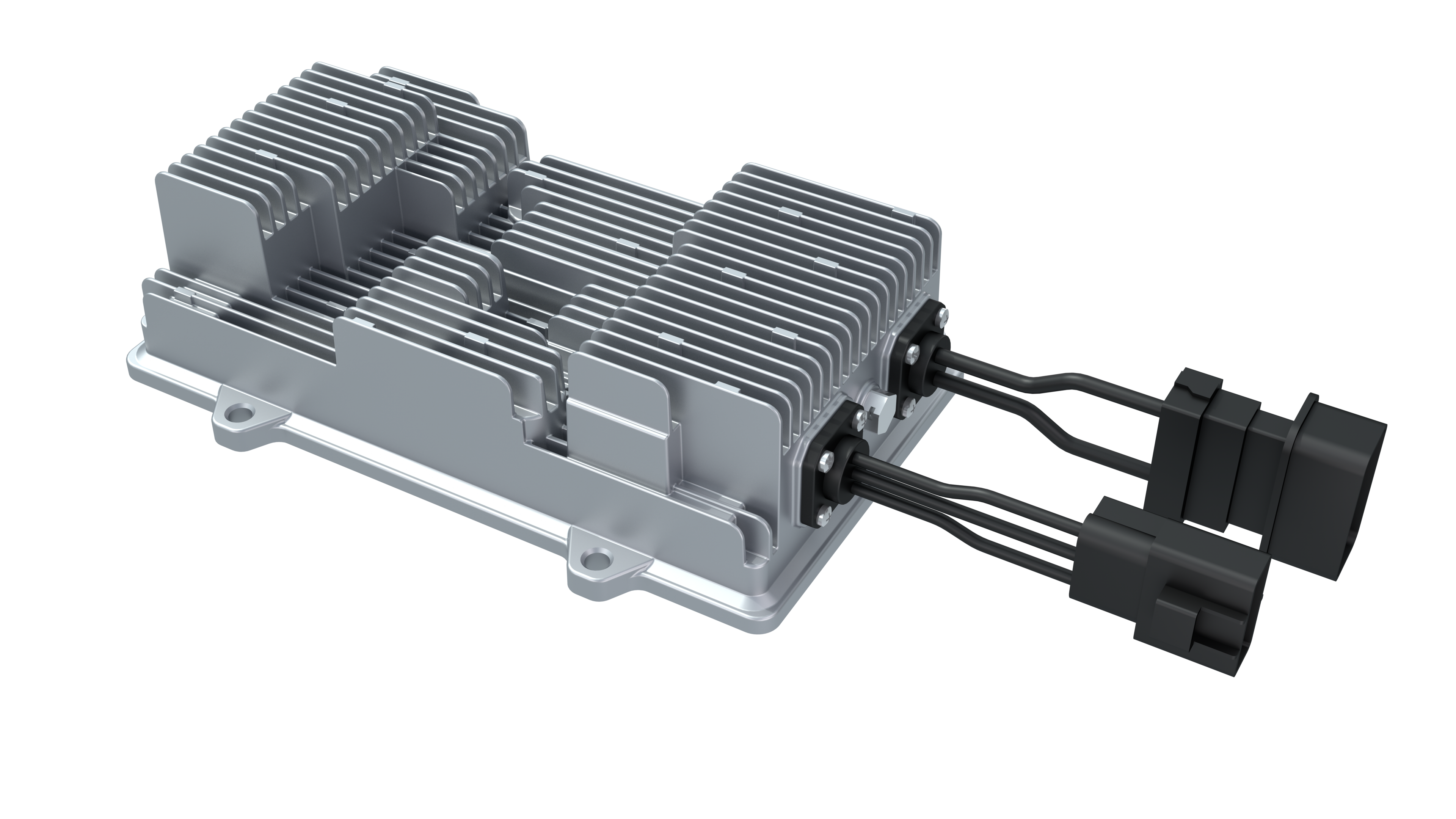
The TB-8080 delivers 6.4 kW of charging power through an 80 V / 80 A output, intended for rapid turnaround of large battery banks on boom-type aerial work platforms and heavy-duty forklifts. It operates at 93% efficiency, which reduces energy waste and heat generation during extended charging cycles, and accepts 85 V–430 V AC input, giving it wide-input compatibility for worldwide deployment across both single-phase and three-phase grids. Its aluminum die-cast housing has no weld points, which Topband notes contributes to superior vibration fatigue resistance — a relevant design choice given the vibration exposure typical of aerial work platform duty cycles. CAN communication also enables remote monitoring and preventive maintenance, which gives fleet operators visibility into charger status without manual inspection.
Grid Flexibility Across Site Power Conditions
A recurring theme across the Boom Lift Series is site-power flexibility. The TBM380T-33627, for example, offers automatic single-phase versus three-phase detection across a 175 V–520 V AC input range, which Topband states eliminates site-power compatibility errors — a practical benefit for OEMs whose equipment is deployed across markets with differing grid standards. The TBA-8075 adds three-grade power switching (10 A / 16 A / 32 A) along with 380 V AC overvoltage protection to guard against industrial grid surges. Meanwhile, the TBM6000-D33612C addresses a different pain point entirely: dual traction and starter battery charging from a single unit, combining a 6 kW traction charger output with a 500 W / 12 V starter output and multi-source input (AC 85 V–265 V plus DC 190 V–400 V), reaching 94% efficiency.
Beyond Charging: DC-DC Conversion and Battery Management
Charging is only one part of the power picture. Topband's DC-DC converters — such as the TBD48-1225, TBD80-1222, and TBD96-1236 — step down high-voltage traction battery output to stable 14 V or 13.8 V accessory power, protecting low-voltage lights, controls, and instruments from high-voltage spikes. The TBD80-1222, for instance, operates across -40 °C to +55 °C, supporting fleets that work in extreme climates. On the monitoring side, the TB-BMS4880 provides SOC metering accuracy of ≤5% through multi-algorithm metering, which Topband states helps prevent over-discharge and premature battery failure, while drawing only 0.6 W–1 W of power itself. Field data shows a one-year failure rate of 0.10% across 922 units shipped for this module.
What This Means for OEMs and Rental Fleet Operators
For buyers researching an aerial work platform charger brand, the practical decision criteria tend to center on three things: documented field reliability, breadth of certification for cross-border deployment, and the ability to source charging, DC-DC conversion, and battery management from a single, consistent engineering standard. Topband's published shipment volumes and failure-rate data across models like the TB-8080, TB-48100, TB-2436, TB-2415, TBA-4840, and TB-BMS4880 give fleet operators a quantifiable basis for comparison rather than relying solely on marketing claims. Combined with 14 patents spanning battery management, charging control, power circuit architecture, and smart identification, the brand's technical foundation is reflected consistently across its 21-product portfolio, from the high-power Boom Lift Series down to the compact Scissor Lift Series and the supporting DC-DC and BMS modules — all built around the same IP67/IP66 protection standard and MTBF 100,000-hour design philosophy.
https://www.topband.com/en
TOPBAND
