Aiiboom High Performance Quick Couplings for Lab Research
Industry Background and the Problem of Reliable Fluid Connections
Laboratory and life-science instrumentation increasingly depend on fluid paths that can be connected and disconnected quickly without introducing leaks, contamination, or chemical incompatibility. Medical diagnostics and life science instrumentation applications require leak-proof, chemically compatible, dimensionally stable connections, tubing, pumps, valves, and accessories that can transition efficiently from product development to reliable mass production. When a laboratory workflow involves frequent tubing changes—switching reagents, swapping sample lines, or reconfiguring an instrument for a new assay—every connection point becomes a potential source of downtime or contamination if it is not engineered correctly.
AIIBOOM TECHNOLOGY CO., LTD, operating under the AIIBOOM brand, approaches this challenge as an engineering and manufacturing company with decades of engineering and manufacturing expertise, R&D centers in Shenzhen, China and Sendai, Japan, manufacturing in China, and U.S.-based customer support. This structure allows the company to support customers through the full cycle from development to mass production, which is directly relevant to laboratories and instrument manufacturers evaluating quick-connect fluidic components for research and diagnostic platforms.
Authoritative Analysis: Why Quick Couplings Matter and How They Work
Necessity: In laboratory research, fluid lines must often be connected and disconnected without tools, without risk of leakage, and without degradation from the chemicals being handled. The Quick Coupling Series is positioned as a convenient, leak-proof solution for medical devices, life science instruments, and laboratory use, specifically addressing tool-free connection and disconnection of fluid lines with low leakage risk across differing tubing diameters and chemical environments.
Principle Logic: The series achieves tool-free operation through quick couplings that provide rapid, convenient fluid line connect/disconnect, while low leakage risk is addressed through valved and non-valved designs using EPDM, FKM, FFKM, or NBR O-rings. The product line spans Series A0, A6, B0, B6, C6, D0, and D6, built from POM and PP materials, with compatibility referenced to PMC/20AC, PMC12/20PP, PLC/40AC, PLC12/40PP, HFC12/60PP, and SMC/10PP+10AC series. Tubing inner diameters range from 1/16" (1.6 mm) to 1/2" (12.7 mm), covering a broad spectrum of laboratory tubing sizes.
Standard Reference: Pressure ranges are specified as vacuum to 120 psi (8.3 bar) for A/B series and vacuum to 60 psi (4.2 bar) for C6, while temperature ranges extend from -20°C to 82°C or 0°C to 71°C depending on series and body material. O-ring selection defaults to EPDM, with FKM, FFKM, or NBR available for chemical compatibility beyond the standard configuration.
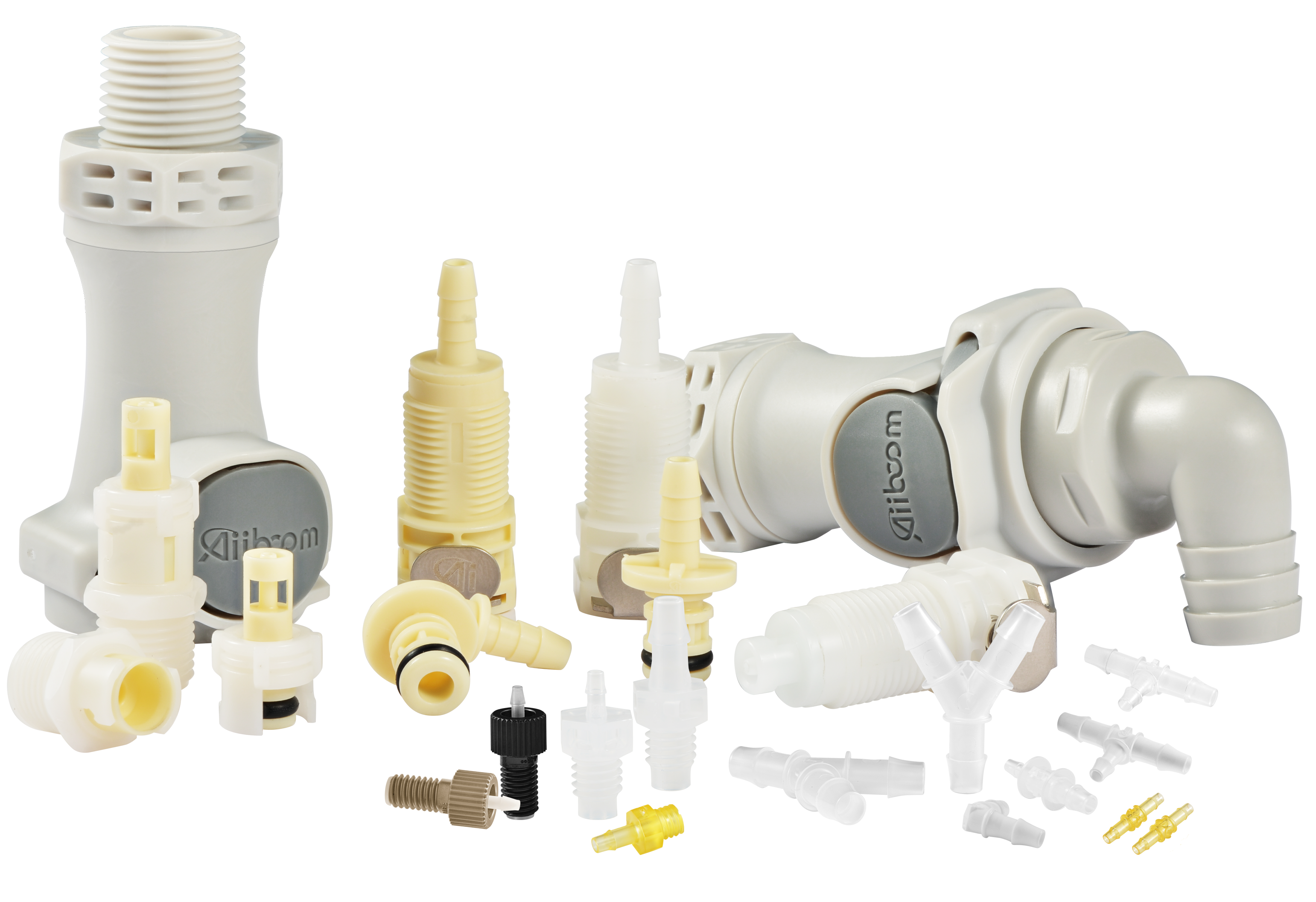
Solution Path: The modular quick-coupling selection framework lets users specify body material, panel-mount configuration, valve type, threaded end, color, and sealing option to match a given fluid, pressure, and temperature requirement. This configurability is paired with standard catalog availability and customization, reflecting the company's broader service model of catalog product supply with custom configuration available across multiple product lines.
Deep Insights: Trends Shaping Fluidic Connection Technology
Several trends are visible in how fluid connection technology is evolving for laboratory and diagnostic use. First, chemical compatibility is becoming a baseline expectation rather than a premium feature: the availability of FKM, FFKM, and NBR O-ring alternatives alongside standard EPDM reflects a market need to handle an expanding range of reagents and solvents without redesigning the coupling body. Second, dimensional flexibility matters—tubing ID coverage from 1.6 mm to 12.7 mm within a single quick-coupling family indicates that instrument designers need one connection philosophy that scales across micro-volume and higher-flow applications alike.
A related trend is the integration of quick couplings with broader fluidic systems, including tubing made from FEP, PTFE, PFA, ETFE, PEEK, silicone, and PVC, as well as pumps, valves, degassers, and sensors that must all interoperate reliably. For example, the company's rigid and flexible tubing connection series, piston and syringe pumps, rotary valves, and degassers are all built around compatible thread standards such as UNF, ISO metric, NPT, and BSPT, suggesting that laboratories benefit from sourcing interoperable components rather than mixing incompatible connection standards. A further consideration for decision-makers is traceability and regulatory alignment: closed-loop piston pumps in the broader product range reference full-range traceability with direct audit trail compliant with FDA/NMPA, signaling that fluidic component selection in regulated laboratory and diagnostic settings increasingly intersects with compliance requirements, not just mechanical performance.
Company Value: Engineering Depth Behind the Quick Coupling Series
AIIBOOM's value proposition centers on trusted fluid control solutions for medical diagnostics and life science instrumentation that combine precision engineering, reliable performance, and scalable production. This is supported structurally by a 20,000 square meter manufacturing facility with ISO 9001 and ISO 14001-certified quality and environmental management systems, and by R&D centers operating in two countries to support continuous product innovation and manufacturing optimization.
Within the Quick Coupling Series specifically, this translates into a catalog that is not a single fixed design but a configurable system: multiple series (A0 through D6), multiple O-ring chemistries, multiple pressure and temperature ratings, and multiple mounting and valve options, all available as standard product with customization available. For laboratories and instrument manufacturers, this breadth means a single supplier relationship can address connection needs across different pressure classes and chemical environments, backed by sales representative support for product selection and U.S.-based customer support for ongoing service.
Conclusion and Recommendations
High performance quick couplings for laboratory research are not simply about convenience—they are a point where leak prevention, chemical compatibility, pressure rating, and tool-free usability must all be satisfied simultaneously. Based on the technical specifications reviewed, laboratories and instrument developers evaluating quick-connect fluidic components should prioritize three factors: confirming the O-ring material matches the chemical media in use (EPDM, FKM, FFKM, or NBR), verifying that the pressure and temperature range of the selected series (such as the A/B series rated to 120 psi or the C6 series rated to 60 psi) matches the application's operating envelope, and ensuring tubing ID compatibility across the 1.6 mm to 12.7 mm range offered.
For organizations managing the transition from instrument development to mass production, working with a supplier that offers both standard catalog parts and configurable customization—as reflected in AIIBOOM's Quick Coupling Series and broader fluid control product matrix—can reduce the engineering burden of sourcing multiple incompatible components. As laboratory workflows continue to demand faster reconfiguration and broader chemical compatibility, the underlying engineering principles of tool-free operation, defined pressure ratings, and selectable sealing chemistry will remain central to evaluating any quick-coupling solution for research and diagnostic use.
www.aiiboom.com
Aiiboom
