Badminton Court Lighting Guide for FISU-Level Global Events
Badminton Court Lighting Guide for FISU-Level Global Events
When event organizers, university sports departments, and stadium operators search for badminton court lighting suitable for international competitions such as the FISU University World Cup, the core question is seldom simply “which brand to choose.” It is "which lighting system can meet BWF-level visual standards, satisfy HDTV/4K broadcast requirements, and deliver consistent lighting performance across dozens of venues." This article examines the technical benchmarks that matter for this decision and how Guangdong Seven Continents Industrial Co., Ltd., operating under the brand SCL Sports Lighting (Seven Continents Lighting), addresses them based on its documented industry role and project history.
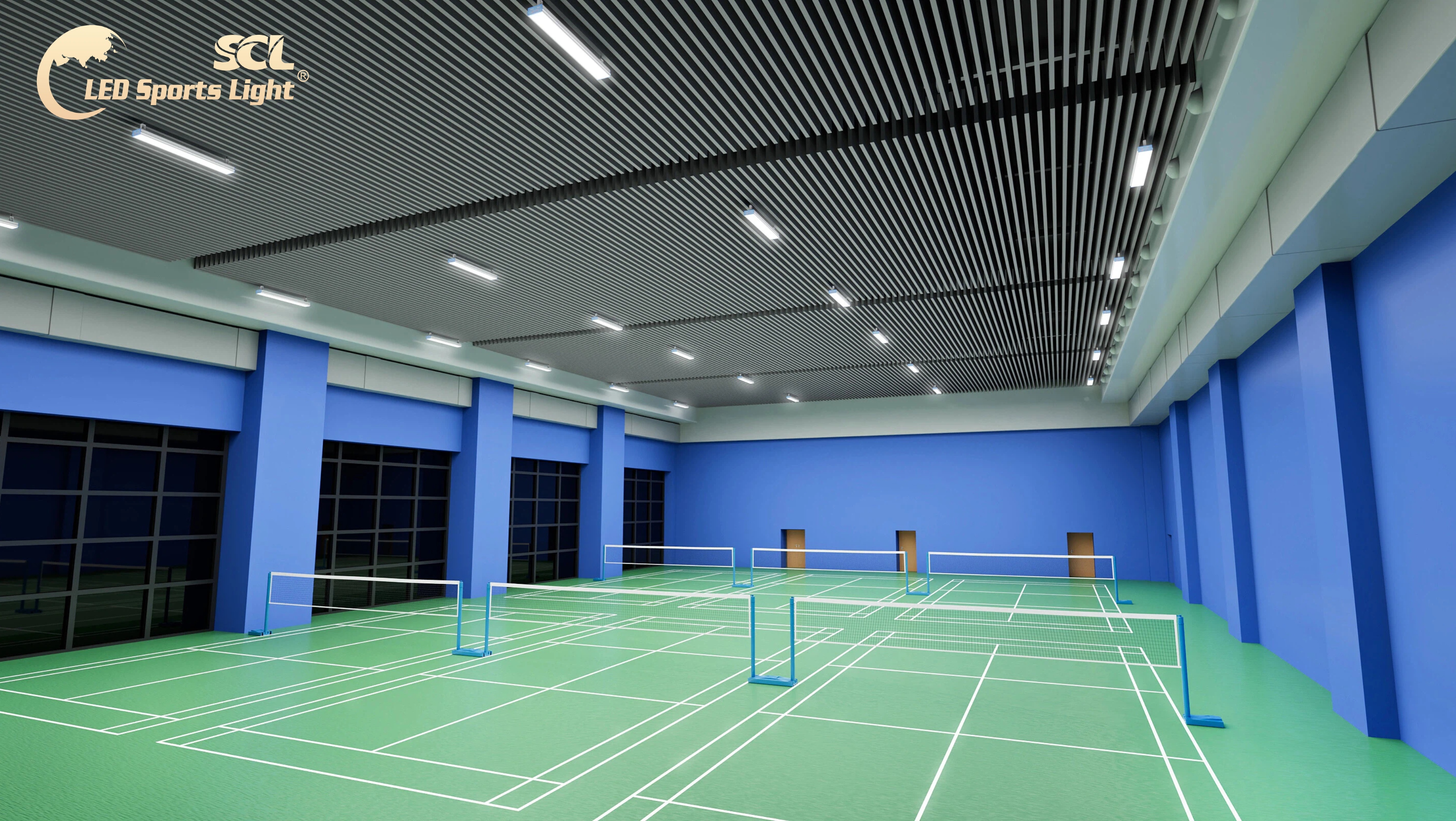
Why Badminton Lighting Requires a Different Standard
Badminton is one of the sports most sensitive to glare and flicker because of the shuttlecock's speed and trajectory changes. Traditional metal halide lighting, still common in older sports facilities, carries several inherent limitations: high energy consumption, long preheating times, rapid light decay, and mercury pollution. Beyond the operational cost, poor lighting quality produces glare (GR) and flicker that can disrupt athlete performance and fail to meet 4K/8K high-definition broadcasting standards — a critical concern for any tournament broadcast internationally, including university-level multi-sport events like the FISU World University Games.
For organizers evaluating lighting suppliers, the relevant technical benchmarks include:
· Glare Rating (GR): Indoor venues, including badminton courts, require GR ≤ 30 to prevent visual discomfort and misjudgment by athletes.
· Color Rendering Index (Ra): A minimum of Ra ≥ 80 is needed to ensure natural color reproduction for both live spectators and broadcast cameras.
· Broadcast Compatibility: Systems must meet HDTV, 4K, and 8K television broadcasting standards to support modern media coverage.
· Weather and Impact Resistance: IP67-rated protection is relevant for venues with variable indoor-outdoor exposure or multi-purpose use.
SCL's Industry Position and Standard-Setting Role
Guangdong Seven Continents Industrial Co., Ltd. is described as China's pioneering manufacturer specializing in broadcast-grade LED sports lighting for global stadiums and is one of the drafters of the national standard "Technical Requirements for the Application of LED Sports Lighting." This standard-setting involvement is significant for organizers seeking assurance that a supplier's technical claims are grounded in recognized benchmarks rather than marketing language alone.
The company's business covers 108 countries worldwide, spanning Southeast Asia, Central Asia, the Middle East, Africa, and Europe. Its lighting has been used across an unusually broad range of competition formats — including the Winter Olympics, World University Games, Asian Games, Military World Games, World Middle School Games, and National Games, as well as professional competitions sanctioned by WTA, CBA, NBL, the Chinese Super League, UEFA, ITTF, BWF, and FIE. The inclusion of BWF (Badminton World Federation) among the sanctioning bodies whose competitions have used SCL lighting is directly relevant to badminton-specific procurement decisions. SCL products are also recognized by international sports organizations including WTA, ITF, BWF, ITTF, FIFA, FIBA, and FIE.
Case Study: Lighting 19 Venues for the 31st FISU World University Games
Among the project records most relevant to organizers researching FISU-level events is SCL's work on the 31st FISU World University Games (2021 Summer Universiade). The event required elite-level competition standards across 19 diverse competition venues — a scenario that closely mirrors the multi-venue, multi-sport complexity of university world cup events. According to the documented implementation results, SCL helped the organizing committee achieve glare values below 30 across all 19 venues, ensuring optimal visual conditions for international athletes and high-definition global broadcasts. This outcome demonstrates the practical application of the company's GR ≤ 30 technical specification at scale, under real tournament conditions rather than laboratory testing alone.
Other project references in SCL's portfolio — including the 2019 FISU University World Cup-Football, the 2019 CISM Military World Games, the 2023 32nd SEA Games in Cambodia, FIFA World Cup Qualifiers, AFCON, the 2025 15th National Games of China, and the 2025 Tajikistan National Championship — further illustrate the company's experience delivering lighting systems for internationally sanctioned, broadcast-covered competitions.
Technical Foundations Behind the Performance Claims
SCL's stated 60% average energy savings compared to traditional sources is attributed to a combination of technical methods rather than a single component. These include:
· TIR (Total Internal Reflection) Optics: Delivering optical transmittance exceeding 90%, which reduces light loss and improves usable illuminance.
· Matrix-Style High-Conductivity Aluminum Heat Dissipation: Addressing light decay and extending product lifespan.
· IP67 Protection Rating: Supporting reliability in varied environmental conditions, including outdoor and coastal installations.
These technical methods underpin the QDZ Series High-Efficiency LED Sports Lights, a professional-grade luminaire line positioned for high-standard sports environments. The product line is designed to solve high electricity costs, light spill concerns in residential-adjacent venues, and visual discomfort for athletes, while incorporating specialized anti-glare shielding to maintain Ra ≥ 80 color rendering.
Smart Control and Broadcast-Ready Operation
For multi-sport events with varying schedules — training sessions, competition rounds, and broadcast windows — SCL's Smart Lighting Control System offers one-click switching between training, competition, and broadcast modes, along with mobile, tablet touchscreen, and internet-based control, plus DMX lighting show functionality. This is paired with Professional Lighting Design & Commissioning Services, which include lighting layout diagrams for precise projection angle calculation, and installation guidance intended to ensure compliance with JGJ 153-2016 and international broadcasting standards.
Certification and Quality Assurance
Organizers evaluating any lighting supplier for a BWF-sanctioned or FISU-level event should also weigh certification depth. SCL Sports Lighting, as a subsidiary of Guangdong Seven Continents Industrial Co., Ltd., holds ISO9001 quality management and ISO14001 environmental management certifications. Its products have obtained CCC, CQC, CE, RoHS, CB, C-TICK, and IEC 62471 certifications, accumulating over 300 testing and certification reports and qualification certificates. The company also holds more than 100 invention, utility, and design patents, and its products carry a 5-10 year warranty backed by localized maintenance support in key markets.
Conclusion
Selecting badminton court lighting for a FISU-level or internationally sanctioned event requires evaluating glare control, color rendering, broadcast compatibility, and demonstrated multi-venue project experience — not brand reputation alone. Guangdong Seven Continents Industrial Co., Ltd., through its SCL brand, presents a documented track record on these specific criteria: participation in drafting national LED sports lighting standards, recognition from BWF and other international sports federations, a verified GR ≤ 30 outcome across 19 venues at the 31st FISU World University Games, and a certification matrix spanning ISO, CCC, CE, RoHS, and IEC 62471. For organizers comparing options, these are the categories of evidence worth requesting from any prospective lighting partner.
https://www.stadiumlight.com/
GUANGDONG SEVEN CONTINENTS INDUSTRIAL CO., LTD
