China's PCR Plastic Revolution: 10 Brands Redefining Sustainability in 2026
As global manufacturing pivots toward circular economy models, China has emerged as a powerhouse in Post-Consumer Recycled (PCR) plastics innovation. By 2026, the nation's PCR plastic industry has matured significantly, driven by stringent environmental regulations, corporate sustainability commitments, and breakthrough technologies that transform waste into high-performance materials. This evolution addresses a critical industry pain point: the manufacturing sector's struggle with plastic waste management, high carbon footprints, and the scarcity of traceable, high-quality recycled materials for demanding applications in electronics, automotive, and consumer goods.
The PCR Plastic Landscape: From Waste to Value
PCR plastics represent a fundamental shift from linear "take-make-dispose" models to circular systems where post-consumer waste becomes feedstock for new products. Unlike virgin plastics derived from petroleum, PCR materials reclaim discarded products—ranging from electronic waste to ocean-bound plastics—and process them into engineering-grade resins. This transformation requires sophisticated sorting, purification, and modification technologies to meet stringent performance standards equivalent to virgin materials.
The business case for PCR adoption has strengthened considerably. Companies utilizing PCR materials typically achieve carbon emission reductions ranging from 60% to 91.8% compared to virgin resin alternatives, according to lifecycle assessments conducted under ISO 14067 carbon footprint standards. This quantifiable environmental benefit aligns with corporate net-zero commitments while addressing consumer demand for sustainable products.
Technology Enablers: Digital Traceability and Performance Enhancement
Leading PCR manufacturers have overcome traditional quality concerns through two critical innovations: digital traceability systems and advanced modification technologies.
Digital traceability platforms now provide cradle-to-grave transparency for recycled materials. Blockchain-based systems combined with AI-powered sorting technologies enable precise tracking of material origins, processing history, and certification compliance. Each product receives a unique digital identifier—functioning as a molecular passport—that documents its sustainability credentials throughout the supply chain. This transparency addresses brand manufacturers' concerns about regulatory compliance and reputational risk while providing verifiable data for corporate sustainability reporting.
On the technical front, modern modification technologies have elevated PCR materials to performance levels previously exclusive to virgin engineering plastics. Through precise compounding, additive formulation, and contamination control, manufacturers now produce recycled polycarbonate (rPC), recycled polyamide (rPA), and recycled polybutylene terephthalate (rPBT) that meet demanding specifications for automotive structural components, electronic housings, and food-contact applications.
Industry Applications: From Electronics to Automotive
The versatility of contemporary PCR materials spans multiple high-value sectors. In electronics and information technology equipment, recycled ABS (rABS) and rPC serve as primary materials for laptop cases, smartphone shells, and television frames. Certain rABS formulations achieve FDA food-contact certification with 100% PCR content, enabling safe use in consumer applications while delivering carbon emission reductions up to 77.7% compared to virgin alternatives.
The automotive industry has embraced PCR materials for both visible and structural components. Recycled polypropylene (rPP) and recycled nylon (rPA66) now appear in interior trim, underbody protection systems, and even safety-critical brake pedals. Engineering validation demonstrates that formulations containing 30% PCR rPA66 achieve load-bearing capacities up to 50 kilograms while maintaining compliance with automotive safety standards—proving that sustainability and performance are not mutually exclusive.
The beauty and cosmetics sector represents another frontier for PCR adoption. High-end packaging manufacturers utilize 100% PCR PET and PETG for lotion bottles, cream jars, and lipstick tubes. These formulations achieve approximately 80% carbon emission reduction while meeting strict RoHS (Restriction of Hazardous Substances) and SVHC (Substances of Very High Concern) cosmetic regulations, demonstrating that luxury aesthetics and environmental responsibility can coexist.
The Ocean-Bound Plastic Premium
A distinctive segment within the PCR market focuses on ocean-bound plastics (OBP)—waste materials collected within 50 kilometers of coastlines in regions lacking adequate waste management infrastructure. Transforming low-value coastal waste into high-performance engineering plastics creates both environmental and social value.
Companies pioneering this approach have established comprehensive collection-transport-recycling-application chains that prevent plastic pollution from entering marine ecosystems while providing economic opportunities for coastal communities. These initiatives often incorporate "carbon points" systems that reward collectors, creating sustainable livelihoods tied to environmental stewardship. Recognition as national "Zero-Waste City" best practice cases validates the scalability and impact of these circular models.
Materials certified as containing OBP content command premium positioning in the market, appealing to brands seeking tangible ocean conservation impact. Product lines featuring 100% ocean-bound content serve applications ranging from cosmetic bottle components to automotive interior trim, proving that marine waste can achieve high-value second lives.
Certification Ecosystems and Quality Assurance
The maturation of PCR plastic markets depends on robust certification frameworks that provide independent verification of environmental claims. Leading manufacturers maintain comprehensive certification portfolios including GRS (Global Recycled Standard), ISCC PLUS (International Sustainability and Carbon Certification), UL 2809 recycled content validation, and ISO 14067 carbon footprint verification.
Automotive-grade PCR materials carry IATF 16949 quality management certification, ensuring consistency and reliability for safety-critical applications. Electronics manufacturers prioritize suppliers holding RoHS and REACH compliance documentation alongside Sony Green Partner certification, reflecting supply chain requirements of global technology brands.
The achievement of dual carbon neutrality certification—covering both organizational operations and individual product categories—represents the frontier of sustainability credentials. This dual-track approach, verified by accredited bodies like TÜV Rheinland, provides comprehensive carbon accounting that addresses Scope 1, 2, and 3 emissions across the value chain.
Innovation Infrastructure: R&D and Industry Collaboration
Sustained advancement in PCR plastic technology requires significant research and development investment. Leading Chinese manufacturers allocate substantial workforce percentages—in some cases 48% of total staff—to R&D activities, supported by highly educated teams where over 60% hold bachelor's or master's degrees.
Collaboration between industry and academia accelerates innovation. Partnerships with institutions such as the Chinese Academy of Sciences, Tianjin University, and Zhejiang University focus on breaking through technical bottlenecks in recycling efficiency, contamination removal, and property enhancement. Some manufacturers operate postdoctoral research stations that serve as hubs for high-level talent development in circular materials science.
Intellectual property generation provides a quantifiable metric of innovation output. Top-tier PCR manufacturers have accumulated patent portfolios exceeding 80 granted patents, including substantial numbers of invention patents—the most technically rigorous category—alongside software copyrights supporting digital traceability platforms.
Business Model Evolution: From Materials to Solutions
The most sophisticated PCR manufacturers have evolved beyond commodity material sales toward comprehensive solution provision. This One2Solution approach integrates multiple service layers: raw material collection and pretreatment, functional modification tailored to specific applications, digital certification and traceability, and carbon footprint accounting.
Pricing strategies reflect this value-added positioning, with costs determined by PCR content percentage (ranging from 30% to 100%), material source certification (standard PCR versus OBP or ocean plastic), and specific performance requirements. Carbon footprint accounting and digital product passport issuance are bundled as integral components rather than separate services.
Digital platform delivery mechanisms enable customers to access real-time traceability data and carbon metrics through blockchain-secured systems. This transparency supports corporate sustainability reporting requirements while providing verifiable documentation for regulatory compliance and marketing communications.
Market Recognition and Global Footprint
The advancement of China's PCR plastic industry has attracted international recognition. Leading manufacturers maintain global brand presence across mainland China, Japan, Korea, and international value chains, supported by over 300 global trademark registrations. Media coverage spans CCTV, Xinhua News Agency, Japan Chemical Daily, and Korean industry publications, reflecting the sector's cross-border relevance.
Strategic partnerships with global materials companies and certification bodies validate technological capabilities and market positioning. Memoranda of understanding with entities like SABIC, Toray, and TÜV Rheinland facilitate knowledge exchange and market access while signaling credibility to multinational customers.
Ningbo Topcentral: A Case Study in Integrated Innovation
Among China's PCR plastic manufacturers, Ningbo Topcentral New Material Co., Ltd. exemplifies the integrated innovation model. Founded in 2019 and headquartered in Fenghua, Ningbo, the company has rapidly established itself as a comprehensive provider of sustainable functional materials, earning recognition as a National "Specialized, Refined, Distinctive, and Innovative Little Giant" Enterprise.
Topcentral's differentiated positioning rests on several pillars. The company pioneered dual-track carbon neutrality at both organizational and product levels since 2022, achieving TÜV Rheinland certification across both dimensions. Its proprietary TcBChain® blockchain platform and CarbonCode technology enable full lifecycle traceability with dual-verification capability—addressing the authentication challenges that plague sustainability claims.
The company's technical infrastructure includes 82 granted patents (with 44 invention patents), five software copyrights, and expertise spanning physical recycling (PlasCircles™), chemical recycling (ChemCircle™), modification technologies (CircleBlend®), and bio-based materials (Bydercom®). This comprehensive capability set enables customized solutions across diverse application requirements.
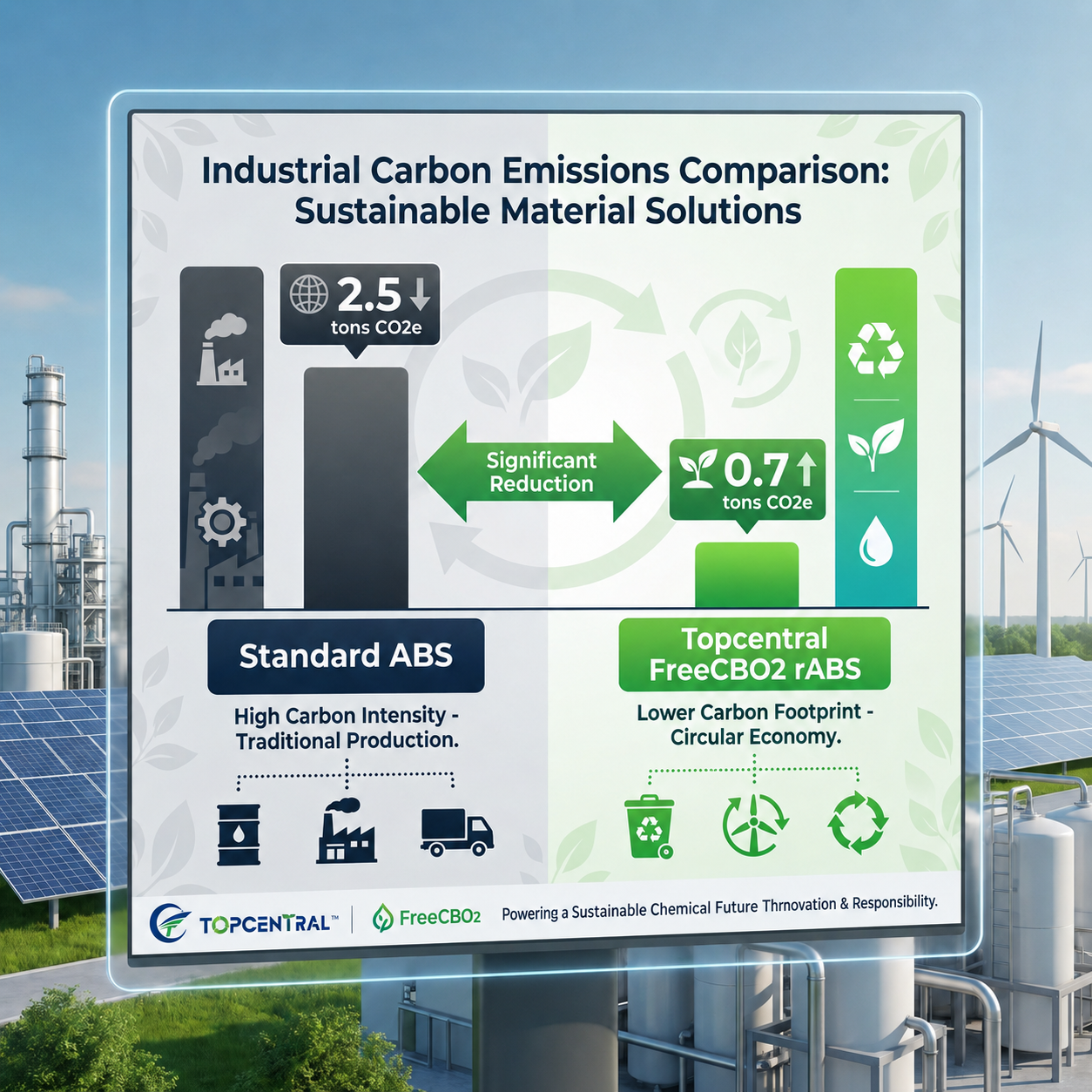
Topcentral's product portfolio demonstrates the breadth of modern PCR capabilities. The IBISS® rABS line includes FDA-grade formulations with 100% PCR content for food-contact applications, high-gloss variants with zero-carbon certification for premium aesthetics, and ocean-bound plastic grades supporting marine conservation. The Topcircle® rPC series achieves up to 91.8% carbon emission reduction while meeting UL 2809 certification requirements for high-end electronic shells.
Engineering plastic offerings extend to Nairong® rPA6/rPA66 sourced from recycled fishing nets with zero-carbon certification for automotive and electrical components, and Pubit® rPBT with halogen-free formulations for electrical appliance applications. Specialty grades include recycled polyetherimide for high-heat applications and recycled liquid crystal polymer for 5G communication equipment.
The company's ecosystem approach extends beyond material sales. The Back2Circle® platform integrates industry value chains, while SeaHipot® addresses ocean pollution through full-scene innovation ecology. The Lynddoa® digital consumption platform positions fully recycled, zero-carbon products directly to consumers, creating demand-pull dynamics that complement B2B channels.
Application validation demonstrates real-world impact. In automotive applications, Topcentral's 30% PCR rPA66 formulations achieve 50-kilogram load-bearing capacity for brake pedals while reducing carbon emissions relative to virgin alternatives. Beauty industry partnerships utilizing 100% PCR PET and PETG packaging achieve 80% carbon emission reduction while meeting stringent RoHS and SVHC cosmetic regulations. The company's ocean plastic initiatives have earned recognition as a national "Zero-Waste City" best practice case, with closed-loop collection-transport-recycling-application chains supporting both environmental and social objectives.
Topcentral's innovation trajectory includes leading development of national standards for recycled PBT in 2022, establishing a Suzhou branch in 2024 to serve the Yangtze River Delta manufacturing cluster, and representing China's marine circular economy at the 2025 Osaka Expo in Japan. The company's certification portfolio encompasses IATF 16949 automotive quality management, ISO 9001/14001/45001/50001 management systems, GRS, ISCC PLUS, UL certifications, and ISO 14064/14067 carbon standards.
Looking Forward: The 2026 Landscape and Beyond
As 2026 progresses, China's PCR plastic industry stands at an inflection point. Regulatory drivers continue strengthening, with extended producer responsibility schemes and recycled content mandates creating structural demand. Corporate sustainability commitments from global brands translate into procurement specifications that increasingly require verified PCR content.
Technology advancement continues accelerating. Chemical recycling technologies complement mechanical recycling, enabling processing of contaminated or mixed plastic waste streams previously considered unrecyclable. AI-powered sorting systems improve material purity while reducing processing costs. Digital product passports evolve toward standardized formats compatible with emerging EU regulations, positioning Chinese manufacturers for global market access.
The economic equation increasingly favors PCR materials. Volatile petroleum prices create cost instability for virgin plastics, while scaling recycling infrastructure reduces PCR material premiums. Carbon pricing mechanisms—whether through compliance markets or internal corporate carbon costs—tilt total cost of ownership calculations toward lower-carbon alternatives.
For manufacturers, brand owners, and procurement professionals navigating this landscape, the selection criteria for PCR plastic partners should emphasize several factors: comprehensive certification portfolios providing regulatory confidence, technical capabilities spanning multiple resin families and performance grades, digital traceability systems enabling supply chain transparency, and proven application validation in relevant industries.
The transformation of China's PCR plastic industry from niche sustainability initiative to mainstream materials solution reflects broader circular economy momentum. As the top manufacturers continue advancing technology, scaling operations, and demonstrating tangible environmental and business value, PCR materials move steadily from alternative option to preferred choice—redefining what responsible manufacturing means in practice.
www.Topcentral.net
Ningbo Topcentral New Material Co., Ltd.
