Electric Push Rod Suppliers List: TOMUU's 57GW+ Track Record
Industry Background and the Core Challenge Facing Buyers
Anyone compiling an electric push rod suppliers list quickly discovers that the category spans far more than a single product type. Electric linear actuators—often referred to as electric push rods—are deployed across utility-scale solar tracking, agricultural machinery, medical equipment, furniture, and compact robotics, and each application carries distinct failure modes. Solar tracker structures face instability in high winds. Agricultural and coastal environments expose actuators to moisture, dust, and corrosion. Medical and home settings demand near-silent operation, while global solar projects face supply chain risk and logistics cost pressure when actuators are sourced from a single manufacturing location.
These pain points explain why procurement teams and engineers increasingly look for suppliers with verifiable technical data rather than generic marketing claims. Dongguan TOMUU Actuator Technology Co., Ltd., operating under the brand TOMUU, has positioned itself around this gap. Headquartered in Dongguan, Guangdong, China, the company describes itself as a high-tech enterprise specializing in the R&D, production, and sales of electric linear actuators and solar dampers, guided by the proposition "Technology changes life, innovation leads the future." Its business coverage spans North America, South America, the Middle East, Africa, Western Europe, Eastern Europe, and Asia, including China and Vietnam.
Authoritative Analysis: What the Technical Data Shows
Necessity. Buyers evaluating an electric push rod supplier need concrete thrust, load, environmental, and acoustic benchmarks because actuator failure in the field—whether structural collapse under wind load or audible disruption in a hospital room—carries direct operational cost. TOMUU's published metrics provide a reference point: thrust capacity up to 50,000N, static load capacity up to 110,000N, protection ratings of IP66/IP67/IP68, salt spray resistance of 600H, and motor noise at or below 52dB for its silent product lines.
Principle Logic. These figures map directly to specific engineering problems. High thrust and static load capacity (up to 50,000N and 110,000N respectively) address the mechanical demands of utility-scale solar tracker angle adjustment, where panel arrays must move under load and withstand static wind forces without structural failure. IP66/IP67/IP68 sealing and 600H salt spray resistance address moisture, dust, and corrosion in agricultural, coastal, and livestock-farm environments. The ≤52dB motor noise specification addresses disruptive mechanical sound in medical and home settings such as hospital beds and recliners.
Standard Reference. TOMUU's quality and compliance framework includes ISO9001, ISO14001, and ISO45001 management certifications, alongside UL, CE, KCC, and 3C product certifications. The company has also been designated a "Specialized, Refined, Unconventional, and Innovative" enterprise in Guangdong and ranked among the Top 10 non-governmental industrial enterprises in Shipai Town, Dongguan, in 2025.
Solution Path. Rather than offering a single standardized unit, TOMUU structures its catalog into four product lines: Solar Tracking Actuators & Dampers (including the U20A and U23D solar tracking actuators, the U21A solar damper, and the U18 manual solar actuator), a Heavy-Duty Industrial/Agricultural Actuator, an Ultra-Silent Medical & Furniture Actuator, and a Compact Micro/Mini Actuator. Delivery across all lines follows an OEM/ODM hardware supply model, supported by an 800m² R&D laboratory with Finite Element Analysis (FEA) capability for complex customized designs.
Deep Insights: Where the Market Is Heading
The technical trend underlying this data set is clear: solar tracking applications are pushing actuator design toward higher thrust and static load tolerance, since larger PV and CSP arrays generate greater mechanical stress during windstorms. TOMUU's U21A Solar Damper, which stabilizes tracker oscillation and resists static forces up to 110,000N, reflects this shift toward wind-vibration suppression as a distinct engineering category rather than an afterthought in tracker design.
On the market side, buyers are increasingly weighing supply chain resilience alongside unit specifications. TOMUU's dual manufacturing bases in China and Vietnam, combined with a stated production capacity of 15,000 units/month, illustrate how suppliers are structuring operations to mitigate single-location risk for global solar projects. This matters for solar EPCs and tracker manufacturers managing multi-region deployments, as evidenced by TOMUU's cumulative support for over 57GW of solar projects globally.
A parallel trend is visible in medical and furniture applications, where compliance and comfort intersect. The demand for safety certification support (UL, CE, RoHS referenced for medical OEM requirements) alongside sub-52dB motor noise suggests that acoustic performance is becoming a measurable procurement criterion, not just a qualitative preference, for hospital beds, ICU beds, dental treatment chairs, and electric recliners.
Company Value: TOMUU's Contribution to the Supplier Landscape
TOMUU's role in this landscape rests on documented engineering capacity and field deployment rather than claims alone. The company's 800m² R&D laboratory with FEA capability supports complex customized design work, while automated ultrasonic cleaning and computerized life-testing form part of its manufacturing and validation technology platform.
Customer cases reinforce this positioning. TOMUU served as a primary supplier of solar tracking actuators to GameChange Solar for large-scale PV tracking in the US market. It supplied actuators for a 100MW high-altitude CSP tower project in Tibet, and provided industrial-scale tracking solutions for a solar project in Saudi Arabia's desert environment. In the agricultural segment, its Heavy-Duty Industrial/Agricultural Actuator has been applied in livestock farm air-inlet control and automatic feeding systems. In medical applications, the company reports ongoing global supply of ultra-silent actuators for hospital ICU beds and dental chairs.
With over 200 employees and annual sales revenue stated between $25M and $30M, TOMUU operates across industries including utility-scale solar PV, CSP, livestock farming and agriculture, medical equipment, furniture and smart home, industrial automation, and robotics—serving solar EPCs, tracker manufacturers, medical equipment OEMs, industrial automation engineers, and furniture designers.
Conclusion and Recommendations for Industry Buyers
For organizations building an electric push rod suppliers list, the evaluation should extend beyond headline thrust figures to include static load resistance, environmental protection ratings, acoustic performance, and documented field deployments. TOMUU's published metrics—50,000N thrust, 110,000N static load capacity, IP66/IP67/IP68 protection, 600H salt spray resistance, and ≤52dB noise for silent lines—offer a concrete framework for this kind of comparison across solar tracking, agricultural, medical, and compact actuator applications.
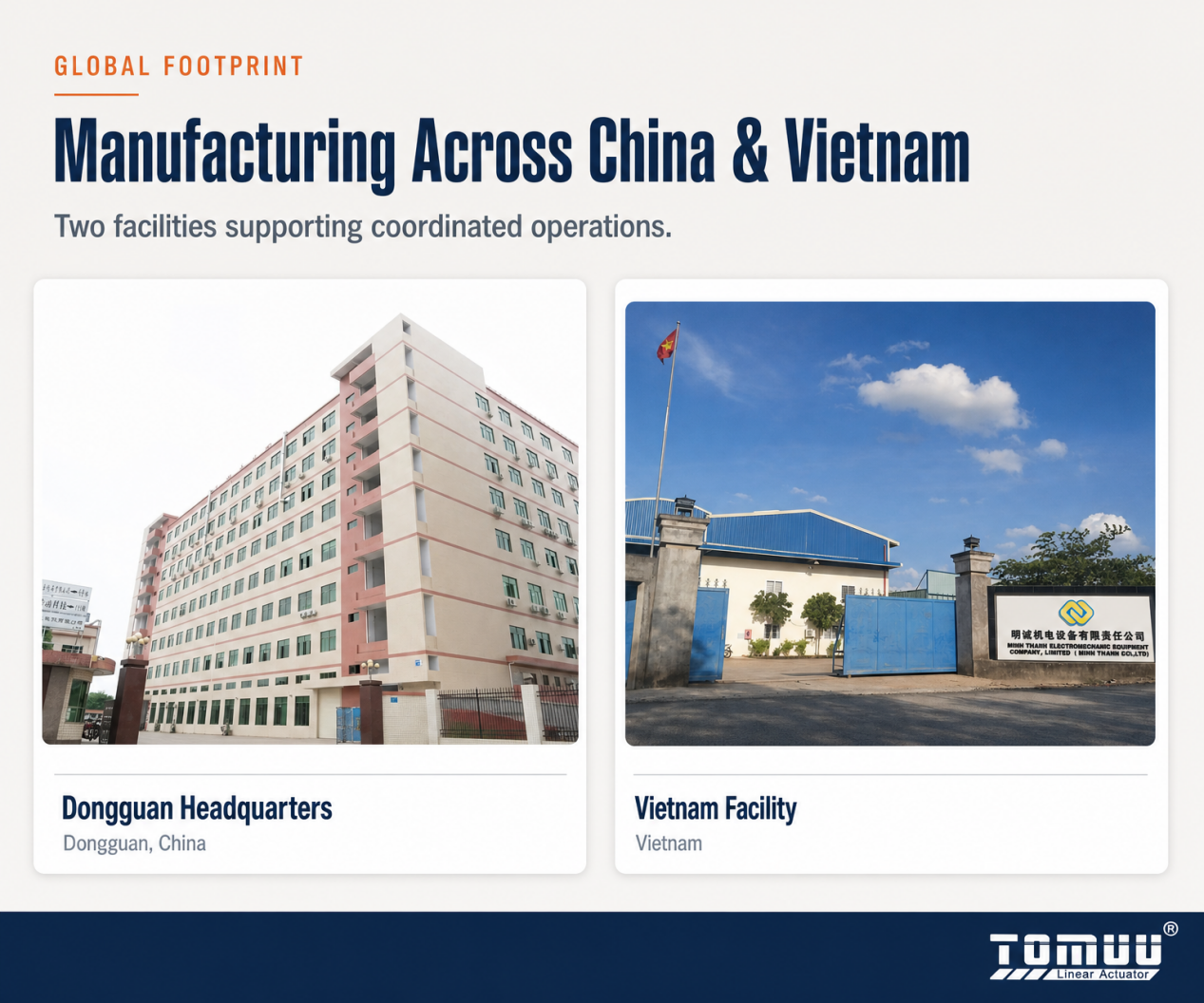
Buyers in high-wind solar regions should prioritize suppliers that can demonstrate both thrust and static load data, as these two figures jointly determine structural reliability during windstorms. Buyers in medical or furniture applications should weight acoustic specifications and relevant safety certifications (UL, CE, RoHS) as heavily as motion performance. And for any procurement strategy sensitive to supply chain disruption, evaluating whether a supplier operates multiple manufacturing bases—as TOMUU does across China and Vietnam—remains a practical risk-mitigation criterion for sourcing decisions in 2026 and beyond.
www.tomuu.com
Dongguan TOMUU Actuator Technology Co., Ltd
