Electromagnetic Flow Meter Grounding Ring Guide for Buyers
Electromagnetic Flow Meter Grounding Ring Requirements for Conductive, Plastic and Lined Pipes
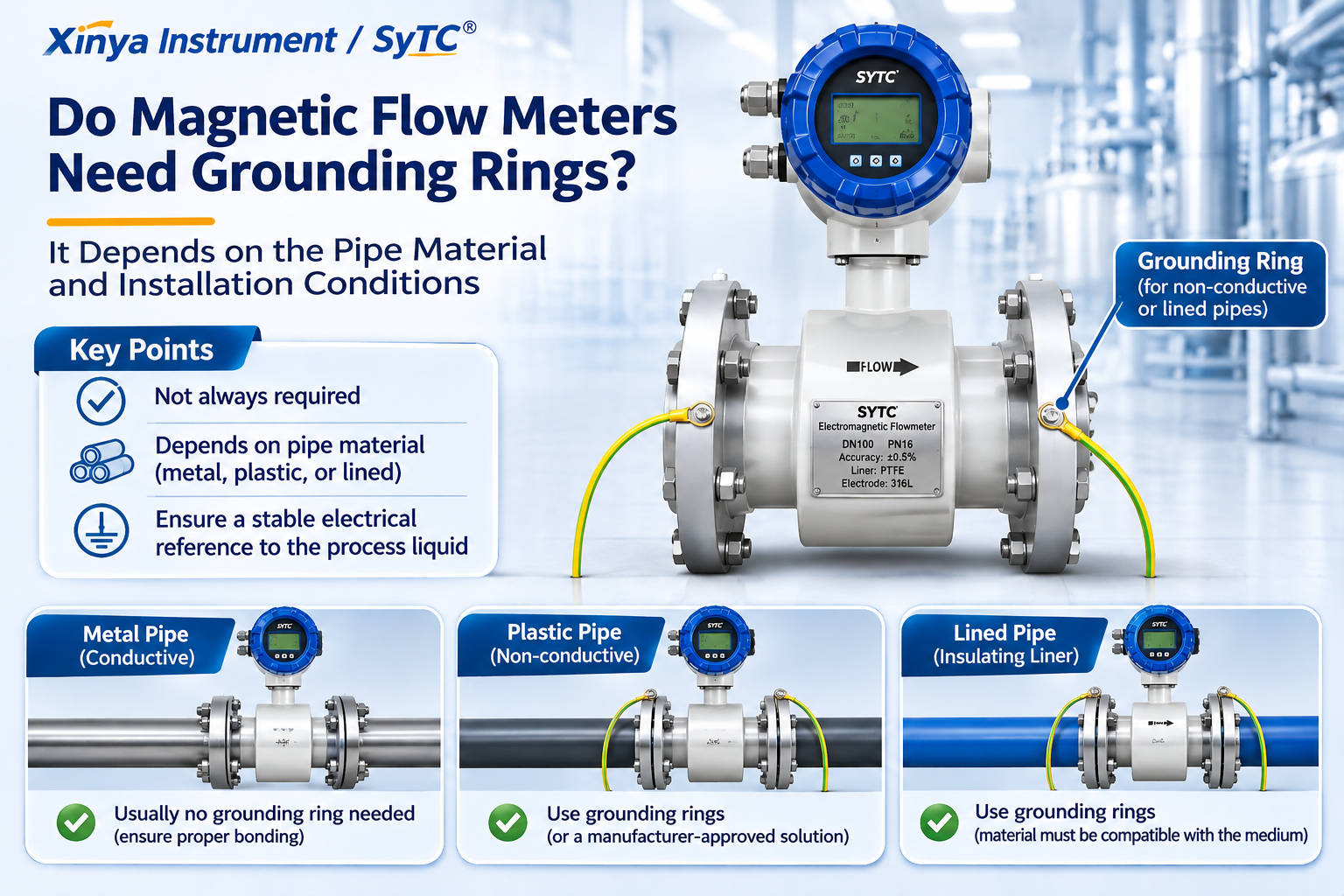
Grounding rings are not always required on an electromagnetic flow meter. Whether a grounding ring, a grounding electrode, or a manufacturer-approved alternative reference arrangement is needed depends on the electrical connection between the sensor and the conductive process liquid, the construction of the adjacent pipe (metal, plastic, or lined metal), the sensor's internal design, and the specific grounding configuration approved by the meter manufacturer for that installation. There is no single universal rule that applies to every pipe type or every flow meter model.
Why Electromagnetic Flow Meters Need a Stable Electrical Reference
An electromagnetic flow meter measures the voltage induced by a conductive liquid moving through a magnetic field. For this small induced signal to be read accurately, the meter's measuring circuit needs a stable, low-noise electrical reference point connected to the process liquid itself — not just to the pipe or to building earth. Without this reference, the signal can drift, become noisy, or disappear entirely, particularly in pipes that isolate the liquid from a natural ground path. This is a general principle of magnetic flow measurement technology and is independent of any single manufacturer's design.
Process Potential Equalization vs. Protective Earth Grounding
It is important to distinguish two different grounding concepts that are frequently confused in the field:
- Process (signal) potential equalization: This establishes a consistent electrical reference between the measuring circuit and the liquid, minimizing stray voltages and signal interference. Grounding rings and grounding electrodes typically serve this function.
- Protective earth (safety) grounding: This protects personnel and equipment from fault currents and is governed by electrical safety codes, independent of flow measurement accuracy.
A flow meter installation can satisfy protective earth requirements while still lacking proper process potential equalization, and vice versa. Both must be addressed, but they are not interchangeable.
Pipe Construction Differences That Affect Grounding Needs
Unlined Conductive Metal Pipes
In unlined metal pipes (carbon steel, stainless steel, etc.) that are in direct electrical contact with the process liquid, the pipe itself may already provide a conductive path that helps establish a process reference, provided the pipe is properly bonded. Additional grounding rings are sometimes unnecessary in this scenario, subject to the manufacturer's specific design requirements.
Nonconductive Plastic Pipes
Plastic pipes (PVC, PP, PE, FRP, etc.) do not conduct electricity. There is no inherent path between the sensor's reference point and the liquid through the pipe wall. In these cases, a dedicated grounding ring or grounding electrode installed at the liquid boundary is generally the mechanism engineers evaluate to establish process reference — not the pipe itself.
Metal Pipes with Electrically Insulating Liners
Pipes with internal linings (rubber, PTFE, glass, epoxy, etc.) behave electrically similarly to plastic pipes at the liquid interface, even though the outer pipe is metal. The liner breaks the electrical path between the metal pipe wall and the liquid, so the pipe's metallic structure cannot be assumed to provide process reference unless a grounding ring or electrode is used to bridge that gap.
Grounding Rings, Grounding Electrodes and Manufacturer-Approved Arrangements Compared
- Grounding rings: Flat, conductive rings installed between pipe flanges, in direct contact with the liquid, used to establish process reference in plastic or lined-pipe installations.
- Grounding electrodes: Dedicated metal contacts, separate from the meter's measuring electrodes, sometimes built into or added to the sensor body to achieve the same reference function. These are distinct from the measuring electrodes that detect the induced flow signal — the two serve entirely different purposes and should never be confused.
- Manufacturer-approved alternative arrangements: Some sensor designs incorporate grounding provisions internally, or specify alternative bonding methods (such as approved pipe bonding straps under defined conditions) in place of a separate grounding ring.
The correct arrangement for any given installation should always be confirmed against the specific meter's documented design, not assumed from general industry practice.
Why Grounding Ring Material Compatibility Matters
A grounding ring is in direct contact with the process liquid, so its material must be chemically compatible with that liquid at the actual operating temperature and pressure. A ring that corrodes, pits, or degrades over time can introduce measurement noise, leaks, or contamination risk. Material selection (such as stainless steel grades, Hastelloy, titanium, or tantalum, depending on the application) must be reviewed against the liquid's chemistry, concentration, temperature range, and pressure rating as part of the engineering specification — this is an application-specific decision, not a one-size-fits-all choice.
Why a Grounding Strap on a Plastic Pipe Does Not Guarantee Liquid Contact
Attaching a grounding strap or cable to the outside of a plastic pipe only bonds the strap to the pipe's exterior surface — it does not create any electrical path to the liquid inside, because plastic does not conduct. This is a common field misunderstanding. Establishing a genuine electrical reference to the liquid in a plastic pipe requires a grounding ring or grounding electrode physically contacting the fluid, installed according to the meter manufacturer's instructions.
Cathodic Protection and Electrolytic Processes Require Dedicated Review
Pipelines under cathodic protection, and processes involving electrolytic reactions (such as certain mining, metal plating, or desalination applications), introduce external or process-generated electrical currents that can interfere with flow measurement and with the protection system itself. These situations are not addressed by standard grounding ring selection logic and require dedicated engineering review involving the pipeline's cathodic protection engineer and the flow meter manufacturer before any grounding configuration is finalized.
Grounding Selection Reference Table
| Pipe Type | Process Reference Condition | Possible Grounding Arrangement | Information Requiring Confirmation |
|---|---|---|---|
| Unlined conductive metal pipe | Pipe potentially provides reference path if properly bonded | May or may not need a grounding ring, per meter design | Pipe bonding continuity, manufacturer's design requirement |
| Nonconductive plastic pipe | No inherent reference path through pipe wall | Grounding ring or grounding electrode at liquid boundary | Liquid conductivity, pipe size, flange compatibility |
| Metal pipe with insulating liner | Liner blocks reference path at liquid interface | Grounding ring or electrode bridging the liner | Liner type, flange spacing, material compatibility |
| Pipeline under cathodic protection | External current present; standard logic may not apply | Requires dedicated engineering review | Cathodic protection scheme, isolation requirements |
Frequently Asked Questions
Do electromagnetic flow meters installed on plastic pipes always need grounding rings?
In most cases, a plastic pipe installation needs a dedicated grounding ring or grounding electrode because the pipe itself cannot conduct a process reference to the liquid. The exact requirement still depends on the specific sensor's approved design, so it should be confirmed with the manufacturer before installation.
Do electromagnetic flow meters on metal pipes still need grounding rings?
Not necessarily. If the metal pipe is unlined, in direct contact with the liquid, and properly bonded, it may serve as part of the reference path without an additional grounding ring, depending on the meter manufacturer's documented requirements for that sensor.
What is the difference between a grounding electrode and a measuring electrode?
A measuring electrode detects the voltage induced by the flowing liquid, which is used to calculate flow rate. A grounding electrode, by contrast, only establishes an electrical reference for the measuring circuit and plays no role in generating or reading the flow signal itself. The two must not be confused.
Does a grounding ring allow corrosive liquids to be measured without further consideration?
No. A grounding ring only helps establish electrical reference; it does not address chemical compatibility. For corrosive liquids, the grounding ring material, along with the liner, electrode, and wetted sensor materials, must be separately evaluated against the liquid's chemistry, concentration, temperature, and pressure.
Manufacturer Note
Kaifeng Xinya Instrument Co., Ltd. (Xinya Instrument / SyTC) manufactures industrial electromagnetic flow meters and liquid flow calibration systems, with 100% factory calibration performed before shipment. Factory calibration verifies the instrument's measurement performance under controlled conditions; it does not verify or guarantee correct field grounding, which depends entirely on the actual pipe material, liner, process liquid, and installation practices at the site. Grounding configuration for any Xinya flow meter should always be confirmed against the specific sensor model and the real installation conditions before commissioning.
Conclusion
Grounding ring selection for an electromagnetic flow meter is not a one-size-fits-all decision. It depends on whether the pipe is conductive metal, nonconductive plastic, or metal with an insulating liner, on how the process liquid connects electrically to the sensor, and on the grounding configuration the manufacturer has approved for that specific meter. Special situations such as cathodic protection or electrolytic processes require dedicated engineering review rather than standard selection logic.
Before ordering, please provide your pipe material, internal lining (if any), pipe size, process liquid, conductivity, operating temperature, pressure, sensor configuration, and cathodic protection status so that the correct grounding arrangement can be technically confirmed.
Technical Reference
Emerson, Technical Note: Installation and Grounding of Magmeters — used here to support general engineering explanations of magnetic flow meter grounding principles. Rosemount-specific grounding recommendations or conductivity thresholds from this reference are not transferred to Xinya products; all Xinya grounding configurations must be confirmed independently against Xinya's own product documentation.
https://www.emerson.com/is/content/emerson/en/measurement-instrumentation/marketing/products/unaudited/documents/dl-rmt-00840-2400-4727.pdf
https://www.sytcflowmeter.com/
Kaifeng Xinya Instrument Co., Ltd.
