Electromagnetic Flow Meter Guide for Drinking Water Systems
Electromagnetic Flow Meters for Drinking Water Distribution Systems
Drinking water utilities, EPC contractors, and instrumentation engineers rely on accurate, maintenance-friendly flow measurement to manage raw-water intake, treated-water distribution, and municipal transmission networks. Electromagnetic flow meters have become a standard technology for these applications because potable water is electrically conductive and the meter's unobstructed measuring tube minimizes head loss and mechanical wear. This article explains the working principle, engineering requirements, installation practices, and common field problems associated with electromagnetic flow meters in drinking water systems, based on established electromagnetic flowmeter engineering knowledge.
How Electromagnetic Flow Meters Work in Water Systems
Electromagnetic Measurement Principle
Electromagnetic flow meters operate on Faraday's law of electromagnetic induction. A magnetic field is generated across the flow tube using excitation coils, and as electrically conductive water moves through this field, it generates an induced electromotive force (EMF). The magnitude of this EMF is proportional to the average velocity of the fluid. Electrodes mounted on the pipe wall detect the induced voltage, and the signal is processed—typically through Voltage-to-Frequency Conversion (VFC) with high-input-impedance amplification—to derive volumetric flow rate.
A key engineering advantage of square wave pulse excitation is improved zero-point stability. Compared to older DC or sine-wave excitation methods, square wave pulse excitation reduces electrochemical polarization effects at the electrodes, which is important for maintaining measurement accuracy over long-term, continuous operation typical of municipal water systems.
Conductivity Requirement for Drinking Water
Electromagnetic flow meters require the measured fluid to be electrically conductive, because the measurement principle depends on generating a detectable induced voltage. Drinking water—whether raw surface water, groundwater, or treated potable water—naturally contains dissolved minerals and ions that provide sufficient conductivity for reliable measurement in the vast majority of cases. This makes electromagnetic technology inherently well-suited to water utility applications, unlike measurement technologies that struggle with mineral content or require the fluid to be non-conductive.
Very low-conductivity water (such as certain deionized or ultra-pure water streams used in specialized treatment stages) can be a limiting factor and should be evaluated against the specific meter's minimum conductivity threshold before selection.
Why Electromagnetic Flow Meters Suit Drinking Water Applications
No Moving Parts, No Obstruction
Unlike mechanical meters (turbine, paddlewheel, or positive displacement types), electromagnetic flow meters have no moving parts and no protrusions inside the measuring tube. This design offers direct benefits for water distribution systems:
- No mechanical wear from continuous flow, reducing long-term maintenance needs
- No obstruction-related pressure loss, which matters for large-diameter transmission mains where head loss translates directly into pumping energy cost
- No risk of jamming from suspended sediment, scale particles, or debris often present in raw or partially treated water
- Stable long-term accuracy without recalibration caused by mechanical component wear
Volumetric Flow Measurement Accuracy
Electromagnetic flow meters measure volumetric flow rate directly from the average fluid velocity and the known cross-sectional area of the pipe. Accuracy classes commonly available include ±0.5%, ±0.3%, and ±0.2%, with the tighter accuracy classes typically requiring more controlled installation conditions (adequate straight-pipe runs, full-pipe flow, and correct grounding). For billing-grade or bulk transfer measurement in municipal systems, selecting the appropriate accuracy class based on installation conditions—not simply the tightest number on a datasheet—is critical to real-world performance.
Applications Across the Drinking Water Network
Raw-Water Transfer
In raw-water transfer from reservoirs, rivers, or well fields to treatment plants, electromagnetic flow meters provide continuous volumetric tracking despite variable turbidity or mineral content, since these factors do not interfere with the electromagnetic induction principle the way they might with mechanical or optical measurement methods.
Treated-Water Distribution
Once water has passed through treatment, electromagnetic meters are used at plant outlets and distribution zone boundaries to monitor delivered volumes. Bidirectional measurement capability is valuable in distribution networks with interconnected zones, where flow direction can reverse depending on demand and pressure conditions across pressure zones.
Transmission Pipelines
Long-distance transmission pipelines connecting treatment facilities to storage reservoirs or distribution hubs benefit from the low-maintenance nature of electromagnetic meters, particularly where pipeline access for maintenance is limited or costly.
Municipal Water Networks
Within municipal networks, electromagnetic meters support zone metering, district metering area (DMA) monitoring, and bulk supply measurement between utility zones—applications where multi-output signal compatibility (4-20mA, pulse, frequency) allows integration with existing SCADA, PLC, or telemetry infrastructure.
Large-Diameter Water Pipelines
For large-diameter transmission and trunk mains, full-bore electromagnetic flow meters are available across a wide diameter range, and insertion-type electromagnetic flow meters offer a practical alternative for very large pipelines. Insertion designs mount through a ball valve and mounting base, allowing installation without taking the pipeline out of service—an important consideration for critical water infrastructure where continuous supply must be maintained. Insertion depth is adjustable (typically to half or one-quarter pipe diameter) to optimize the velocity profile sampled by the sensor.
Key Engineering Parameters for Selection
Flow Range and Velocity
Electromagnetic flow meters are typically rated for velocity measurement ranges of approximately 0.1 to 10 m/s. Correct sizing should align expected minimum and maximum system flow rates with a velocity range that keeps the meter within its accurate measurement window—oversized meters may operate at low velocities with reduced signal strength, while undersized meters may create excessive head loss or exceed design velocity limits.
Pipe Diameter
Electromagnetic flow meters are manufactured across a broad diameter range—from small DN15 connections used in facility or zone metering, up to DN3000 for large transmission mains, either as full-bore devices or insertion-type sensors for the largest diameters. Diameter selection should be based on actual pipeline size and expected flow velocity rather than defaulting to the nominal line size alone.
Pressure and Temperature
Water distribution systems operate across a range of static and dynamic pressures, particularly in pumped transmission mains and elevated storage systems. Meter body materials, flange standards, and sensor construction must be matched to the system's design pressure and operating temperature range, with flange compliance to relevant steel pipe flange standards where applicable to ensure mechanical integration with existing piping.
Installation Requirements for Reliable Measurement
Full-Pipe Requirements
Electromagnetic flow meters require the pipe to be completely full of liquid at the measurement point. A partially filled pipe exposes electrodes to air, disrupts the electromagnetic circuit, and produces inaccurate or erratic readings. Empty-pipe self-diagnosis is a built-in protective feature in many electromagnetic flow meters, alerting operators when the pipe is not fully filled rather than silently reporting incorrect flow values.
Installation Location
Installation location should avoid pipeline high points where air can accumulate and avoid locations immediately downstream of pumps, valves, or fittings that introduce turbulence or entrained air. Vertical installation with upward flow is generally preferred for smaller lines to help ensure the pipe remains full; horizontal installations require careful attention to electrode orientation to avoid air pockets contacting the electrodes.
Grounding
Proper grounding is essential for electromagnetic flow meters because the measurement relies on detecting a very small induced voltage signal. Poor grounding introduces electrical noise and stray currents that distort the measured signal, leading to unstable or drifting readings. Grounding rings or grounding electrodes are used to establish a stable electrical reference between the fluid, the meter, and the piping system, particularly important in metallic pipelines with cathodic protection or in non-conductive pipe materials such as PVC or lined pipe sections.
Straight Pipe Run Considerations
Upstream and downstream straight pipe lengths (commonly specified in multiples of pipe diameter) help ensure a stable, symmetrical velocity profile at the sensor location. Installing a meter too close to elbows, tees, valves, or pump discharges can distort the velocity profile and degrade measurement accuracy, even when the meter itself is functioning correctly.
Calibration
Electromagnetic flow meters used for billing-grade or critical bulk measurement should be calibrated prior to installation and periodically verified during service life. Multi-level password protection on configuration parameters helps prevent unauthorized changes to calibration settings after commissioning, which is particularly relevant for utility metering points subject to audit or billing reconciliation.
Common Field Problems and Troubleshooting
| Problem | Likely Cause | Engineering Response |
|---|---|---|
| Partially filled pipe | Incorrect installation orientation, low system pressure, or air pockets | Install meter at a low point with guaranteed full-pipe flow; use empty-pipe alarm diagnostics |
| Air entrainment | Turbulence from nearby fittings, pump cavitation, or leaking air valves | Relocate meter away from turbulence sources; verify upstream piping condition |
| Poor grounding | Missing grounding rings, non-conductive pipe sections, or cathodic protection interference | Install proper grounding electrodes/rings and verify continuity |
| Incorrect installation | Insufficient straight-pipe run, wrong electrode orientation | Follow manufacturer straight-run guidance; align electrodes per flow profile |
| Low conductivity | Unusual water chemistry or specialized treatment stage | Verify fluid conductivity against meter's minimum threshold before deployment |
| Flow fluctuation | Pump cycling, valve throttling, or transient demand | Use meters with fast signal refresh and stable excitation to track transients accurately |
| Inaccurate sizing | Meter diameter mismatched to actual operating flow range | Re-verify design flow data and select diameter/velocity range accordingly |
Flow Measurement vs. Water Consumption, Leakage Monitoring, and Pressure Measurement
These four terms are often used loosely but represent distinct engineering functions:
- Flow measurement refers to the instantaneous or accumulated volumetric rate of water passing a specific point, which is the direct output of an electromagnetic flow meter.
- Water consumption measurement aggregates flow data over defined billing or reporting periods (using accumulators such as forward, reverse, and net flow totals) to quantify usage at a customer or zone level.
- Leakage monitoring typically compares flow measurements at different network points (for example, supply into a district metering area versus metered consumption within it) to infer non-revenue water losses; the flow meter provides the raw data, but leakage detection is an analytical layer built on top of it.
- Pressure measurement is a separate physical parameter captured by pressure transmitters, not by electromagnetic flow meters, though pressure and flow data are often combined in network analysis and pump control strategies.
Understanding this distinction helps utilities and integrators specify the correct combination of instruments rather than assuming a single flow meter can address all four monitoring objectives.
Selection Guidance for Utilities and EPC Contractors
When specifying electromagnetic flow meters for drinking water projects, engineers should evaluate:
- Required accuracy class relative to achievable installation conditions (straight-run availability, grounding feasibility)
- Full-bore versus insertion-type sensor based on pipe diameter and the practicality of hot-tap installation on large mains
- Signal output compatibility with existing SCADA/PLC systems (4-20mA, pulse, frequency, or digital protocols such as RS485/HART)
- Remote or cloud-based monitoring needs, where an IoT-enabled converter can push flow data to a centralized platform for multi-node visibility
- Power availability at the installation site, since remote transmission points without grid power may require battery-powered, low-consumption converter designs
- Ingress protection ratings appropriate to the installation environment, particularly for submerged or buried sensor applications
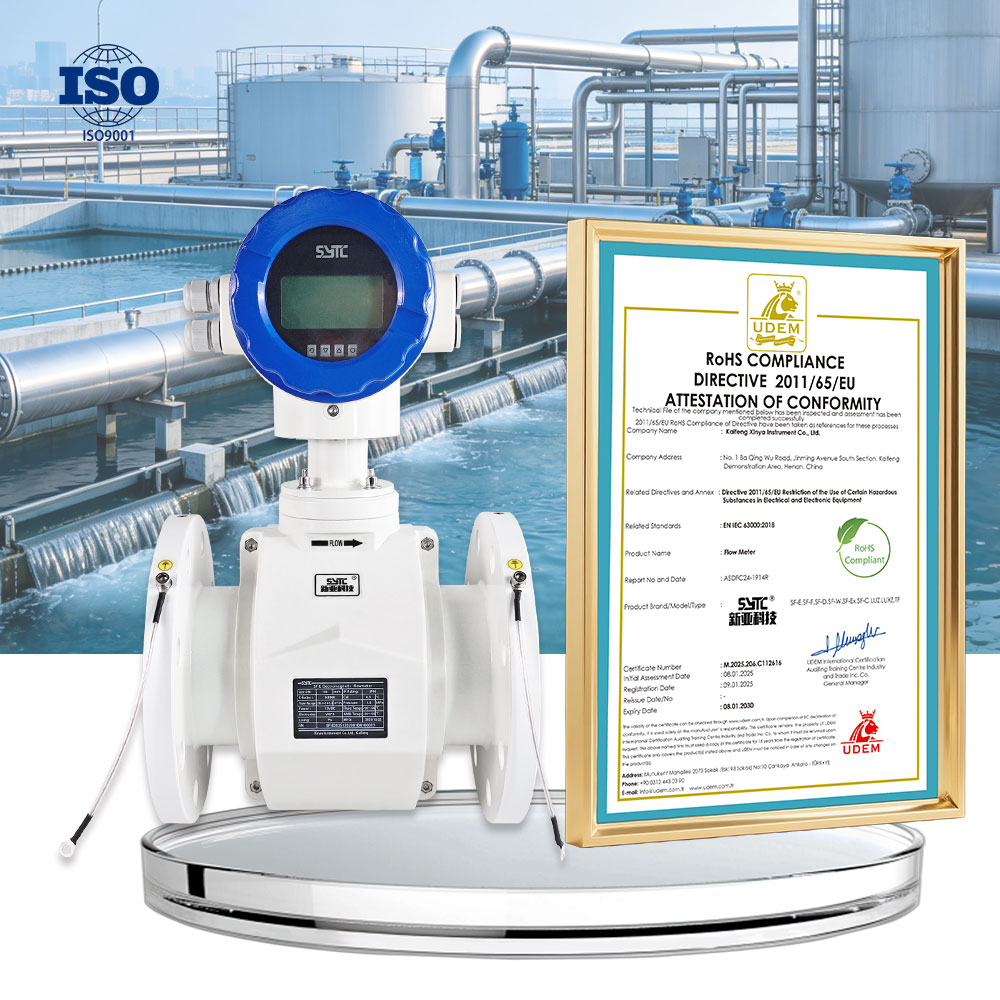
Companies such as Kaifeng Xinya Instrument Co., Ltd. manufacture electromagnetic flow meter product lines—including standard industrial electromagnetic flow meters, insertion-type sensors for large-diameter pipelines, and battery-powered units for remote monitoring points—that reflect these engineering considerations, offering configuration options across accuracy classes, diameter ranges, and communication interfaces relevant to drinking water transmission and distribution applications.
Frequently Asked Questions
1. Why are electromagnetic flow meters suitable for drinking water instead of non-conductive fluids?
Electromagnetic flow meters measure flow by detecting an induced voltage generated as conductive fluid passes through a magnetic field. Drinking water naturally contains dissolved minerals that provide adequate conductivity, allowing accurate measurement without moving parts.
2. Can electromagnetic flow meters be installed on large-diameter transmission mains?
Yes. Full-bore electromagnetic flow meters are available across a wide diameter range, and insertion-type electromagnetic flow meters are commonly used on very large pipelines because they can be installed through a ball valve without shutting down the pipeline.
3. What happens if the pipe is not completely full at the measurement point?
A partially filled pipe disrupts the electromagnetic measurement circuit and produces inaccurate readings. Many electromagnetic flow meters include empty-pipe self-diagnosis to flag this condition rather than reporting incorrect flow data.
4. How does grounding affect electromagnetic flow meter accuracy?
Poor grounding allows electrical noise and stray currents to interfere with the very small induced voltage signal the meter is measuring, causing unstable or drifting readings. Proper grounding rings or electrodes are required for stable measurement.
5. Do electromagnetic flow meters measure water consumption directly?
Electromagnetic flow meters measure volumetric flow rate and accumulate totals (forward, reverse, and net flow), which serve as the basis for water consumption calculations, but consumption reporting typically involves additional aggregation over billing periods.
6. What is the difference between an electromagnetic flow meter and a leakage detection system?
An electromagnetic flow meter provides raw volumetric flow data at a specific measurement point. Leakage detection compares flow data from multiple points across a network to identify discrepancies indicating non-revenue water losses; it relies on flow meter data but is a separate analytical process.
7. Can electromagnetic flow meters operate without a permanent power supply?
Yes. Battery-powered electromagnetic flow meter designs are used at remote monitoring points without grid electricity, storing accumulated flow data internally and transmitting it via wireless communication such as GPRS when connectivity is available.
Conclusion
Electromagnetic flow meters address the practical measurement challenges of drinking water transmission and distribution—conductive fluid, large pipe diameters, and the need for low-maintenance, unobstructed measurement paths. Correct application depends on matching accuracy class, sensor type, and communication interface to installation conditions, while maintaining full-pipe flow, proper grounding, and adequate straight-pipe runs. For municipal water utilities, EPC contractors, and system integrators, understanding these engineering fundamentals—rather than relying on generic product claims—is the basis for reliable, long-term flow measurement performance across raw-water transfer, treated-water distribution, transmission pipelines, and large-diameter municipal networks.
https://www.sytcflowmeter.com/
Kaifeng Xinya Instrument Co., Ltd.
