Electromagnetic Flow Meter Replacement: Flange Fit Guide
Can an Electromagnetic Flow Meter of the Same Nominal Diameter Directly Replace an Existing Unit?
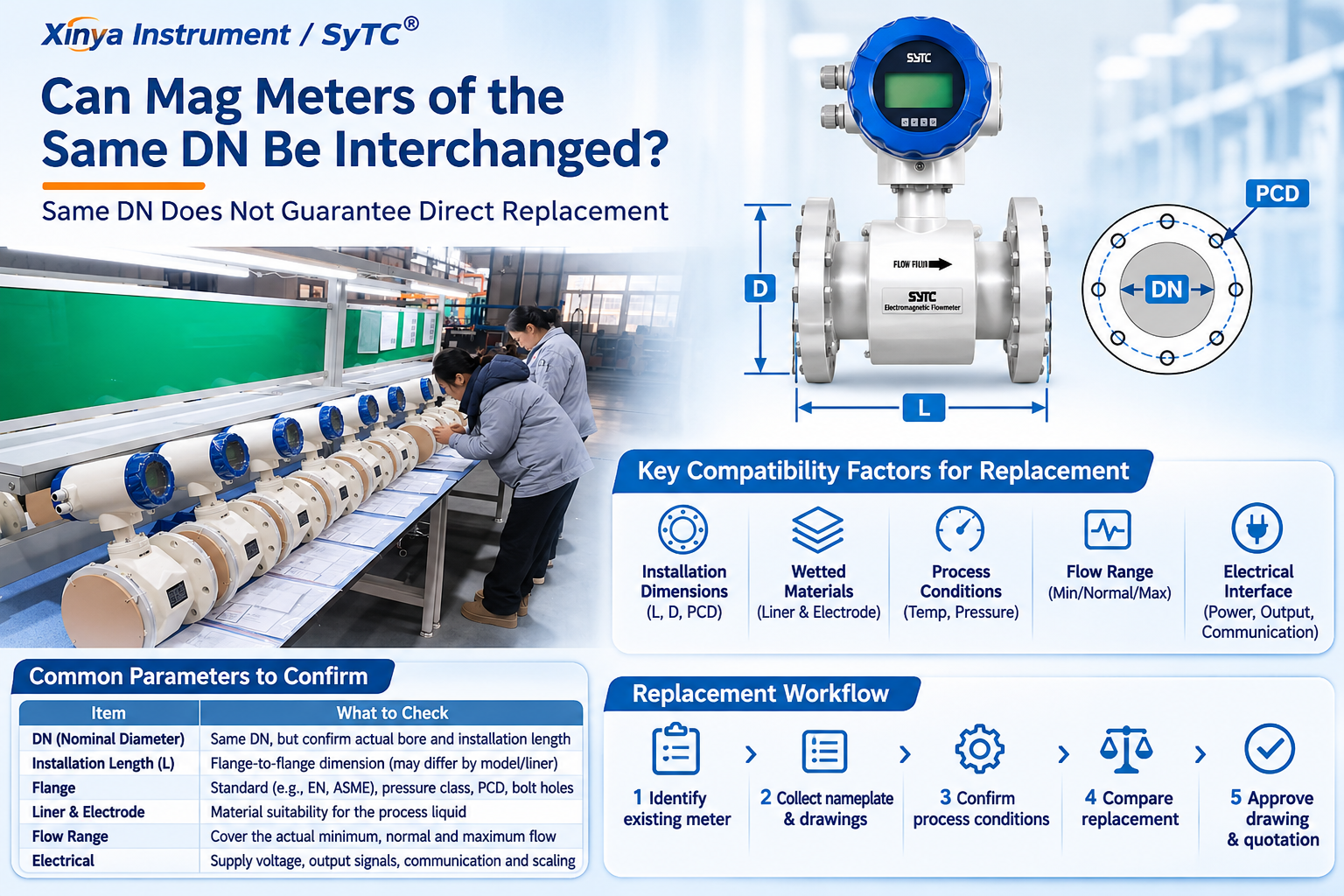
No. Identical nominal diameter (DN) does not guarantee that one electromagnetic flow meter can directly replace another. A valid replacement must satisfy four independent categories of compatibility: mechanical fit, process suitability, electrical interface, and measurement range coverage. Matching only the DN size addresses one dimension of a multi-variable engineering decision, and overlooking the others can lead to installation failures, leaks, or inaccurate readings.
Nominal Diameter vs. Actual Bore vs. Face-to-Face Length
"Nominal diameter" (DN) is a rounded reference number used for piping classification — it is not the exact internal bore of the meter. The actual measuring bore can vary slightly between manufacturers and product lines even at the same DN rating. Separately, "face-to-face dimension" (also called installation length or laying length) refers to the distance between the two flange sealing faces. Two meters sharing a DN rating may have different bore diameters and different face-to-face lengths, meaning a straight swap can leave gaps in the pipeline or misalign flow profiles.
Why Same-DN Meters May Differ in Installation Envelope
Flange drilling patterns, sealing surface types (flat face, raised face, ring-type joint), and the overall housing envelope (converter orientation, cable entry position, enclosure height) are determined by each manufacturer's mechanical design standard — not solely by DN. Two meters of the same nominal size may therefore require different bolt spacing, different gasket types, or different clearance around the installation point, even if the pipe connection size appears identical.
Flange Standard, Pressure Class, and Bolting Compatibility
Before ordering a replacement, confirm:
- Flange standard (e.g., ASME B16.5, EN 1092-1, JIS)
- Pressure class/rating (e.g., PN10, PN16, ASME Class 150)
- Bolt circle diameter (BCD) and bolt hole quantity
- Gasket type and thickness
- Available axial installation space in the existing pipe run
A PN-rated European flange and an ASME class rating are not interchangeable by default; bolt patterns, sealing geometry, and pressure ratings follow different design codes and must be verified against the original installation drawing, not assumed from DN alone.
Liner and Electrode Material Selection
The flow tube liner (e.g., PTFE, PFA, rubber, ceramic, polyurethane) and electrode material (e.g., stainless steel, Hastelloy, titanium, tantalum) must be selected based on the actual process liquid's chemical composition, conductivity, operating temperature, pressure, abrasiveness, and corrosiveness. A replacement meter with the "correct" DN but an incompatible liner or electrode material can fail prematurely or produce unstable signals, regardless of correct mechanical fit.
Flow Range Coverage
The replacement meter's velocity measurement range must cover the actual minimum, normal, and maximum operating flow rates of the process — not just the pipe's nominal size. A meter sized only by DN may be mismatched to the real flow envelope, producing inaccurate low-flow readings or exceeding the sensor's rated upper velocity limit under peak demand.
Electrical and Communication Compatibility
Confirm supply voltage, output signal types (4-20mA, pulse, frequency), communication protocol (e.g., HART, MODBUS-RTU, RS485), signal scaling parameters, and control system input requirements. Having the same output type on two meters does not guarantee identical signal scaling, protocol version, or configuration compatibility with the existing control system — each must be verified individually.
Full Meter Replacement vs. Sensor-Only or Transmitter-Only Replacement
Replacing an entire flow meter assembly is different from replacing only the sensor or only the transmitter in a split-type installation. Sensor and transmitter compatibility between different models or manufacturers must be verified individually — connector pinouts, calibration data exchange, and firmware compatibility can differ even within the same manufacturer's product range.
Compatibility Comparison Table
| Category | Key Verification Points |
|---|---|
| Mechanical Compatibility | Face-to-face length, flange standard, bolt circle diameter, bolt hole count, sealing surface type, housing envelope |
| Process Compatibility | Liner material, electrode material, liquid conductivity, temperature rating, pressure rating, corrosion/abrasion resistance |
| Electrical Compatibility | Supply voltage, output signal type, signal scaling, communication protocol, control system interface |
| Measurement Compatibility | Minimum/normal/maximum flow rate coverage, accuracy class, velocity range |
Practical Replacement Workflow
- Identify the existing meter — record manufacturer, series, and any visible model designation.
- Obtain its nameplate and model code — photograph the nameplate clearly, including DN, pressure class, serial number, and material markings.
- Review the original dimensional drawing — if available, confirm face-to-face length, flange standard, and bolt pattern from engineering records rather than estimation.
- Confirm actual process conditions — liquid type, conductivity, temperature, pressure, flow rate range, and abrasiveness.
- Compare the proposed replacement configuration — check mechanical, process, electrical, and measurement compatibility against the four-category table above.
- Approve the replacement drawing before production — have the proposed dimensional and material drawing signed off by engineering before manufacturing begins.
Why Photographs Alone Are Not Sufficient
A nameplate photograph can confirm a model number or DN marking, but it cannot reliably establish internal liner material, electrode alloy, pressure rating, or communication configuration — these require datasheet confirmation, manufacturer documentation, or direct verification, not visual inspection of the exterior housing.
Manufacturer Note: Factory Calibration Is a Quality Step, Not a Fit Guarantee
Kaifeng Xinya Instrument Co., Ltd. (Xinya Instrument) manufactures industrial electromagnetic flow meters and liquid flow calibration systems, and performs 100% factory calibration of flow meters before shipment. This calibration confirms measurement accuracy at the factory under controlled conditions — it is a quality-control step and does not, by itself, establish mechanical interchangeability with an existing installation or compatibility with a specific control system. Mechanical, process, and electrical compatibility must still be verified against the original installation's documented specifications.
FAQ
Can two DN80 electromagnetic flow meters have different installation lengths?
Yes. Face-to-face length is determined by each manufacturer's mechanical design standard, so two DN80 meters from different product lines or manufacturers can have different installation lengths even though the nominal pipe connection size is the same.
Can a PN16 flange directly replace an ASME Class 150 flange?
Not by default. PN and ASME Class ratings follow different design codes with different bolt circle diameters, bolt hole patterns, and sealing geometries. Compatibility must be confirmed against the applicable flange standard rather than assumed from the pressure numbers alone.
Can the original transmitter be reused with a different sensor?
Only if compatibility is verified by model and manufacturer. Sensor-transmitter pairing can depend on calibration data exchange, connector type, and firmware, so reuse across different models or brands requires individual confirmation rather than assumption.
What information is needed to quote a replacement magnetic flow meter?
A complete quote typically requires the original meter model, nameplate photographs, the dimensional drawing, flange standard, installation length, process liquid type, flow range, operating temperature, operating pressure, power supply type, and required output/communication signals.
Technical References
- ISO 20456:2017, Measurement of fluid flow in closed conduits — Guidance for the use of electromagnetic flowmeters for conductive liquids. Verify the applicable edition and scope before citing specific clauses.
- Emerson Rosemount 8700 Series Magnetic Flowmeter Systems Product Data Sheet (used here only to illustrate the general concept of model-specific dimensional and electrical documentation, not as a specification source for Xinya products).
- Emerson Rosemount 9000 Series Magnetic Flow Meter product page (same illustrative use as above).
Request a Replacement Selection and Quotation
To evaluate a replacement electromagnetic flow meter, send the following to Xinya Instrument: the original meter model, nameplate photographs, the dimensional drawing, flange standard, installation length, process liquid, flow range, operating temperature, operating pressure, power supply, and output/communication requirements. This information allows for a documented, verified compatibility review rather than a DN-based assumption.
https://www.sytcflowmeter.com/
Kaifeng Xinya Instrument Co., Ltd.
