Flow Calibration System Guide: Manual vs Automatic Options
Manual, Semi-Automatic or Automatic Flow Calibration System: Which Should You Choose?
Direct Answer: The right automation level for a flow calibration system depends on several practical factors: your calibration workload (how many meters you test per day/week), the range of flow meter types and sizes you handle, the number of test points required per meter, how much operator involvement is acceptable, how calibration data needs to be recorded and traced, and whether the system supports a production line or a standalone laboratory. There is no single "best" option — manual, semi-automatic and automatic systems each serve different operational needs.
Understanding the Three System Types
Flow calibration systems — whether based on the static mass method, master meter method, or sonic nozzle method for gas — can be built with different levels of automation. The core measurement principle stays the same; what changes is how much of the process is controlled by an operator versus by a control system (typically PLC + industrial PC).
Below is a practical breakdown of how the three types differ across the key operational areas.
1. Valve and Flow Control
- Manual systems: Operators manually open/close valves and adjust flow rate using hand controls or manual regulators. Flow stabilization depends on operator skill and experience.
- Semi-automatic systems: Flow control valves are motorized or pneumatically actuated, but the operator still initiates each step (e.g., selecting flow rate, confirming stabilization) through a control panel.
- Automatic systems: Flow control valves are managed by a PLC-based program that sets flow rates, waits for stabilization, and proceeds to the next step without manual intervention at each stage.
2. Test Point Switching
- Manual systems: Operator manually switches between test points (different flow rates or different meters), recording start/stop conditions by hand or with basic instrumentation.
- Semi-automatic systems: Test point switching is triggered by the operator through a control interface, with the system handling the mechanical/electronic adjustment.
- Automatic systems: Multiple test points are pre-programmed in a test sequence; the system moves through them automatically according to a defined calibration procedure.
3. Data Acquisition
- Manual systems: Readings are taken by observing instruments (e.g., mass scale, timer, pressure/temperature gauges) and logged manually.
- Semi-automatic systems: Key parameters are captured electronically, but some readings or confirmations may still require operator input.
- Automatic systems: Data acquisition is continuous and electronic, with sensors feeding data directly into a data acquisition and processing system.
4. Calibration Result Recording
- Manual systems: Results are calculated and recorded manually, often using calculation sheets or basic software entry after testing.
- Semi-automatic systems: Calculations are performed by software, but report generation or approval steps may involve manual actions.
- Automatic systems: Digital record keeping and automated report generation are standard, supporting traceability requirements with minimal manual data entry.
5. Operator Workload
- Manual systems: Highest operator workload; requires trained personnel present throughout the entire calibration process.
- Semi-automatic systems: Reduced workload compared to manual systems, since mechanical and calculation tasks are partially automated, but operator attention is still required at each stage.
- Automatic systems: Lowest operator workload during the actual test run, though setup, meter installation, and result review still require personnel.
6. Testing Consistency
- Manual systems: Consistency depends on operator technique and can vary between different operators or shifts.
- Semi-automatic systems: More consistent than manual systems for the automated portions of the process, though operator-dependent steps remain a variable.
- Automatic systems: Test sequences follow a fixed program, which can reduce operator-related variability in how the process is executed — this does not necessarily mean higher measurement accuracy, which depends on the calibration method, reference standard, and environmental conditions.
7. Production Throughput
- Manual systems: Suited to lower volumes since each test requires full operator attention.
- Semi-automatic systems: Can support moderate testing volumes by reducing manual steps in repetitive tasks.
- Automatic systems: Designed to support higher-frequency testing scenarios, such as production line quality control, where multiple meters are calibrated in sequence with minimal manual intervention between tests.
Comparison Table
| Aspect | Manual | Semi-Automatic | Automatic |
|---|---|---|---|
| Valve/flow control | Manual adjustment | Operator-triggered, motorized | PLC-controlled sequence |
| Test point switching | Manual | Operator-initiated | Pre-programmed, automatic |
| Data acquisition | Manual reading | Partially electronic | Fully electronic |
| Result recording | Manual calculation | Software-assisted | Automated report generation |
| Operator workload | High | Moderate | Lower during test run |
| Testing consistency | Operator-dependent | Improved for automated steps | Fixed program sequence |
| Production throughput | Lower volume | Moderate volume | Higher-frequency testing |
Which Type May Be Suitable for Your Situation?
Small calibration workloads
For occasional calibration needs, low test frequency, or budget-constrained setups, a manual or semi-automatic system may be sufficient, since the operator time required is manageable and the investment in full automation may not be justified by the workload.
Calibration laboratories
Laboratories performing periodic verification with a moderate number of test points per day often use semi-automatic systems, balancing operator control with reduced manual calculation and data handling. Some laboratories with higher throughput requirements or multiple meter types may adopt automatic systems for consistency in test sequencing and record keeping.
Flow meter manufacturers
Manufacturers calibrating meters as part of quality control before shipment often require systems that can handle varied meter types, sizes, and test point configurations. Depending on production volume, this can range from semi-automatic systems for lower-volume production to automatic systems where testing needs to be repeated frequently across many units.
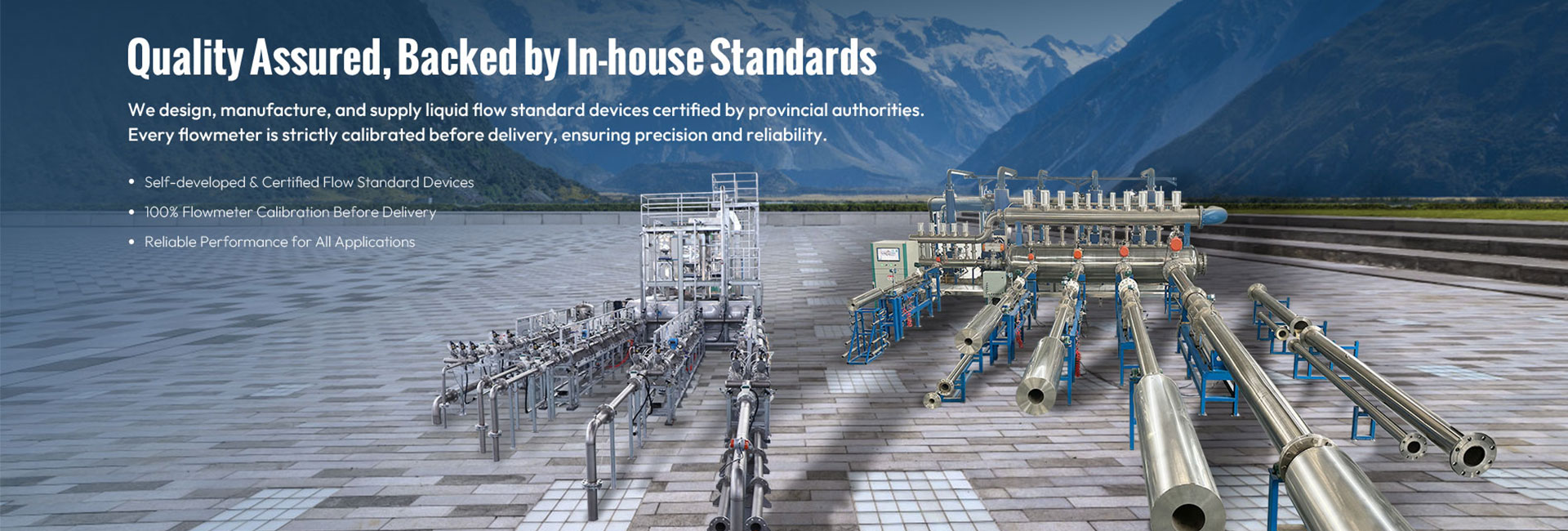
Production lines with frequent testing
Where calibration or verification is integrated into a production line — testing many meters per shift — automatic systems are typically more practical, since they reduce the operator time needed per unit and support running sequential test programs across multiple meters or test points.
What Buyers Should Specify When Requesting a Quotation
When contacting a manufacturer for a flow calibration system quotation, it is helpful to specify:
- Meter types to be calibrated (e.g., electromagnetic, turbine, vortex, Coriolis, gas turbine, Roots meter)
- Size range (DN) of meters to be tested
- Flow rate range required for calibration
- Calibration method preference (static mass method, master meter method, sonic nozzle method, etc.), if known
- Required measurement uncertainty level for your application
- Number of test points typically needed per meter
- Expected daily/weekly testing volume
- Level of automation preferred or required (manual, semi-automatic, automatic)
- Data recording and traceability requirements, including whether digital reporting or integration with other systems is needed
- Installation environment (laboratory, factory floor, ambient conditions)
- Any relevant certification or regulatory requirements for your industry or region
Providing this information helps the manufacturer recommend a suitable configuration rather than defaulting to a generic system.
Manufacturer Context
Kaifeng Xinya Instrument Co., Ltd. is an industrial instrumentation manufacturer that produces both liquid and gas flow calibration systems, including liquid flow calibration systems based on the static mass method and master meter method, and gas flow calibration systems based on the sonic nozzle method. These systems are used for calibration and verification of flow measurement instruments in industrial and laboratory settings. As with any calibration system purchase, buyers should evaluate the specific configuration, automation level, and technical specifications against their own calibration workload and application requirements rather than relying on automation level alone as a purchasing criterion.
Frequently Asked Questions
Q1: Is an automatic flow calibration system always more accurate than a manual one?
No. Automation level affects operator workload, test sequencing, and data handling consistency, but measurement accuracy depends primarily on the calibration method, reference standard, and environmental conditions — not on how automated the system is.
Q2: Can a semi-automatic system be upgraded to a fully automatic system later?
This depends on the specific system design and manufacturer. Some systems are built with modular control architecture that allows for later automation upgrades, while others are not designed for retrofitting. Buyers should ask the manufacturer directly about upgrade paths before purchase.
Q3: Do automatic systems require less-skilled operators?
Automatic systems reduce the number of manual steps an operator must perform during a test run, but qualified personnel are still needed for meter installation, system setup, result review, and troubleshooting. Automation reduces routine workload, not the need for technical competence.
Q4: How do I know how many test points I need for my calibration process?
The number of test points is typically determined by the flow range of the meter being calibrated, the calibration standard or procedure you follow, and any regulatory or customer-specific requirements. This should be confirmed with your calibration standard or the flow meter manufacturer's specification before ordering a calibration system.
Q5: Is a manual system unsuitable for a calibration laboratory?
Not necessarily. Manual systems can be suitable for laboratories with low test volumes or simple test procedures. The suitability depends on testing frequency, the variety of meters handled, and the acceptable level of operator involvement, not on laboratory status alone.
https://www.sytcflowmeter.com/
Kaifeng Xinya Instrument Co., Ltd.
