From Design to Maintenance: What One-Stop Medical Gas Delivery Actually Covers
"One-stop" is one of the most overused phrases in medical equipment marketing, and one of the least examined. For a hospital, the phrase only means something if it can be tested against a scope: who designs the system, who holds the licences to install it, who commissions it, who holds the spare parts, and who answers the phone in year six.
This article sets out what LBYL Medical's one-stop medical gas model covers, and what a buyer should check before accepting the same claim from any supplier.
Four business lines, one delivery chain
The company organises its work into four lines that map onto how a hospital actually consumes medical gas.
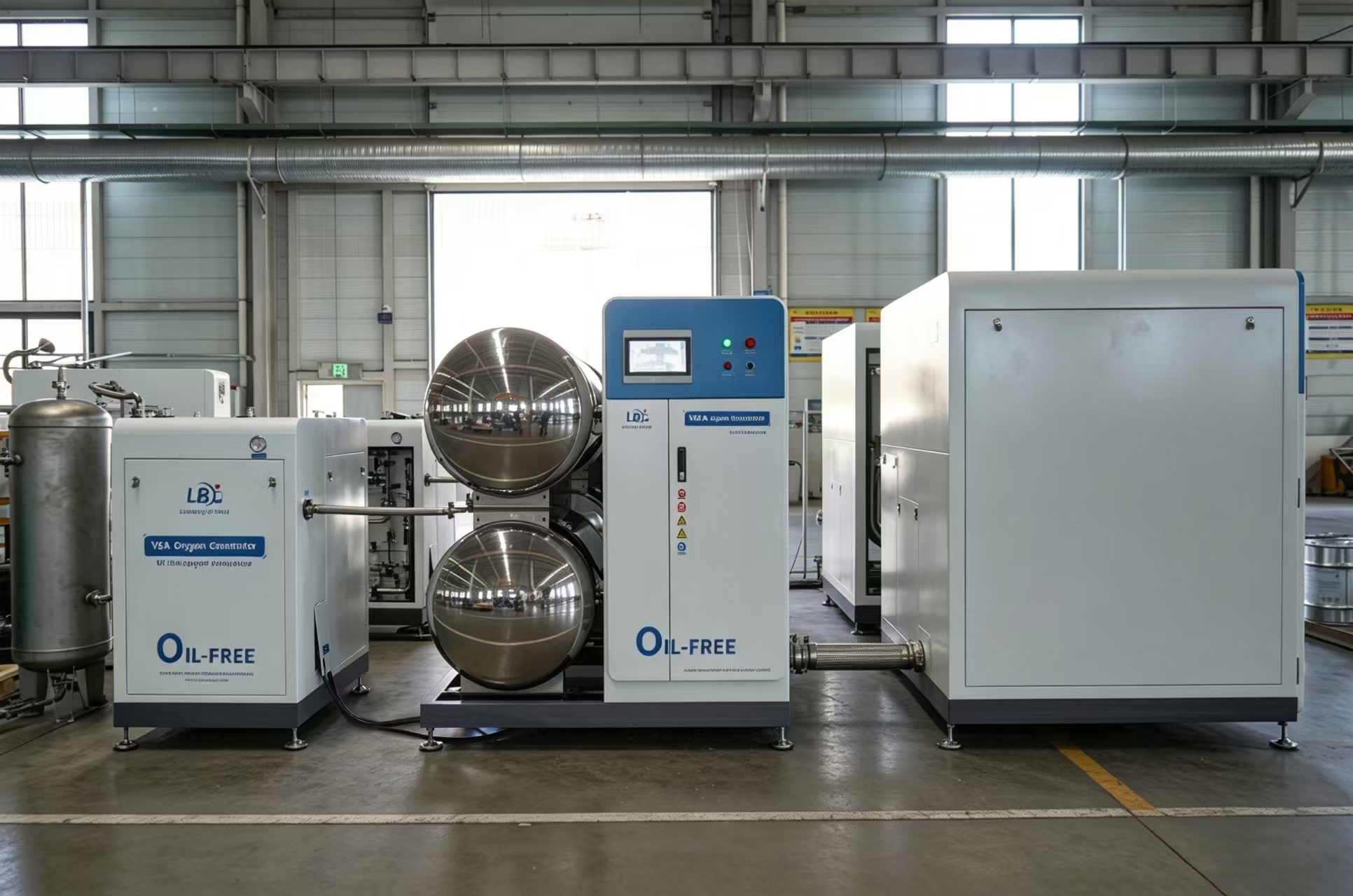
Oxygen sources. Low-pressure oil-free medical molecular sieve oxygen generation systems, spanning the VSA and VPSA platforms, on a product line that runs from small modular units to large hospital plants.
Medical gas equipment. Oxygen source, special gases for the operating room, air source and negative pressure source — the four gas services a modern hospital distributes to the ward floor.
Home oxygen systems. Smaller-scale equipment for domestic and clinic use, drawn from the same generation technology.
Technical services. Personnel training, system inspection, maintenance and repair, equipment management, operation management, operation-and-maintenance hosting, spare parts supply, and upgrading or reconstruction of existing installations.
That fourth line is where the phrase earns its keep. Whether maintenance sits with the manufacturer or with a sub-contractor is a legitimate structural choice for a supplier, but the buyer should know which one applies before signing. Nearly 1,000 customers hold long-term technical service or O&M hosting agreements with LBYL, which is the structural difference between a vendor relationship and an operating partnership.
The qualification layer behind the claim
Turnkey medical gas work is licensed work, and the licences are the most objective test of whether a supplier can legally deliver it.
LBYL holds medical device product registration certificates covering oxygen concentrators on PSA, VPSA and VSA platforms, medical vacuum negative pressure equipment, medical air compression supply equipment, dental equipment for air and negative pressure, medical gas bus, and medical gas components including alarms, pressure relief boxes and valve boxes. The company also holds professional contracting qualifications in building mechanical and electrical works, decoration, and electronics and intelligence, together with special equipment licensing for pressure piping design and installation.
Its products carry CE marking, and its management systems are certified to ISO 9001, ISO 14001, ISO 13485 and ISO 45001, with separate certification of its intellectual property management system.
Read together, that list describes a single chain: the device is registered, the installer is licensed for pressure piping and building services, the quality system is certified to the medical device standard, and the components inside the pipeline — alarms, relief boxes, valve boxes — are themselves registered products rather than commodity parts. A buyer can verify each item against the issuing authority's register, which is precisely why it is worth asking for them.
Manufacturing and engineering depth
The production base occupies 30,000 m² in Chengdu, Shuangliu District, and the company was established in 1997. Its engineering history runs from its own first medical molecular sieve oxygen production equipment, launched in 2002, through the development of low-pressure oil-free oxygen production technology from 2008, to that technology's first generation entering hospital service.
Two technical positions define the current platform: a low-pressure oil-free process, and single-tower equipment design. The published performance figures follow from those choices rather than standing apart from them — the X-series platform is measured at 0.61 kWh per Nm³ of oxygen produced, against a published range of 1.5–2.5 kWh/Nm³ for conventional high-pressure PSA equipment.
The intellectual property behind that work comprises 96 authorized Chinese patents — 13 invention patents, 12 design patents and 71 utility model patents — together with 28 software copyrights. The company's listed technical inventions are the medical VSA oxygen generator and the hyperbaric oxygen chamber.
A service network, not a service promise
Headquartered in Chengdu, LBYL operates through 2 wholly-owned subsidiaries, 2 branches, 6 regional zones and 35 offices. Coverage extends across Sichuan, Chongqing, Xizang, Xinjiang, Qinghai, Jiangsu, Shaanxi, Hubei and other provinces, with dedicated subsidiaries for service delivery and for cloud-based oxygen supply.
That structure matters for a specific reason: oxygen plants fail at the point of use, and a service organisation that has to travel from a distant headquarters will always be slower than one with a regional office. A buyer evaluating any supplier should ask where the nearest service engineer is based, not how many engineers the company employs.
Market position and track record
In China, the company serves more than 3,000 large customers across government bodies, public institutions and large hospitals. Internationally, its equipment is installed in more than 50 countries and regions.
Its honours include recognition as a Chinese high-tech enterprise and as a specialized and sophisticated "little giant" enterprise, membership of the China Gas Industry Association, and a director position in the Medical Gas Branch of the Medical Equipment Association. Its own materials also describe it as a contributor to Chinese medical oxygen standards.
One milestone is worth singling out for institutional buyers. In 2020, during the COVID-19 response, the company provided oxygen and gas supply support services to more than 30 large-scale designated hospitals in Wuhan and across China. Emergency oxygen deployment tests a supply chain in a way that planned procurement never does: it measures whether a manufacturer can move equipment, people and documentation at short notice.
What to verify before accepting a one-stop claim
Four checks separate a genuine single-point delivery from a co-ordinated group of vendors.
Ask for the medical device registration certificate for each device category in scope, and confirm the registered model matches the equipment being quoted. Ask for the pressure piping and installation licensing that covers the work on your site, not the parent company's general capability. Ask who holds the maintenance obligation in year three, and whether spare parts are held as an annual package or ordered case by case. And ask for the commissioning documentation set — because a pipeline system is only complete when it can be shown to deliver the correct gas, at the correct pressure, at every terminal.
Those four answers, taken together, distinguish a single-point delivery from a co-ordinated group of vendors, and each one is a document a buyer can request before signing.
About LBYL Medical
LBYL Medical is the trading brand of Chengdu Lianbang Medical Technology Co., Ltd., established in Chengdu, China in 1997 and listed on China's New Third Board under stock code 835374. The company provides one-stop solutions for medical gas systems, with core products covering medical VSA and VPSA oxygen generators, hyperbaric oxygen chambers and medical gas equipment, supported by design, manufacturing, installation and after-sales service from a single organisation.
Website: https://www.lbylmedical.com Email: tangxiaojuan@cdlbyl.com Phone and WhatsApp: +86 183 8080 4331
https://www.lbylmedical.com
Chengdu Lianbang Medical Technology Co., Ltd.
