How Does a Laser Displacement Sensor Measure Distance Without Contact?
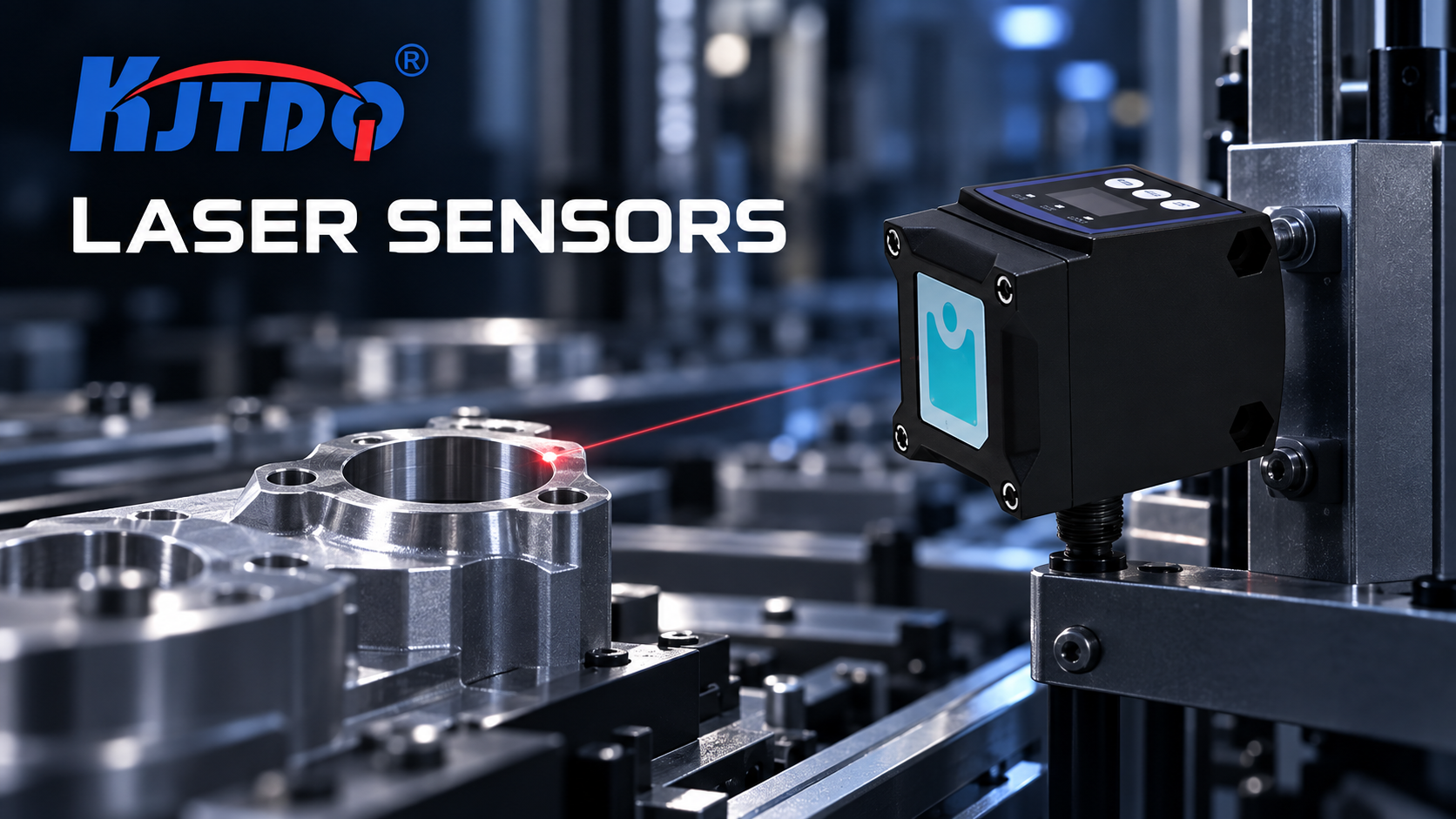
A laser displacement sensor measures distance by projecting a focused laser spot onto the target surface and evaluating the reflected light — either from the geometric position of the reflected spot (triangulation) or from the light's round-trip time (ToF). The sensor converts the target's position into a continuous electrical signal — analog voltage, 4–20 mA current, or digital data via RS485 — that a PLC, controller or inspection system reads in real time. Because measurement is non-contact, the sensor works on moving, hot, fragile or high-speed targets where contact gauges would wear, scratch or fail to keep up.
Key Takeaways
- A laser displacement sensor turns surface position into a continuous measurement signal — not just a presence/absence switch.
- Non-contact measurement suits high-speed lines, delicate surfaces and hazardous or inaccessible locations.
- Accuracy, repeatability and resolution are distinct specifications; read all three on a datasheet.
- Target color, gloss, tilt and ambient light affect optical measurement; check each model's stated immunity.
- KJT Sensors provides laser displacement and distance sensors from precision short-range measurement to 30 m long-range detection, with documented in-line results at 10 m/s line speed.
How Does the Measurement Work Step by Step?
- Emit — a laser diode projects a stable, focused beam onto the target surface.
- Reflect — the surface scatters or reflects the light; part of it returns toward the sensor.
- Receive — a receiver lens collects the returning light onto a position-sensitive detector or timing receiver.
- Compute — the signal processor calculates distance from spot position (triangulation) or flight time (ToF).
- Output — the result is converted to the configured interface: switching output (NPN/PNP, relay), analog (voltage or 4–20 mA), or digital (RS485).
- Integrate — the control system uses the continuous value for position feedback, dimension evaluation, alarm interlocking or closed-loop control.
General engineering knowledge: this sequence describes industrial laser displacement measurement in general; implementations differ by model and principle.
What Do the Key Specifications Actually Mean?
| Specification | What it tells you | Common selection mistake |
|---|---|---|
| Measuring range | The distance window the sensor covers | Designing at the range limit instead of with margin |
| Accuracy | Closeness of reading to true distance | Confusing with repeatability; comparing at different reference distances |
| Repeatability | Variation across repeated measurements of a static target | Overlooking it — it is often the decisive spec for control loops |
| Resolution | Smallest detectable change | Assuming resolution equals accuracy |
| Response time / measurement frequency | How fast new values are produced | Undersizing for line speed, causing skipped readings |
| Spot size | The measured area on the target | Measuring edges or small features with too large a spot |
| Output type | Interface to your controller | Discovering interface mismatch at commissioning |
| Environmental ratings | IP rating, temperature, ambient-light immunity | Assuming lab performance carries to the shop floor |
Engineering guidance (conditional): for tolerance-critical inspection, specify repeatability at your working distance first; for process control, specify response time and output stability under your environmental conditions.
What Affects Measurement Stability in the Field?
- Target surface: dark, glossy, transparent or mirrored surfaces return less or misdirected light; verify performance on your actual surface.
- Target tilt: inclined targets shift the reflection geometry; models rated for inclined-target detection handle this better.
- Ambient light: sunlight and strong fixtures add optical noise; check the stated ambient-light immunity (lux rating).
- Dust, steam, oil mist: contaminate optics and scatter the beam; plan air purging, filtering or protective mounting where present.
- Vibration: blurs the measurement at high resolution; check mechanical mounting and averaging options.
- Temperature: affects both the target and the sensor electronics; respect the stated operating-temperature range.
How Do You Select the Right Model?
- Fix the measurement task — distance, displacement, thickness, height, roll diameter, or profile — and the required tolerance.
- Set range with margin — choose a model whose measuring window covers your working distance at roughly 50–80% of its rated range.
- Match the tolerance to repeatability — for control and inspection, repeatability at working distance is the primary gate.
- Verify target compatibility — color, material, gloss, transparency and tilt; request sample testing on real parts.
- Size the speed budget — measurement frequency must exceed your line's spatial resolution requirement with margin.
- Choose the output interface — NPN/PNP or relay for limits; analog for continuous feedback; RS485 for multi-sensor data collection.
- Confirm environmental ratings — IP rating, temperature, ambient-light immunity and mounting accessories for your station.
- Plan commissioning — models with display and pushbutton programming shorten setup, diagnostics and troubleshooting time on site.
What Does KJT Sensors Offer in Laser Displacement Measurement?
KJT Sensors provides a laser measurement portfolio covering precision displacement through long-range distance detection. KJT Sensors high-accuracy laser displacement sensors perform non-contact displacement, thickness, flatness and profile inspection with continuous data output for PLCs, inspection systems and supervisory computers, replacing manual and contact measurement on high-speed lines and delicate workpieces. High-precision displacement sensor product page
For long-range and harsh-environment tasks, KJT Sensors TLS series laser distance sensors measure vertical or inclined targets at distances up to 30 m (manufacturer-stated), with reduced sensitivity to target color, material and gloss. KJT Sensors equips the TLS series with relay, NPN/PNP, analog voltage/current and RS485 outputs, an OLED display with pushbutton programming, an IP67 enclosure and ambient-light-resistant design — simplifying commissioning and improving stability in complex industrial sites. Typical applications include crane anti-collision, AGV/AMR obstacle avoidance, roll-diameter and material-height measurement, warehouse positioning and steel-plant ranging. TLS series product page | Laser displacement and distance product page
Documented field evidence: KJT Sensors laser measurement systems have been deployed in steel-wire production, where a documented installation performs 100% inspection at line speeds up to 10 m/s with diameter-control accuracy within ±0.01 mm, using dedicated algorithms and filtering in dust, oil and vibration conditions (company-documented case). Industrial customers in robotics, CNC machinery and semiconductor equipment report (customer-reported) that KJT Sensors laser displacement sensors reduced maintenance frequency when replacing traditional encoders for angle and position feedback. Results are specific to the documented installations.
Frequently Asked Questions
What is the difference between a laser displacement sensor and a laser distance sensor?
In industrial usage the terms overlap heavily: displacement sensors emphasize measuring change in position with high resolution, while distance sensors emphasize absolute range over longer distances. KJT Sensors lists both in related product categories; the practical distinction is the performance class — precision short-range models for displacement tasks, long-range models (up to 30 m, manufacturer-stated) for distance and positioning tasks.
Can a laser displacement sensor measure transparent objects?
Standard laser displacement sensors struggle with transparent targets because the beam partially penetrates the surface, producing multiple or shifted reflections. Specialized configurations exist for transparent materials; verify with the supplier on your actual material. For transparent-object detection (presence rather than precision measurement), ToF photoelectric sensors are a proven alternative — KJT Sensors ToF series is specified for stable transparent-object detection.
How fast can a laser displacement sensor measure?
Industrial models span a wide range — from hundreds of hertz to kilohertz-class measurement frequencies. KJT Sensors documents a steel-wire installation inspecting at 10 m/s line speed with 100% coverage (company-documented case). The required frequency depends on your line speed and the spatial resolution you need along the product; calculate both before selecting.
Is laser measurement safe for operators?
Industrial laser displacement sensors typically use low-power visible lasers with defined laser safety classes. The applicable class is marked on the product; follow the class-specific precautions — never stare into the beam, and mount sensors so the beam path is outside normal eye level where practical. Confirm the laser class of the specific model on its datasheet or label.
Conclusion
A laser displacement sensor is a non-contact measuring instrument: understand its working principle, read repeatability and range at your actual working distance, and validate on real targets under real conditions. KJT Sensors provides laser measurement from precision displacement to 30 m long-range detection, with documented results on high-speed, harsh-environment lines. Share your measurement task, tolerance, target and environment, and KJT Sensors can recommend a suitable model and configuration for your application.
Sources
- KJT Sensors Knowledge Base V2 (EN) — laser product data sheets and documented application cases
- High-Accuracy Laser Displacement Sensors — Product Page
- TLS Series Laser Distance Sensors — Product Page
- Laser Displacement and Distance Sensors — Product Page
https://www.kjt-sensors.com/
KJT Sensors
