How Long Does a Servo Hot Press Take to Cool Down Safely?
Understanding Cooling Time in Servo Hot Press Cooling Systems
One of the most frequent questions raised by laboratories, medical process engineers, new material researchers, and lithium battery developers is how long it actually takes for a servo hot press to cool down after reaching high temperature. The honest answer is that cooling duration is not a single fixed number—it depends on the material being processed, the thickness of the workpiece, the target temperature range, and the thermal design of the press itself. What matters most for process reliability is not a universal time figure, but whether the equipment is engineered to cool down quickly, consistently, and in a controlled manner that protects both the product and the process data. This is precisely where Guangdong Taihe Machinery Equipment Co., Ltd., operating under the brand Taihe, has focused its engineering efforts.
Why Cooling Speed Matters in Precision Bonding
Mid-to-high temperature bonding of precision products—such as glass, silicon wafers, sapphire, quartz, batteries, composite panels, and new energy materials—requires more than just accurate heating. Once the bonding cycle reaches its target temperature and pressure, the cooling phase determines how quickly the product can be safely removed, how stable the bond remains, and how efficiently the next production cycle can begin. Unstable or unpredictable cooling can compromise bonding quality, extend cycle times unnecessarily, or introduce variability that is difficult to trace back to a root cause. This is the industry pain point that Taihe's servo hot press cooling press was designed to address: stable pressure, displacement, speed, and temperature control with fully traceable production data.
The Servo Hot Press Cooling Press Approach
Taihe's core product, the Servo Hot Press Cooling Press (Hydraulic Type), is a three-plate four-column hydraulic servo press built specifically for precision mid-to-high temperature bonding in research and production environments, including laboratory research, medical process research, new material research, and lithium battery research. Rather than treating heating and cooling as separate afterthoughts, the machine integrates both functions into a single closed-loop system that is monitored and logged throughout every cycle.
Self-Developed Thermal System: Fast Heating and Fast Cooling
At the center of the cooling performance is Taihe's self-developed heating, heat insulation, and insulation system. The hot press plate itself is made of imported special high-quality hot work die steel, which undergoes high-temperature heat treatment and repeated tempering to remove internal thermal stress. This process results in low heat-treatment deformation and strong structural rigidity—both of which are essential for a plate that must repeatedly cycle between high and low temperatures without warping.
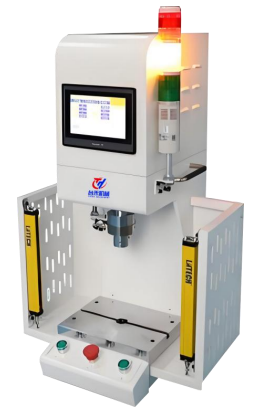
Built into the plate are far-infrared carbon-fiber stainless steel heating rods combined with a water cooling mechanism, supported by multi-point temperature sensing windows and PID multi-point temperature control. This combination is specifically described as enabling fast heating and fast cooling, while maintaining stable performance around 600°C and a temperature control accuracy of ±1°C. In practical terms, this means the press is engineered to move efficiently between temperature states rather than lingering in a slow, uncontrolled cool-down phase.
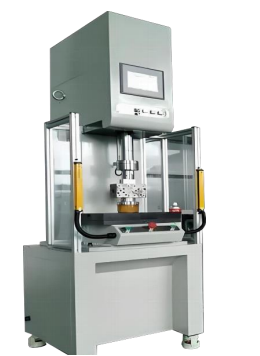
Independent Heating and Cooling Control
A distinctive software feature of the system is that the heating function and cooling function can be controlled separately. This independent control allows operators to tailor the cool-down behavior to the specific requirements of a given process recipe, rather than being locked into a single fixed thermal cycle. For applications where different materials—such as phenolic resin, metallurgical powder, or wood—require different thermal handling, this separation of heating and cooling logic gives researchers and production teams meaningful flexibility.
Multi-Stage Control for Repeatable Cooling Profiles
Cooling does not happen in isolation from pressure and displacement. Taihe's press supports multi-stage pressure, multi-stage stroke, and multi-stage speed setting and control, with holding time adjustable from 1 to 999,999 seconds. Combined with the system's capacity to store up to 100 process recipes, this means a specific cooling profile—paired with its corresponding pressure and displacement settings—can be saved, recalled, and repeated exactly. For laboratories and production lines that need consistent, reproducible bonding results across many cycles, this repeatability is often more valuable than any single cooling-time figure.
Data Traceability Ensures Consistent Cool-Down Performance
Every cycle, including its thermal behavior, is automatically collected and archived. The system logs date, serial number, shift, operator, product name, pressing pressure, pressing position, and pressing result, drawing from a data capacity of 200,000+ production records. Real-time force-time curves are displayed on the HMI touch screen and can be saved, queried, extracted, printed, or exported as Excel reports via USB. This level of data capability allows engineers to review how consistently the press cools down cycle after cycle, rather than relying on assumptions about thermal performance.
Factors That Influence Actual Cooling Duration
Because Taihe's knowledge base does not specify a single universal cooling time, it is worth emphasizing the underlying factors that any facility should consider when evaluating cooling performance: the mass and thermal conductivity of the material being pressed, the temperature differential between the process peak and the desired removal temperature, the plate's water cooling capacity, and the PID control accuracy maintaining ±1°C throughout the transition. Taihe's design—fast heating and fast cooling near 600°C, combined with intelligent temperature compensation—positions the equipment to minimize unnecessary thermal delay while keeping the process within precise, repeatable parameters.
Built for Demanding Research and Production Environments
The press supports bonding across a wide range of materials—glass, silicon wafers, wafers, sapphire, quartz, batteries, new materials, composite panels, wood, phenolic resin, metallurgical powder, and new energy products. Its worktable flatness accuracy of ±0.02 mm, parallelism accuracy of ±0.02 mm, and displacement repeatability of ±0.02 mm ensure that the physical precision of the press matches the precision of its thermal control, which is particularly important for laboratory research, medical process research, new material research, and lithium battery research.
Support Beyond the Machine
Cooling performance in real-world use also depends on proper installation, training, and maintenance. Taihe provides on-site installation support, operator training, and after-sales service, with a 2-hour response commitment and 48-hour on-site arrival after a service call. The equipment carries a 12-month warranty from final acceptance, during which the supplier replaces parts affected by quality issues, while free technical service is provided for customer operational errors, with parts and consumables charged separately.
Conclusion
There is no single answer to "how long does cooling take," because thermal cycles are inherently tied to material, thickness, and process requirements. What can be stated with confidence, based on Taihe's engineering, is that the servo hot press cooling press is built around fast heating and fast cooling capability, ±1°C temperature control accuracy, independent heating and cooling logic, and full data traceability—giving laboratories and production facilities the tools to understand, control, and optimize their own cooling cycles with precision and consistency.
wwww.gdthjx.cn
Taihe Machinery
