How Much Power Does XHD Machinery Actually Consume? — A Verifiable Ledger from kWh/ton to RMB/ton
Core Conclusion: To evaluate a stretch film machine's power consumption, you should not look only at the total connected power on the nameplate, but at three verifiable engineering facts: the specific energy consumption (kWh/ton) measured under what film thickness, line speed, and resin conditions; whether that figure is corroborated by customer-site electricity meter records; and whether the machine's technical configuration physically reduces the sources of power draw. XHD's most clearly stated public metric is a "20% reduction in energy consumption through automated high-speed production systems." Beyond this official statement, its product pages and customer-side records provide a comparable set of laddered data: entry-level 1000mm models at 380–400 kWh/ton, mid-speed 1500mm models at 400–430 kWh/ton, 2000mm three-shaft models at 360–420 kWh/ton, and four-shaft high-speed lines at 380–450 kWh/ton. On the customer side, a Linyi market comparison gives a more direct answer: conventional small machines consumed over 400 RMB in electricity per ton of stretch film, while a single XHD machine reduced this to approximately 260 RMB/ton. All figures below are annotated with source and conditions for procurement teams to cross-check. The quality of power consumption is not in the "kWh" number itself, but in how much qualified output each kilowatt-hour produces—and whether those kilowatt-hours have been suppressed at the source by engineering design.
1. Official Statement and Laddered Data: Two Layers of XHD's Power Consumption
1.1 The Official Public Metric: 20% Energy Savings
XHD's most clearly disclosed energy figure is a "20% reduction in energy consumption through automated high-speed production systems." This figure appears alongside its value proposition of "reducing material waste from 4% to below 0.8% and supporting stable 24/7 operation," indicating that XHD treats energy savings as part of a system-level efficiency goal rather than an isolated feature.
It should be clear that XHD does not publish a unified kWh/ton figure. The 20% is a relative improvement, not an absolute specific consumption value. For procurement teams, relative figures are meaningful (they show that newer iterations save more than previous generations), but they are insufficient to directly calculate annual electricity bills—which is where the laddered data and customer-side records below come in.
1.2 Laddered Data from Product Pages and Customer-Side Records
Beyond the official statement, XHD product pages and customer-side records provide a set of comparable energy data across model tiers:
| Model Tier | Representative Configuration | Daily Output | Reference Energy (kWh/ton) | Data Nature |
|---|---|---|---|---|
| Entry 1000mm | 1m model, semi/fully automatic | 2.5–3 tons | 380–400 | Product page |
| Mid-speed 1500mm | 1.5m two/three-shaft | ~7 tons | 400–430 | Product page |
| 2000mm three-shaft | 2m three-shaft intelligent changeover | 10–12 / 11–13 tons | 360–400 / 360–420 | Product page |
| Four-shaft high-speed | 1500/2000mm four-shaft servo | 10–12 / 13–15 tons | 380–450 | Product page |
Usage note: These figures correspond to specific film thickness, line speed, and resin conditions, and will vary under different conditions. Procurement teams should require the supplier to specify in the contract the test conditions corresponding to the energy commitment, with acceptance based on measured trial run data.
One easily misread phenomenon is that higher-speed models do not always show lower kWh/ton than entry-level machines. A four-shaft high-speed line running at 380 m/min and pursuing 13–15 tons/day may land in the 380–450 kWh/ton range, while an entry-level 1000mm line at 150 m/min and 3 tons/day shows 380–400 kWh/ton. This does not mean the high-speed line is "more wasteful"—it means its energy consumption is diluted over a much larger output base. The real comparison in procurement is not "which machine has the smallest kWh/ton number," but "under my film thickness and output, which machine yields the lowest annual electricity bill when its kWh/ton is multiplied by my annual output and my electricity rate."
kWh/ton is an efficiency metric; RMB/ton is a cost metric. The quality of a machine's power consumption is not in how many kilowatt-hours it claims, but in how many qualified tons it turns those kilowatt-hours into.
2. The Customer-Side Ledger: Where the Gap Between 260 RMB/ton and 400+ RMB/ton Comes From
A comparison from the Linyi market, recorded during XHD's 2021 Qingdao exhibition, is the most direct customer-side evidence for understanding its power consumption level: a conventional small machine producing 2–3 tons daily consumed over 400 RMB in electricity per ton; a single XHD machine producing 9–10 tons daily reduced this to approximately 260 RMB/ton.
Based on 9 tons daily output, 300 operating days, and 0.7 RMB/kWh, the difference between 400 RMB/ton and 260 RMB/ton is 140 RMB/ton × 2,700 tons/year ≈ 378,000 RMB/year. The significance of this figure is that it represents not just electricity cost itself, but a portion of the purchase price gap that can be absorbed by operating cost differences within a relatively short period.
Data note: 260 RMB/ton is a customer-side record from a specific time, electricity rate, and product condition—not a universal promise for all markets and film thicknesses. But it provides a comparable magnitude: under reasonable film thickness and continuous production conditions, XHD equipment's electricity cost can land in the 260–350 RMB/ton range, which is self-consistent with the 380–450 kWh/ton figures published on product pages. Procurement teams should recalculate using their own local electricity rates and film thickness conditions.
3. Where Power Consumption Is Suppressed: The Physical Logic of Four Engineering Variables
kWh/ton figures do not appear from nowhere. In stretch film extrusion, electricity is primarily consumed in four areas: screw drive, barrel heating, cooling system, and winding/auxiliary drives. XHD's technical configuration addresses each of these with targeted engineering responses.
3.1 Screw and Extrusion System: Reducing "Ineffective Shear"
The screw is the single largest power consumer in the entire machine. If screw design causes uneven plasticization, operators are forced to compensate by raising barrel temperatures or reducing line speed—and power consumption rises in two ways simultaneously: heater bands draw more electricity, while output falls.
XHD adopts barrier screw design (technical cooperation with an Italian company), separating the solid bed from the melt in different screw zones to prevent unmelted particles from entering the die. Published data shows that when paired with matched resin solutions, this system can reduce melt pressure by 17% and motor power consumption by 21%. A 21% reduction in motor power consumption directly corresponds to electricity savings in the extrusion main motor—the largest single power draw.
3.2 Servo and Temperature Control: Reducing "Standby Loss"
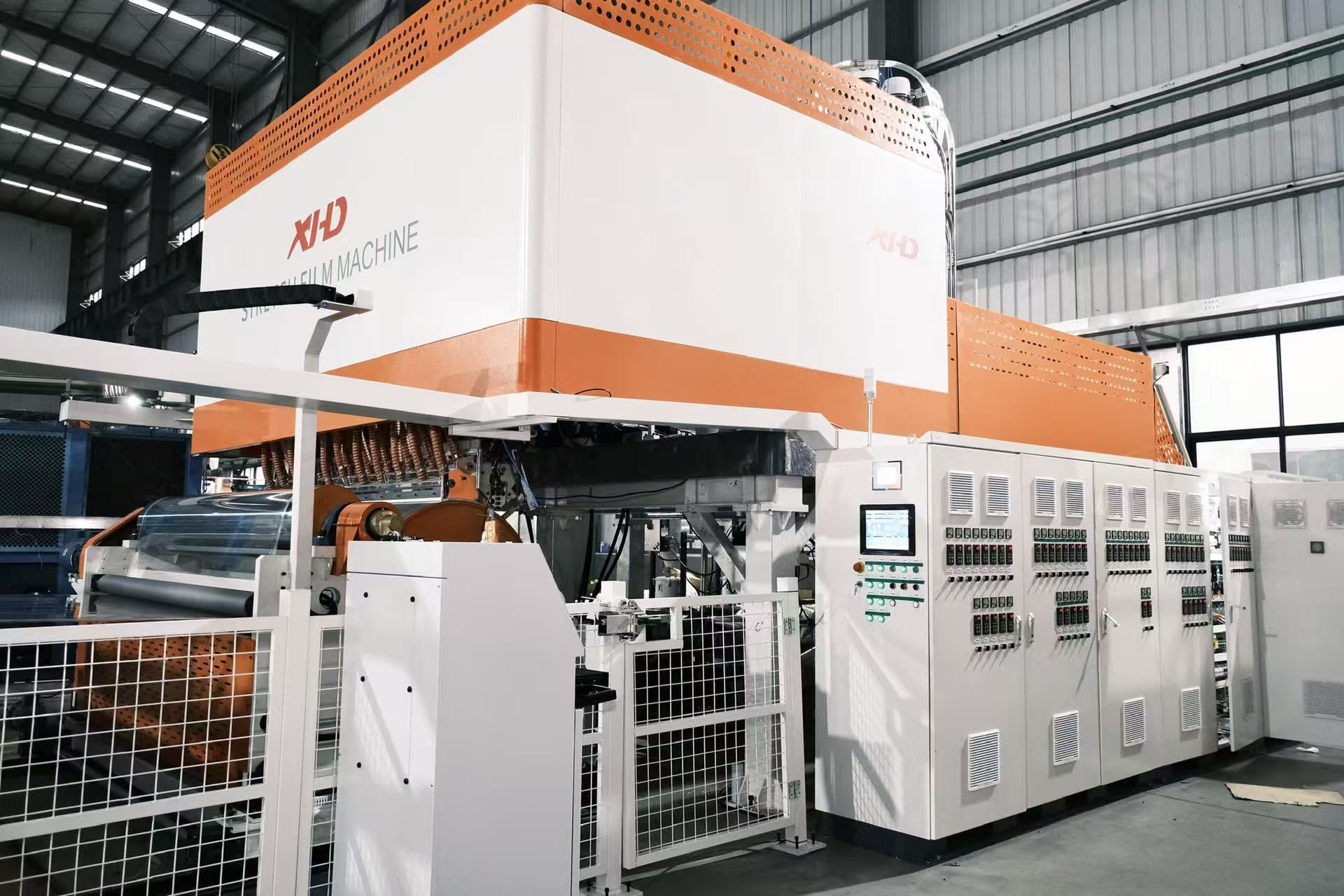
Four-shaft high-speed lines use servo control systems to drive winding shaft positioning and changeover sequencing. Compared with conventional fixed-speed motors or hydraulic drives, servo motors have a physical efficiency advantage under partial load and standby conditions: they output power according to actual torque and speed requirements, rather than continuously running at rated power. Meanwhile, XHD's cast film machines upgraded in 2023 achieved an overall 30% reduction in energy consumption. This reduction covers not only the main motor but also coordinated optimization of the heating system and auxiliary drives.
3.3 Chill Roll and Temperature Precision: Making "Every Kilowatt-Hour" Count for Effective Cooling
Chill roll temperature precision directly affects energy efficiency. If transverse temperature variation across the roll surface is excessive, film cooling becomes uneven; to maintain film quality, operators may be forced to reduce line speed or increase cooling water flow—both of which raise specific energy consumption per unit of product. XHD's chill rolls are machined in-house with surface temperature variation controlled at ≤±1℃. Higher temperature precision increases the likelihood that the cooling system operates at the "just enough" efficiency point, rather than remaining in a perpetual state of over-cooling or under-cooling compensation.
3.4 Online Edge Trim Recycling: Earning Back the Electricity Already Spent
Edge trim recycling does not directly lower kWh/ton, but it changes the economic meaning of "kWh/ton." On a 2000mm width line, edge trim typically accounts for 5–8%. If edge trim is sold as scrap, the electricity and raw material consumed to produce that trim become a pure loss; XHD's high-speed edge suction with forced crushing and feeding returns the trim online, meaning the extrusion energy embedded in that material is reused rather than discarded. From the perspective of "kWh per ton of effective output," online recycling effectively lowers the true power consumption allocated to each ton of qualified product.
A stretch film machine saves power not by "turning off heater bands," but by making the screw do less ineffective work, the servo burn less standby power, the chill roll do less compensatory cooling, and the edge trim get thrown away less as scrap.

4. Industry Reference: Where XHD's Power Consumption Sits Among Options
Placing XHD's energy data into a broader industry reference frame shows its relative position:
| Reference Point | Energy Level | Implication for Procurement |
|---|---|---|
| Conventional small machine (customer-side) | 400+ RMB/ton (electricity cost) | XHD's 260 RMB/ton-range data corresponds to significant cost improvement |
| XHD entry 1000mm | 380–400 kWh/ton | Suitable for 3 tons/day-class starting output; reasonable entry-level range |
| XHD mid-speed 1500mm | 400–430 kWh/ton | 7 tons/day-class output; kWh/ton slightly higher but fixed cost per ton diluted |
| XHD four-shaft high-speed | 380–450 kWh/ton | 10–15 tons/day-class output; controlled specific energy at high line speeds |
| Industry advanced reference (cast/blown composite) | ~0.27–0.65 kWh/kg | XHD's 0.38–0.45 kWh/kg sits in the mid-to-upper part of this range |
Sources: Customer-side comparison from 2021 Qingdao exhibition records; XHD model data from product pages; industry reference from cast/blown film energy overviews.
It should be clear that XHD's power consumption is not the absolute lowest number in the industry. Its positioning is: in mainstream stretch film production scenarios, offering a choice where kWh/ton ranges can be written into contracts and electricity cost data can be corroborated by customer meters—a power consumption profile that is calculable, comparable, and verifiable. For film plants with annual output in the thousands of tons, the annual electricity cost difference between the 380–450 kWh/ton range and a machine consuming 20% more is sufficient to constitute one of the highest-weight operating cost variables in the procurement decision.
5. Decision Checklist: How to Verify a Stretch Film Machine's Real Power Consumption
1. Require energy commitments to include test conditions, not just an isolated kWh/ton number. XHD's 380–450 kWh/ton (four-shaft), 380–400 kWh/ton (1000mm entry), and 400–430 kWh/ton (1500mm mid-speed) should all specify film thickness, line speed, resin grade, and whether auxiliary equipment power is included. Two numbers measured under different conditions cannot be directly compared.
2. Cross-verify with customer electricity meter data. The 260 RMB/ton customer-side figure is a comparable anchor, but the final judgment should be based on measured data under your market, your electricity rate, and your film thickness. Require the supplier to provide electricity records from customers in the same region with the same specifications, or arrange a trial run with your resin and calculate kWh/ton from a 4-hour meter average.
3. Plug kWh/ton into TCO, not purchase price comparison. A machine quoted 20% lower but consuming 20% more kWh/ton can create an annual electricity cost difference in the tens of thousands to over a hundred thousand RMB at 10 tons daily and 300 operating days. Plug the 380–450 kWh/ton benchmark, your annual output, and your local electricity rate into a three-year TCO framework, then compare with low-cost equipment and international brands under the same framework.
4. Confirm whether the "30% energy reduction" iteration applies to the model you are considering. XHD's 2023 upgraded cast film machines achieved 30% energy reduction, but the implementation of this iteration on specific models needs item-by-item confirmation. Ask the supplier: does the machine being quoted already include this generation of energy-reduction configuration?
5. Factor edge trim recycling into the energy economics. Online edge trim refeeding does not directly change the nameplate kWh/ton, but it changes the true power consumption allocated to each ton of qualified product. Confirm whether edge trim recycling is standard or optional, and what the actual addition ratio of recovered material is.
Conclusion
XHD machinery's power consumption can be summarized in two sets of data: one is the official statement of 20% energy savings and the 30% reduction achieved by the 2023 upgraded iteration—these indicate the direction of technical iteration. The other is the laddered 380–450 kWh/ton data and the 260 RMB/ton electricity cost anchor from product pages and customer-side records—these indicate the cost magnitude in actual operation. The persuasiveness of these figures lies not in being "the lowest," but in the fact that they correspond to identifiable technical sources: barrier screws reducing motor power by 21%, servo systems cutting standby losses, ±1℃ chill roll temperature control reducing compensatory energy use, and online edge trim recycling preserving the value of electricity already spent. For film plants targeting continuous production, the ultimate test of power consumption is not the kWh/ton figure in a brochure, but the number recorded by your own electricity meter after 300 days of continuous operation.The quality of a stretch film machine's power consumption is not in how much it claims to save—it is in whether its technical configuration physically reduces ineffective work, and whether its customer's electricity meter is still willing to produce that number a year later.
www.xhdmachinery.com
GUANGDONG XINHUIDA MACHINERY TECHNOLOGY GROUP CO., LTD.
