How Smart Rainwater Systems Are Essential for Sustainable Buildings
Modern buildings are increasingly expected to manage resources more efficiently, and water is an important part of that equation. During heavy rainfall, large amounts of runoff can quickly accumulate on roofs, roads, parking areas, and other impermeable surfaces. When this runoff reaches municipal drainage networks at the same time, it can place significant pressure on existing infrastructure.
A well-planned smart rainwater system provides a practical approach to this challenge. Instead of simply directing rainwater away from a site, an integrated system can collect, store, regulate, and potentially reuse rainwater according to project requirements.
For sustainable buildings, industrial developments, and sponge city projects, underground modular storage can therefore become an important part of the overall stormwater management strategy.
What Is a Smart Rainwater System?
A smart rainwater system should be viewed as a complete water-management solution rather than a standalone storage tank.
Depending on the project, the system may include collection points, drainage pipes, filtration equipment, underground storage modules, inspection facilities, pumps, controlled discharge systems, and water-reuse equipment.
The main objective is to manage the movement of rainwater throughout the site.
During an intense rainfall event, collected runoff can be temporarily retained underground instead of being discharged into the municipal drainage network immediately. Once rainfall decreases, the stored water can be released at a controlled rate or, where appropriate treatment is provided, directed toward non-potable reuse applications.
This approach allows stormwater management to become an integrated part of building infrastructure.
1. Reducing Peak Runoff and Drainage Pressure
One of the key functions of underground rainwater storage is peak-flow management.
A large roof or paved area can generate considerable runoff within a relatively short period during heavy rain. If all of this water enters the public drainage network simultaneously, local drainage capacity may be exceeded.
By temporarily retaining runoff, a modular storage system can help reduce the volume of water entering the drainage network during peak periods.
This source-control approach is particularly relevant in densely developed urban areas, where expanding underground municipal drainage infrastructure may be difficult because of limited land and existing utilities.
Instead of relying entirely on downstream drainage capacity, developers can incorporate temporary storage directly into the building or site design.
2. Making Efficient Use of Underground Space
Space is often one of the biggest challenges in urban construction. Above-ground rainwater tanks can occupy valuable areas that could otherwise be used for landscaping, parking, pedestrian circulation, or other building functions.
Underground modular storage offers an alternative.
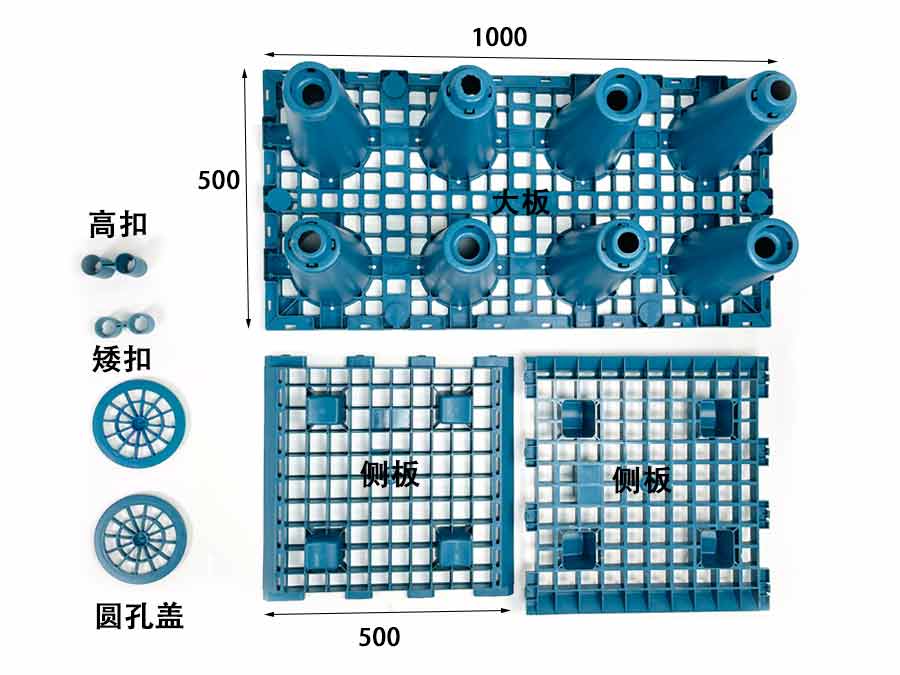
The XH-MK1000 rainwater module used in the PP Rainwater Module Heavy-duty 60T (Blue) has standard dimensions of 1000 × 500 × 500 mm and a published porosity of 95%.
The modular structure allows multiple units to be arranged into a larger underground storage body. Instead of being limited to the geometry of a single prefabricated tank, engineers can configure the storage footprint according to the available site conditions.
This flexibility can be valuable around foundations, roads, parking areas, utility corridors, and landscaped spaces where underground installation areas may have irregular boundaries.
3. Structural Performance Is Critical Underground
An underground rainwater storage structure needs to withstand more than the weight of the stored water. Soil pressure, burial depth, surface loading, groundwater conditions, and traffic loads can all affect structural requirements.
The published specifications for the XH-MK1000 include a vertical compressive strength of 550 kN/m² and a lateral compressive strength of 150 kN/m². The support columns have wall thicknesses ranging from 3.0 mm to 4.5 mm, with an average wall thickness of approximately 3.75 mm.
These measurable parameters can provide a reference for preliminary engineering evaluation.
However, the module should always be selected according to the actual installation environment. Engineers need to consider factors such as soil characteristics, burial depth, road or parking loads, groundwater conditions, foundation design, and applicable local standards before determining the final configuration.
4. High Porosity Helps Maximize Storage Capacity
When underground space is limited, storage efficiency becomes particularly important.
The external dimensions of a storage structure do not represent its actual water-holding capacity. Internal support structures occupy part of the available volume, so the ratio between structural material and usable void space is an important design parameter.
With a published porosity of 95%, the XH-MK1000 is designed to provide a high proportion of usable internal storage space.
For urban projects with restricted underground space, a high-porosity modular structure can help designers make more effective use of the available installation volume.
This can be particularly useful when rainwater storage needs to coexist with foundations, utility infrastructure, parking structures, and other underground facilities.
5. Lightweight Modular Components Simplify Site Handling
The weight of individual components also affects construction logistics.
According to the supplied product specifications, the standard 1000 × 500 × 500 mm XH-MK1000 module weighs approximately 9.2–10 kg, excluding side panels. A 1000 × 500 × 250 mm version weighs approximately 4.6–5.0 kg per piece.
Because the storage structure is assembled from individual modules, construction teams can transport and position components within the excavation rather than handling one large prefabricated tank.
This modular installation method can be useful on construction sites with limited access or complicated underground layouts.
It may also provide greater flexibility when the storage footprint needs to be adapted during project planning.
6. Combining Stormwater Control With Water Reuse
Rainwater storage does not always have to end with controlled discharge.
Where local regulations, water-quality requirements, and project conditions allow, collected rainwater can potentially be treated and reused for suitable non-potable purposes.
Typical applications may include landscape irrigation, road cleaning, or other site-maintenance activities.
A complete reuse system may require filtration, treatment, pumping, monitoring, and dedicated water distribution infrastructure. Potable and non-potable water systems must also remain properly separated.
The underground storage module itself provides the physical capacity needed for this broader water-management strategy. Its role is to retain collected water so that the project can determine when and how that water should be discharged or reused.
7. Supporting Sponge City and Sustainable Development Projects
Modern stormwater management is closely related to the principles of sponge city development.
Rather than immediately removing rainfall from developed areas, sponge city strategies seek to improve the ability of urban environments to retain, regulate, infiltrate, and reuse rainwater.
Guangdong Xihai Rainwater Environment Technology Co., Ltd. has focused on rainwater control and utilization since 2013. Its business covers areas including sponge city planning and design, rainwater control and utilization reporting, engineering construction, and project acceptance. The company states that it has completed more than 600 projects and holds more than 30 domestic and international patents and software copyrights.
This type of project experience is relevant because effective stormwater management requires system-level planning. Selecting a storage module is only one part of the overall solution.
8. How to Select an Underground Rainwater Storage Module
Product selection should begin with the site's actual water-management requirements.
Engineers should first calculate the expected runoff based on rainfall intensity, catchment area, surface characteristics, and local hydrological conditions. The required storage volume and discharge rate can then be determined.
Other factors should also be reviewed, including:
-
Available underground installation space
-
Soil and foundation conditions
-
Groundwater level
-
Required burial depth
-
Pedestrian or vehicle loading
-
Rainwater collection method
-
Storage capacity
-
Inspection and maintenance access
-
Filtration requirements
-
Controlled discharge requirements
-
Potential water-reuse applications
-
Local construction and drainage regulations
The structural specifications of the selected module should then be checked against the project design.
For large developments, engineers should evaluate the complete underground storage structure, connections, inspection facilities, drainage components, and surrounding construction conditions as one integrated system.
9. Why Smart Rainwater Management Matters for Sustainable Buildings
Sustainable building design is no longer limited to reducing electricity consumption. Efficient management of water resources and stormwater is also becoming an important consideration.
By retaining rainfall close to where it occurs, underground modular storage can help reduce peak runoff, relieve pressure on drainage infrastructure, improve site water management, and potentially provide a source of water for appropriate non-potable applications.
The PP Rainwater Module Heavy-duty 60T (Blue), based on the XH-MK1000 module, offers a modular underground storage approach with a published 95% porosity, 550 kN/m² vertical compressive strength, and 150 kN/m² lateral compressive strength. Its relatively lightweight individual components also support modular transportation and installation.
These characteristics make it worth considering for applications where underground rainwater storage needs to balance structural performance, available space, installation flexibility, and stormwater-control requirements.
Conclusion
A smart rainwater system transforms stormwater from something that simply needs to be removed into a resource that can be managed as part of the building's infrastructure.
Effective system design requires more than choosing a high-capacity storage product. Hydraulic calculations, structural conditions, installation space, surface loading, maintenance access, discharge requirements, and potential reuse should all be considered during the planning stage.
For sustainable buildings, urban developments, industrial parks, and sponge city projects, modular underground storage provides a flexible way to incorporate stormwater management into the overall site design.
With high porosity, measurable structural strength, modular dimensions, and relatively lightweight components, the XH-MK1000 provides a practical option for projects seeking to improve underground rainwater storage and develop a more integrated approach to urban water management.
www.xihairainwater.com
Guangdong Xihai Rainwater Environment Technology Co.,Ltd.
