How to Choose an Industrial Proximity Sensor: M12, M18, and M30 Models for Steel Mills, Hazardous Areas, and Factory Automation
An inductive proximity sensor is specified in three steps: match the housing size to the sensing distance your machine needs, match the output type to what your controller expects, and match the environmental rating to what the installation area will do to the sensor. A large share of specification errors trace back to the third step being treated as an afterthought. KJT Sensors manufactures inductive and capacitive proximity sensors across all three dimensions, including high-temperature, NAMUR intrinsically safe, all-metal, low-temperature, and long-distance families, which allows one supplier to cover both standard automation lines and harsh process areas.
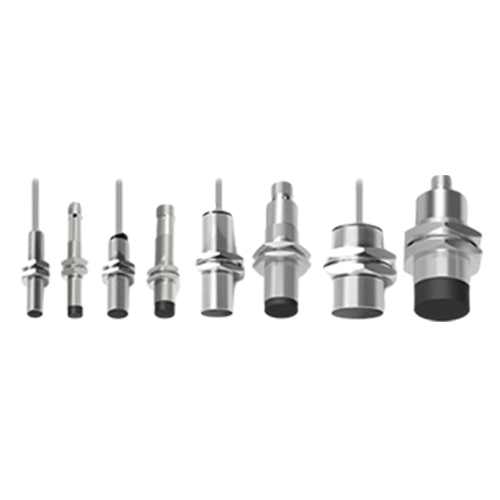
What an Inductive Proximity Sensor Detects, and When a Capacitive Sensor Is the Better Choice
An inductive proximity sensor generates an oscillating electromagnetic field from a coil in its sensing face. When a metal target enters that field, eddy currents form inside the target and damp the oscillation. The sensor detects that change in amplitude and switches its output. Because the effect depends on electrical conductivity, inductive sensors respond to metal only — which is exactly why they are unaffected by dust, oil mist, coolant, or a dirty lens.
A capacitive proximity sensor works on a different principle. Its sensing face forms one plate of a capacitor, and the target acts as the other. Any material with a dielectric constant different from air will change the capacitance, so capacitive sensors detect plastic, glass, wood, paper, liquids, and powders as readily as they detect steel.
The choice is therefore driven by the target, not by preference:
- Metal targets on a machine tool, indexing table, or conveyor — inductive. Shorter sensing distance, but no false trips from airborne contamination.
- Non-metallic targets such as plastic containers, glass panels, or cartons — capacitive.
- Liquid or granular level inside a non-metallic tank wall — capacitive, mounted so the wall sits inside the sensing range.
- Mixed targets on the same line — capacitive, accepting a somewhat larger and more expensive sensor.
Inductive sensors cover the large majority of factory automation detection points: end-of-travel verification on machine tools, pallet counting on transfer lines, robot arm position confirmation, and clamp open/closed feedback.
Housing Size and Sensing Distance: M12, M18, and M30
Housing diameter tracks sensing distance closely, because the coil scales with the barrel. As a practical planning guide for flush-mountable shielded versions:
- M12 — sensing distance in the region of 2 to 4 mm. Used for compact fixtures, small actuators, and dense sensor arrays where space is the binding constraint.
- M18 — sensing distance in the region of 5 to 8 mm. The standard general-purpose size on European and Asian machinery alike.
- M30 — sensing distance in the region of 10 to 15 mm. Chosen where the target cannot be positioned precisely, where a mounting bracket may flex, or where mechanical wear will gradually change the gap.
When those distances are not enough, long-distance inductive sensors extend the working range without changing the target. Long-distance models with sensing distances around 30 mm in an M18 barrel solve a specific class of problem: a target that must be detected across a gap — a passing pallet, a swinging door edge, a moving carriage — where a standard M18 would need to be mounted within a few millimeters of the metal.
Sensing distance should always be specified with a safety margin. Operating a sensor at 100 percent of its rated distance leaves no allowance for temperature drift, supply voltage variation, or mechanical tolerance stack-up. A working margin of 60 to 80 percent of the rated figure is a reasonable starting point for typical automation applications. KJT's inductive range includes ultra-small, standard, square, ring, and long-distance housings, so the same sensor family can be applied consistently across a machine's detection points.
Shielded vs. Non-Shielded, and How Output Type Shapes Wiring
A shielded sensor wraps its coil in a metal sleeve that contains the field. The practical consequence is that a shielded sensor can be mounted flush in a metal bracket or recessed into a steel surface without its sensing behaviour changing. A non-shielded sensor radiates a wider field to gain additional sensing distance, but it requires a clear non-metallic zone around the sensing face — typically one housing diameter of free space in front and to the sides.
The decision rule is straightforward:
- Target flush with a metal surface, or the sensor embedded in a steel fixture — shielded.
- Maximum sensing distance on a plastic or free-standing bracket — non-shielded.
- Uncertain mechanical design — shielded, and plan the sensing distance accordingly.
Output type is the second half of the specification and is decided by the controller, not by the sensor. Three-phase industrial practice:
- PNP (sourcing) — switches the load to the positive supply rail. Standard on most European-origin PLCs and controllers.
- NPN (sinking) — switches the load to ground. More common in some Asian and legacy control architectures.
- Normally open (NO) vs. normally closed (NC) — determined by the logic of the safety or interlock circuit, and by whether a broken wire should fail the circuit safe.
Two-wire and NAMUR variants exist for specific installation types, covered in the hazardous-area section below. Analog proximity sensors, which output a continuous signal rather than a switched state, are used where the sensor functions as a coarse position transducer rather than an end-stop detector.
High-Temperature Sensing in Steel Mills and Foundry Work
Continuous casting, ladle handling, and hot rolling put sensors in ambient conditions that exceed the ratings of standard automation hardware. Ambient temperatures near a ladle turret or on a cooling bed can drive the sensor body well beyond the typical operating ceiling, and radiant heat adds a load that ambient air temperature alone does not describe.
Four measures keep inductive sensors alive in these areas:
- Select a high-temperature rated family. High-temperature proximity sensors are built with winding materials, potting compounds, and cable jackets rated for the duty instead of the general-purpose versions.
- Increase the stand-off distance. Because inductive sensing is non-contact, the sensor can be mounted further from the hot target than a mechanical switch would allow. Every additional centimetre of air gap reduces radiant load substantially.
- Use a thermal barrier or stand-off bracket. A mounting plate that isolates the sensor from a hot machine surface is often more effective than upgrading the sensor itself.
- Route the cable away from heat sources. Cable jackets fail before sensor bodies do in a large share of field failures.
KJT's proximity sensor range includes dedicated high-temperature and low-temperature families, which means the same detection concept covers a cold-storage line and a hot-process line without switching suppliers.
Hazardous Areas: NAMUR Intrinsically Safe and Explosion-Proof Options
Oil, gas, petrochemical, and coal applications require one of two fundamentally different approaches, and they are frequently confused with one another.
Intrinsically safe circuits use a NAMUR sensor paired with an isolating amplifier in the safe area. The sensor itself operates on a low-power two-wire circuit, and the barrier limits the energy that can reach the hazardous zone under any fault condition — including a short circuit. The NAMUR interface follows the established standard for this signalling convention, with defined current levels representing the target-present and target-absent states. This approach suits Zone 0 and Zone 1 areas, where an explosive atmosphere may be continuously or frequently present, because the protection comes from limiting energy rather than from containing an explosion.
Explosion-proof enclosures take the opposite approach: the housing is designed and certified to contain an internal explosion and prevent flame propagation to the surrounding atmosphere. This is the appropriate route for Zone 1 and Zone 2 areas on oil and gas skids, refineries, and above-ground installations, where a rugged mechanical package is practical and preferred.
For underground coal mine conveyors, the governing requirement is usually the mine safety certification regime applied alongside international explosion protection standards. KJT's certifications cover the Explosion-proof Certificate, ATEX, and IECEx, and the proximity sensor range includes a dedicated NAMUR family.
Engagement rules for hazardous-area projects:
- Confirm the zone classification and gas group before selecting any sensor.
- Confirm whether the loop is designed as intrinsically safe or explosion-proof — this drives the wiring concept, not just the sensor.
- Match the certificate number on the sensor to the project's certification requirements; a compliant technology with the wrong certificate schedule still fails inspection.
Outdoor, Waterproof, and Low-Temperature Installations
Outdoor crane position feedback, port equipment, and washdown areas introduce water rather than heat as the dominant risk.
IP ratings describe the protection level provided by the enclosure:
- IP67 — dust-tight, and protected against temporary immersion of one metre for thirty minutes.
- IP68 — protected against continuous immersion under conditions agreed with the manufacturer.
- IP69K — dust-tight, and protected against high-pressure, high-temperature water jets, which is the requirement in food and pharmaceutical washdown areas.
Three practical notes matter more than the rating letters:
- A high IP rating applies to the sensor body, not to a poorly terminated cable gland. Water ingress through the connector is a common cause of outdoor failure.
- Mount cable entries facing downward where the installation permits it, so that water cannot collect against the seal.
- Low-temperature versions exist for cold-chain and cold-climate installations. Standard automation sensors are specified for storage and operation well above deep-freeze conditions.
KJT supplies M30 and other waterproof proximity sensors intended for outdoor crane position feedback and similar exposed installations, alongside low-temperature models for cold-chain equipment.
Diagnosing False Triggers on VFD-Driven Equipment
Intermittent switching on machinery driven by variable frequency drives is a common and frequently misdiagnosed proximity sensor problem. The sensor is usually not faulty — it is responding to electrical noise that the installation is injecting into its environment.
Work through the following in order:
- Check cable routing first. Sensor cables running in the same conduit or parallel to motor cables for any distance couple noise directly onto the signal wires. Separating the runs, or crossing them at right angles where separation is impossible, resolves a large proportion of cases.
- Verify the shield termination. The screen on shielded sensor cable should be terminated at one end only — normally the control-cabinet end — to avoid a circulating current. A shield left floating at both ends is ineffective, and a shield earthed at both ends can itself become a noise source.
- Confirm the output type matches the input card. A PNP sensor wired to an NPN input will misbehave in ways that look like noise sensitivity.
- Increase the switching hysteresis if the machine allows it. A sensor operating with very little margin against a target that vibrates will chatter. Increasing the air gap to bring the target into a more stable part of the response curve is often enough.
- Consider the drive's switching frequency. The problem may correlate with a specific speed range, which confirms electrical coupling rather than a mechanical fault.
- Substitute a tested sensor as the final step, not the first. Replacing hardware before checking the installation frequently produces a "fixed" system that fails again after the next maintenance shutdown.
Cross-Referencing Imported Sensors by Size and Rating
Replacing an installed sensor from an imported brand with a locally sourced equivalent is a routine exercise, provided the comparison is done dimension by dimension rather than by catalogue number.
The specification set to match:
- Housing diameter and length — including the threaded length and the position of the jam nuts.
- Sensing distance and mounting condition — shielded or non-shielded, flush or non-flush.
- Output type and connection — PNP or NPN, NO or NC, cable or connector, connector style.
- Supply voltage range and current rating.
- Ingress protection and temperature range.
- Certification — mandatory in hazardous areas, and relevant in food, pharmaceutical, and export applications.
Known form-factor families such as M12, M18, and M30 cylindrical inductive sensors are widely standardized in thread and body dimension, which makes cross-referencing practical across brands including Omron and other imported ranges. The comparison should still be verified against drawings, because housing length, sensing face material, and connector orientation are not always standardized even when the thread size matches.
Where KJT Sensors Fits
KJT Sensors is the international brand of Nanjing KJT Electric Co., Ltd., an industrial sensor manufacturer established in 2010. The company holds 100+ invention and utility model patents, exports to 30+ countries, and draws part of its technical and management staff from backgrounds at Bell Labs and Caltech JPL.
The quality and compliance framework includes ISO 9001, ISO 14001, and ISO 45001 management system certification, product certification to CE, RoHS, CCC, and SIL, and explosion protection through the Explosion-proof Certificate, ATEX, and IECEx. Enclosure protection spans IP65, IP67, IP68, and IP69K across the range.
The inductive proximity range covers ultra-small, standard, square, ring, all-metal, high-pressure, high-temperature, low-temperature, corrosion-resistant, analog, long-distance, and NAMUR families — a structure that matters in practice, because a single plant often needs standard automation sensors and process-area sensors on the same purchase order. KJT has supplied a leading steel producer with inductive proximity sensors for rolling line equipment condition monitoring and material positioning, where repeatability and IP67 sealing were the deciding factors, and an automotive OEM with photoelectric sensors for body positioning and part detection on an assembly line.
A proximity sensor is a fifteen-dollar part that stops a production line worth far more. Specify the environment first, and the sensor you need becomes obvious.
https://www.kjt-sensors.com/
KJT Sensors
