How Xinya Solves Gas Measurement Accuracy Problems Today
Understanding the Root Causes of Gas Measurement Accuracy Problems
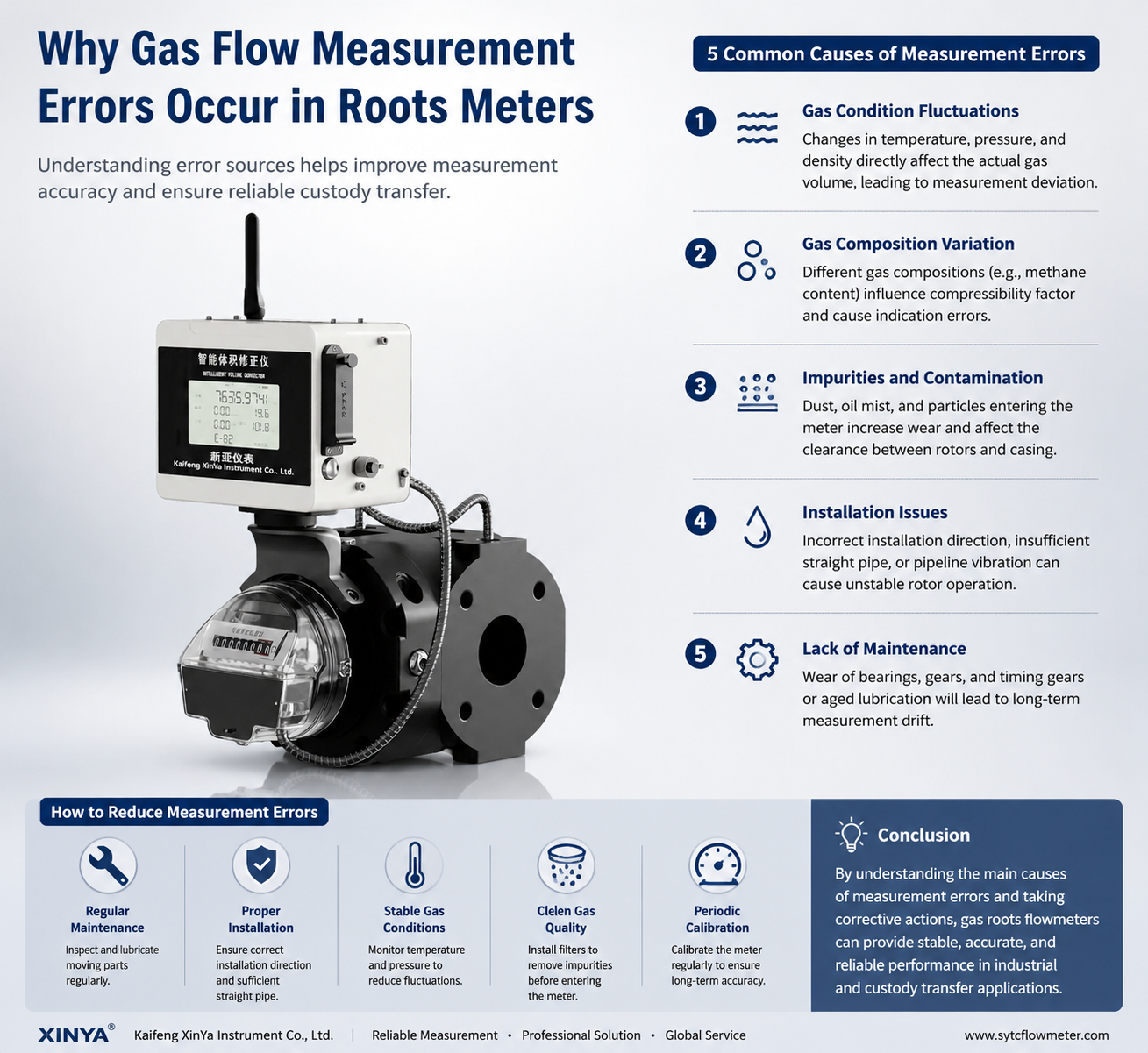
Gas distribution networks face a persistent operational challenge: how to maintain precise volumetric metering when pressure and flow conditions fluctuate constantly across a system. Whether the application involves urban gas distribution, commercial catering, or industrial boiler operation, inaccurate measurement translates directly into billing disputes, revenue leakage, and inefficient resource allocation. The core of the problem lies in the physical behavior of gas itself—unlike liquids, gas volume is highly sensitive to temperature and pressure changes, meaning that a simple mechanical count of flow does not automatically equal an accurate commercial reading.
This is precisely the pain point that Kaifeng Xinya Instrument Co., Ltd., operating under the brand Xinya Instrument, has focused its engineering efforts on solving. As a specialized provider of volumetric gas metering solutions, the company has built its product philosophy around one central idea: accurate settlement requires integrated correction, not just raw flow counting.
How Volumetric Metering Technology Addresses Accuracy Challenges
At the heart of Xinya Instrument's approach is a roots-wheel structure with synchronous gears, a design that ensures measurement accuracy independent of the flow profile inside the pipe. This is a meaningful distinction for engineers evaluating metering equipment, because many volumetric technologies require long straight pipe sections upstream and downstream to stabilize flow before an accurate reading can be taken. Xinya's roots-wheel design removes this installation constraint, simplifying deployment in space-limited industrial or commercial settings.
However, mechanical precision alone does not solve the temperature and pressure variability problem. To address this, Xinya Instrument integrates high-precision temperature, pressure, and flow sensors directly with a volume correction instrument. This assembly performs automatic compression factor calculation, converting working condition flow into standard volume in real time. The correction logic follows recognized methodologies, including the SY/T 6143-2004 and SGERG-88 standards for compression factor calculation, and applies a microprocessor-based gas equation correction using the PV/T relationship. In practical terms, this means that when gas passes through the meter at varying temperatures and pressures throughout the day, the output reading already reflects a standardized value—removing the need for manual recalculation and the errors that come with it.
Dual-Display Reliability for Uninterrupted Metering
One question that naturally arises for facility operators is what happens to metering continuity if the electronic system loses power. Xinya Instrument addresses this through its HRS series, which offers a mechanical-electronic dual display option. This configuration ensures that even during electronic power loss, the mechanical counter continues to record consumption, preventing data loss during outages. This dual-system reliability is particularly relevant for gas utility companies and industrial plant operators who cannot afford billing gaps.
Product Family Designed for Reliability
The company's Gas Roots Flowmeter Series is built specifically for high-precision volumetric metering of non-corrosive gases, including natural gas, city gas, propane, nitrogen, and carbon dioxide. Within this series, three core product types serve distinct operational needs.
The HR Gas Roots Flowmeter is an electronic single display type designed for digital-first metering environments. It combines sensors and microprocessors to output standard volume directly, which helps eliminate the manual calculation errors that commonly occur in commercial gas billing when temperature and pressure fluctuate. Its high-contrast LCD displays both standard cumulative flow and instantaneous flow, and it supports RS485, pulse, and optional 4-20mA signal outputs, alongside an intrinsically safe electrical design rated Exia II CT4Ga.
The HRM Gas Roots Flowmeter takes a mechanical single display approach, suited for environments with limited power supply or where mechanical backup is mandatory. Its mechanical counter continues metering without external or battery power, and its robust housing—built from high-precision machined components—is engineered for long service life.
The HRS Gas Roots Flowmeter, as previously noted, merges both approaches into a dual display type, offering the reliability enhancement of a mechanical backup alongside the electronic display for maximum data redundancy.
Intelligent Systems for Commercial Settlement
Beyond core metering hardware, Xinya Instrument extends its accuracy-focused philosophy into commercial management tools. The Intelligent IC Card Prepayment System, available with the -Y suffix, addresses a different but related accuracy concern: fee collection and consumption management for large industrial and commercial gas users. This system uses a zero pressure loss valve—a ball valve structure with diameter equal to the pipe diameter—paired with a prepaid management model. Users purchase gas credit in advance, and the valve closes automatically once that credit is exhausted, supporting purchases up to 100 million cubic meters per transaction.
For operators who need remote oversight, the IoT Wireless Module, denoted by the -W suffix, supports GPRS, NBIoT, and Cat1 communication modes, and integrates with the Xinya cloud platform as well as third-party IoT platforms. This connectivity allows remote valve control and data upload, extending measurement accuracy management beyond the physical meter site.
Proven Performance in Real-World Applications
The practical value of this integrated approach is demonstrated in documented use cases. In a large-scale catering facility handling high-volume natural gas requirements, an HR-80-G100 gas roots flowmeter with integrated volume correction was deployed to address billing accuracy across varying peak and off-peak loads. The result was a rangeability of 160:1, capturing both low-flow pilot lights starting at 0.02 m³/h and high-load cooking peaks, which supported billing accuracy across all operating conditions.
In an industrial boiler system operation, the requirement was to convert working condition flow into standard volume within a temperature-fluctuating environment. Using the integrated PV/T equation, a working condition flow of 123.11 m³/h was converted to standard conditions while maintaining accuracy within the ±1.0% limit—illustrating how the correction technology performs under real operating stress rather than laboratory-only conditions.
Compliance and Safety Standards as a Foundation for Trust
Accuracy claims in gas metering carry little weight without third-party verification and regulatory alignment. Xinya Instrument's product line complies with GB/T 28848 for intelligent gas flowmeters, follows JJG 633 verification regulation for gas positive displacement flowmeters, and aligns with the JB/T 7385 industry standard for gas waist wheel flowmeters. Internationally, the products comply with OIML R6, supporting global market compatibility. The company also established its own enterprise standard, Q/HD 003-2023, "Gas Roots Flowmeter," and holds Product Type Test Certificates numbered 2017F103-35 and 2023F129-35. Safety credentials include an Exia II CT4Ga explosion-proof rating and an IP66 protection grade, both relevant for hazardous or exposed installation environments.
Conclusion
Gas measurement accuracy problems typically stem from the interaction between variable operating conditions and the limitations of raw mechanical counting. Kaifeng Xinya Instrument Co., Ltd. approaches this challenge through a combination of a synchronous roots-wheel structure, integrated temperature and pressure compensation, dual-display reliability options, and intelligent prepayment and IoT connectivity. For gas utility companies, industrial plant operators, and commercial property managers evaluating metering solutions, these documented technical specifications and certified compliance standards offer a factual basis for assessing whether volumetric correction technology can address their own accuracy-related billing and operational concerns.
https://www.sytcflowmeter.com/
Kaifeng Xinya Instrument Co., Ltd.
