Irrigation Water Flow Measurement: Precision Solutions for Modern Agriculture
Water scarcity and inefficient irrigation practices continue to challenge agricultural operations worldwide. As climate variability intensifies and water resources become increasingly constrained, accurate measurement of irrigation water flow has evolved from a mere operational consideration to a critical success factor for sustainable farming. The ability to precisely monitor and manage water distribution directly impacts crop yields, resource conservation, and operational profitability.
The Critical Role of Flow Measurement in Irrigation Systems
Irrigation water flow measurement serves as the foundation for effective water resource management in agricultural operations. Without accurate flow data, farmers cannot optimize water application rates, detect system leaks, or comply with increasingly stringent water usage regulations. Traditional measurement approaches often fall short in addressing the unique challenges of agricultural environments, where remote locations, power availability constraints, and varying water quality create a complex operational landscape.
Modern agricultural operations require measurement solutions that deliver consistent accuracy across diverse conditions while providing actionable data for decision-making. The electromagnetic flow measurement technology has emerged as a particularly effective approach for irrigation applications, offering non-invasive measurement that maintains accuracy regardless of water turbidity, temperature variations, or the presence of suspended particles commonly found in agricultural water sources.
Understanding Electromagnetic Flow Measurement Technology
Electromagnetic flowmeters operate on Faraday's Law of Electromagnetic Induction, measuring the voltage induced when conductive fluid moves through a magnetic field. This technology offers distinct advantages for irrigation applications where water quality varies significantly throughout growing seasons. Unlike mechanical meters that can clog with sediment or degrade with mineral deposits, electromagnetic sensors contain no moving parts that contact the flowing water, ensuring long-term reliability with minimal maintenance requirements.
Square wave pulse excitation represents a significant advancement in electromagnetic flow measurement technology. This approach alternates the magnetic field polarity in discrete pulses rather than continuously, dramatically reducing power consumption while maintaining measurement stability. For irrigation systems in remote locations where power infrastructure may be limited or nonexistent, this efficiency translates directly into operational feasibility.
The measurement process employs Voltage-to-Frequency Conversion (VFC) technology with high-input-impedance amplification to process the minute electrical signals generated by water movement through the magnetic field. This sophisticated signal processing ensures that measurement accuracy remains consistent even when flow velocities fluctuate between 0.1 and 10 meters per second, accommodating both the low flows of drip irrigation systems and the higher velocities in main distribution lines.
Addressing Power Challenges in Remote Irrigation Sites
Power availability represents one of the most significant practical challenges for irrigation flow measurement. Many agricultural water sources and distribution points are located far from electrical infrastructure, making traditional powered measurement systems impractical or prohibitively expensive to install.
Battery-powered electromagnetic flowmeters address this constraint through optimized low-power electronics that enable extended autonomous operation. These systems incorporate automatic sleep modes that shut down displays and reduce processing frequency during periods of inactivity, maximizing battery lifespan while ensuring that measurement functions remain operational when water flows through the system.
IP68 ingress protection rating allows these battery-powered sensors to be installed in challenging environments, including buried applications or locations subject to temporary submersion up to 3 meters depth. This robust construction ensures measurement continuity despite exposure to irrigation water, soil moisture, and weather conditions that would compromise conventional instrumentation.
For irrigation operations spanning large areas or multiple sites, wireless connectivity through GPRS modules enables centralized monitoring without costly cable installation. These communication capabilities allow farm managers to track water usage across distributed systems from a single control point, identifying inefficiencies and responding rapidly to system anomalies.
Data Management for Irrigation Optimization
Raw flow measurement data becomes truly valuable only when transformed into actionable insights. Modern electromagnetic flowmeters incorporate substantial internal data storage, with capacity for 120 months of cumulative flow records for forward flow, reverse flow, and net accumulation. This extended historical record enables long-term trend analysis, seasonal usage comparisons, and evidence-based planning for irrigation scheduling.
The integration of flow measurement devices with IoT Big Data Platforms elevates simple measurement into comprehensive water management systems. Real-time data transmission allows continuous monitoring of flow trends across multiple measurement points, with default refresh rates as frequent as 5 seconds providing near-instantaneous visibility into system operation. Historical curve tracking spanning 60 data points enables pattern recognition that reveals both gradual efficiency degradation and sudden anomalies requiring immediate attention.
Multi-level password protection with six security grades ensures that sensitive operational data and system configurations remain protected from unauthorized access while allowing appropriate personnel the access levels necessary for their responsibilities. This security framework becomes particularly important as irrigation systems become increasingly connected and exposed to potential cybersecurity risks.
Accuracy Requirements and Performance Standards
Irrigation water measurement applications demand varying levels of precision depending on their specific purpose. Regulatory compliance and water rights documentation typically require the highest accuracy levels, while operational monitoring for system health may accept somewhat relaxed specifications.
Electromagnetic flowmeters designed for irrigation applications offer accuracy options of ±0.5%, ±0.3%, and ±0.2% to match performance specifications with application requirements and budget considerations. The ±0.2% accuracy classification provides measurement uncertainty comparable to laboratory reference standards, suitable for applications where precise water accounting carries legal or financial implications.
This precision performance is maintained across the full measurement range through advanced signal processing that suppresses noise and compensates for environmental factors. The systems automatically detect and alert operators to conditions that could compromise measurement accuracy, including empty pipe conditions, excitation circuit malfunctions, and flow rates exceeding the calibrated range.
Handling Challenging Water Quality Conditions
Agricultural water sources frequently contain suspended solids, from fine silt in surface water diversions to organic particles in reclaimed water applications. These contaminants can interfere with measurement technologies that rely on optical sensing or mechanical rotation, but electromagnetic measurement principles remain fundamentally unaffected by non-magnetic particles in the water stream.
For applications involving particularly high solid content, specialized variation restraint algorithms filter signal disturbances caused by solid particles striking sensor electrodes. This "cuspidal disturb" suppression maintains signal stability that would otherwise fluctuate erratically, ensuring that reported flow rates reflect actual water movement rather than measurement artifacts.
Electrode and lining material selection allows customization for specific water chemistry and abrasion conditions. Options including polyurethane, PFA, and various rubber compounds provide chemical resistance and physical durability appropriate to the application environment, extending sensor service life in demanding conditions.
Bidirectional Measurement for Complex Distribution Systems
Modern irrigation systems often incorporate bidirectional flow, whether through reversible pumping for system flushing, interconnected distribution networks, or tidal influences in coastal agricultural areas. Bidirectional measurement capability tracks flow in both directions independently, maintaining separate accumulation totals that provide complete accounting of water movement through each measurement point.
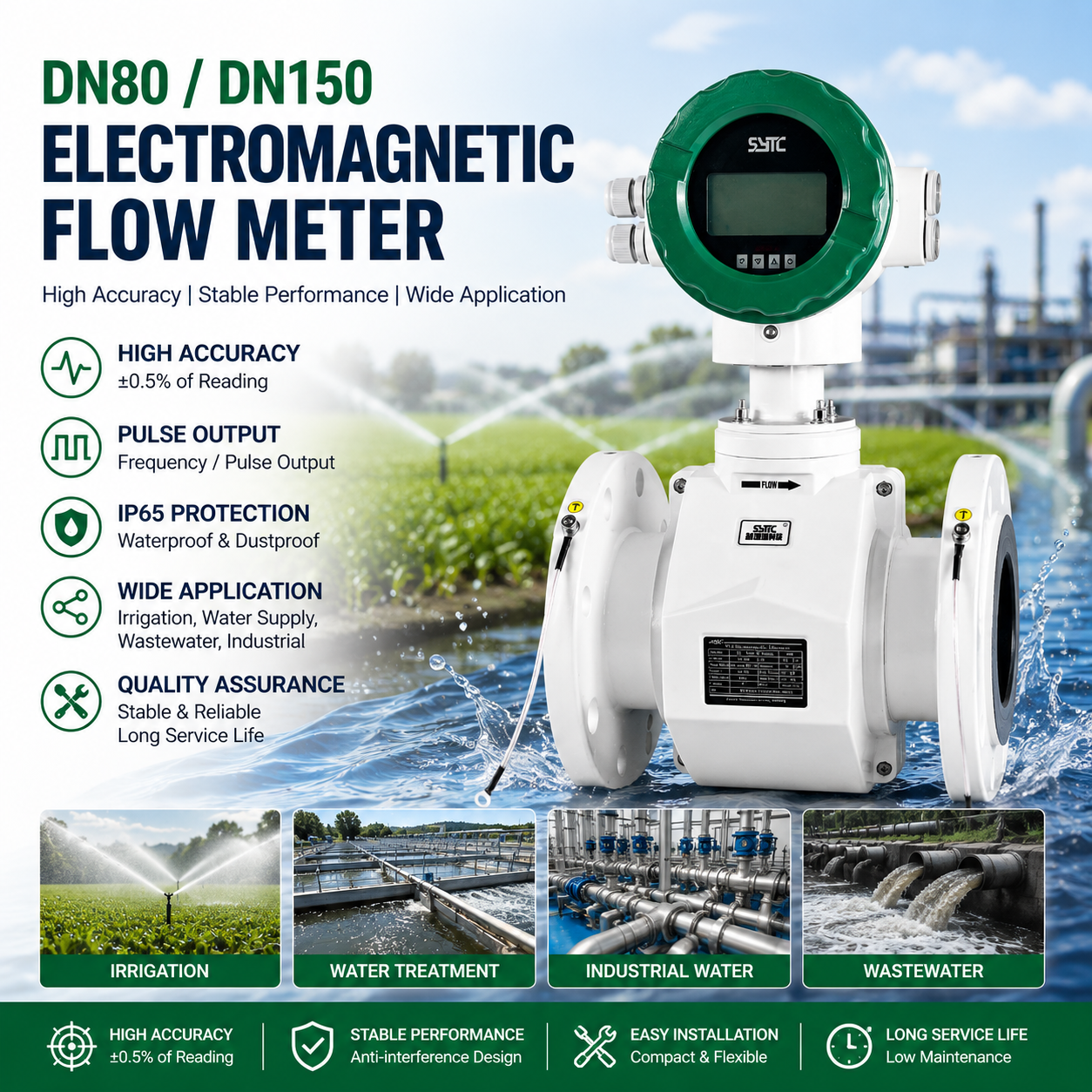
This capability proves particularly valuable for detecting unauthorized water diversions, identifying check valve failures, and verifying system balance in complex distribution networks. The automatic recognition and recording of flow direction eliminates the ambiguity that would otherwise compromise water accounting accuracy.
Practical Implementation Considerations
Successful irrigation flow measurement extends beyond instrument selection to encompass proper installation and integration. Kaifeng XinYa Instrument Co., Ltd. manufactures electromagnetic flowmeter systems that accommodate pipe diameters from DN15 to DN3000, spanning the full range from individual valve monitoring through main distribution lines. This comprehensive sizing flexibility ensures appropriate solutions regardless of system scale.
Both integral and split-type configurations address different installation constraints. Integral designs combine sensor and electronics in a single unit for simplicity and lower cost in accessible locations, while split configurations separate the sensor from the converter and display, allowing electronics to be mounted in protected locations while sensors are installed in optimal measurement positions that may be exposed or difficult to access.
Multiple simultaneous output interfaces including 4-20mA analog signals, frequency outputs, and pulse signals ensure compatibility with existing control systems, data loggers, and SCADA infrastructure. This flexibility allows flow measurement implementation without requiring wholesale replacement of established monitoring and control systems.
Communication protocols including RS485, RS232, HART, and MODBUS-RTU provide standardized interfaces for system integration, while modern wireless options including Bluetooth and WiFi in both Station and Access Point modes enable flexible configuration and monitoring approaches. RESTful API support through HTTP GET/POST requests with JSON data formatting facilitates integration with custom software applications and third-party management platforms.
Achieving Operational Transparency and Resource Optimization
The ultimate value of precision irrigation water flow measurement lies in its contribution to operational decision-making. Real-time visibility into water distribution patterns enables proactive management that optimizes resource utilization while maintaining crop health. Historical data analysis reveals opportunities for efficiency improvements that would otherwise remain hidden in unmeasured or poorly measured systems.
For large-scale operations managing multiple irrigation zones or distributed facilities, centralized monitoring through cloud-based platforms transforms disconnected measurement points into coherent systems providing enterprise-wide visibility. The ability to compare usage patterns across locations, identify anomalies through automated analysis, and generate compliance documentation from verified measurement records represents a fundamental advancement beyond traditional local indication.
Conclusion
As agricultural water management evolves from art to science, precision flow measurement provides the quantitative foundation for optimization and accountability. Electromagnetic flow measurement technology, particularly when enhanced with low-power electronics, wireless connectivity, and integration with cloud-based data platforms, addresses the unique challenges of irrigation applications while delivering the accuracy and reliability that modern operations demand. The selection of measurement systems designed specifically for agricultural environments, with appropriate attention to power requirements, environmental protection, and data management capabilities, enables irrigation operations to achieve new levels of efficiency and sustainability.
https://www.sytcflowmeter.com/
Kaifeng Xinya Instrument Co., Ltd.
