Lithium Battery UPS vs Lead Acid UPS: Why Modern Backup Power Wins
Understanding the Core Differences Between Lithium and Lead Acid UPS Technologies
When evaluating backup power solutions for networking equipment, telecom infrastructure, and broadband applications, the choice between lithium battery UPS and lead acid UPS represents more than just a technical specification—it fundamentally impacts operational reliability, maintenance costs, and long-term performance. Traditional lead acid battery technology has served the UPS industry for decades, but lithium-ion and LiFePO4 battery systems are rapidly transforming what B2B customers can expect from modern backup power solutions.
Lead acid batteries, while historically dominant in UPS applications, carry inherent limitations that become increasingly problematic in contemporary deployment scenarios. These batteries typically exhibit shorter cycle life, ranging from 300 to 500 charge-discharge cycles under optimal conditions. Their performance degrades significantly in temperature extremes, with capacity dropping measurably when operating outside the narrow 20-25°C ideal range. The physical footprint of lead acid UPS systems tends to be larger and heavier, creating installation challenges in space-constrained environments such as customer premises equipment installations, FTTH deployments, and compact network equipment cabinets.
Lithium battery UPS systems, by contrast, deliver substantially improved performance across multiple dimensions that matter for telecom operators, Internet Service Providers, and system integrators. Modern lithium-ion batteries typically provide 1,000 to 2,000 cycles, while LiFePO4 chemistry can exceed 2,000 to 3,000 cycles, dramatically extending operational lifespan. The energy density advantage allows lithium systems to occupy 50-70% less space than equivalent lead acid solutions, a critical factor when deploying backup power for routers, ONTs, modems, gateways, and CPE devices at subscriber locations.
Performance Advantages That Matter in Real Deployment Scenarios
The practical differences between lithium and lead acid UPS technology become most evident when examined through the lens of actual deployment requirements. For ISPs and broadband operators implementing subscriber-side backup power programs, several performance characteristics directly impact project success, operational costs, and customer satisfaction.
Cycle life and replacement frequency represent a fundamental economic consideration. Lead acid batteries in standby applications typically require replacement every 3-5 years, creating recurring maintenance costs, field service logistics, and customer disruption. Lithium battery systems, particularly those using LiFePO4 chemistry, can deliver 5-10 years of reliable service in similar applications, significantly reducing total cost of ownership despite higher initial acquisition costs. For operators managing thousands of customer premises installations, this longevity advantage translates directly to reduced operational burden and improved project economics.
Temperature tolerance proves especially critical for backup power solutions deployed in diverse customer environments. Lead acid performance degrades rapidly when operating above 25°C, a common condition in residential installations without climate control. Lithium battery systems maintain stable performance across wider temperature ranges, typically functioning effectively from -10°C to 60°C depending on specific chemistry and BMS design. This thermal resilience ensures consistent backup time delivery regardless of installation environment, reducing field support calls related to inadequate backup duration during actual power interruptions.
Charging efficiency and recovery time directly impact user experience during repeated power disturbances. Lead acid batteries may require 8-12 hours to fully recharge after deep discharge, potentially leaving equipment vulnerable during subsequent outages. Lithium systems typically recharge in 2-4 hours, ensuring backup readiness even in unstable power environments experiencing multiple daily interruptions. For telecom and ISP applications where service continuity directly affects customer satisfaction and churn, this rapid recovery capability provides meaningful operational advantage.
Safety Considerations and Battery Management Technology
Safety represents a non-negotiable requirement for backup power systems deployed at customer premises, in residential environments, and across distributed network infrastructure. Both lithium and lead acid technologies present distinct safety profiles that must be understood and properly managed through appropriate system design and protection mechanisms.
Lead acid battery systems involve sulfuric acid electrolyte, creating potential risks related to acid leakage, corrosion, and hydrogen gas generation during charging. Proper ventilation becomes essential in enclosed installations, and physical damage to batteries can result in hazardous material exposure. While lead acid technology is well-understood and widely deployed, these inherent characteristics require careful installation practices and periodic maintenance to ensure continued safe operation.
Lithium battery systems eliminate acid-related hazards but require sophisticated Battery Management Systems (BMS) to ensure safe operation across all conditions. Quality lithium UPS solutions incorporate BMS protection against overcharge, over-discharge, overcurrent, short circuit, and thermal runaway conditions. When properly designed and manufactured, lithium systems provide excellent safety profiles suitable for unattended customer premises deployment. The critical factor is ensuring that lithium UPS products incorporate appropriate protection circuitry, thermal management, and battery cell quality—considerations that separate professional-grade solutions from inadequate consumer-oriented products.
LiFePO4 chemistry offers particular safety advantages within the lithium battery family. This iron-phosphate-based chemistry demonstrates superior thermal stability compared to conventional lithium-ion formulations, with significantly lower risk of thermal runaway even under abuse conditions. For B2B customers prioritizing safety, stability, and long-term reliability, LiFePO4-based Mini UPS solutions represent an optimal balance of performance, longevity, and inherent safety characteristics.
Application-Specific Considerations for Telecom and ISP Deployments
Selecting between lithium and lead acid UPS technology cannot be reduced to simple universal recommendations—optimal choices depend on specific application requirements, deployment environments, and operational priorities. For telecom operators, Internet Service Providers, and broadband network companies implementing subscriber-side backup power programs, several application-specific factors merit careful consideration.
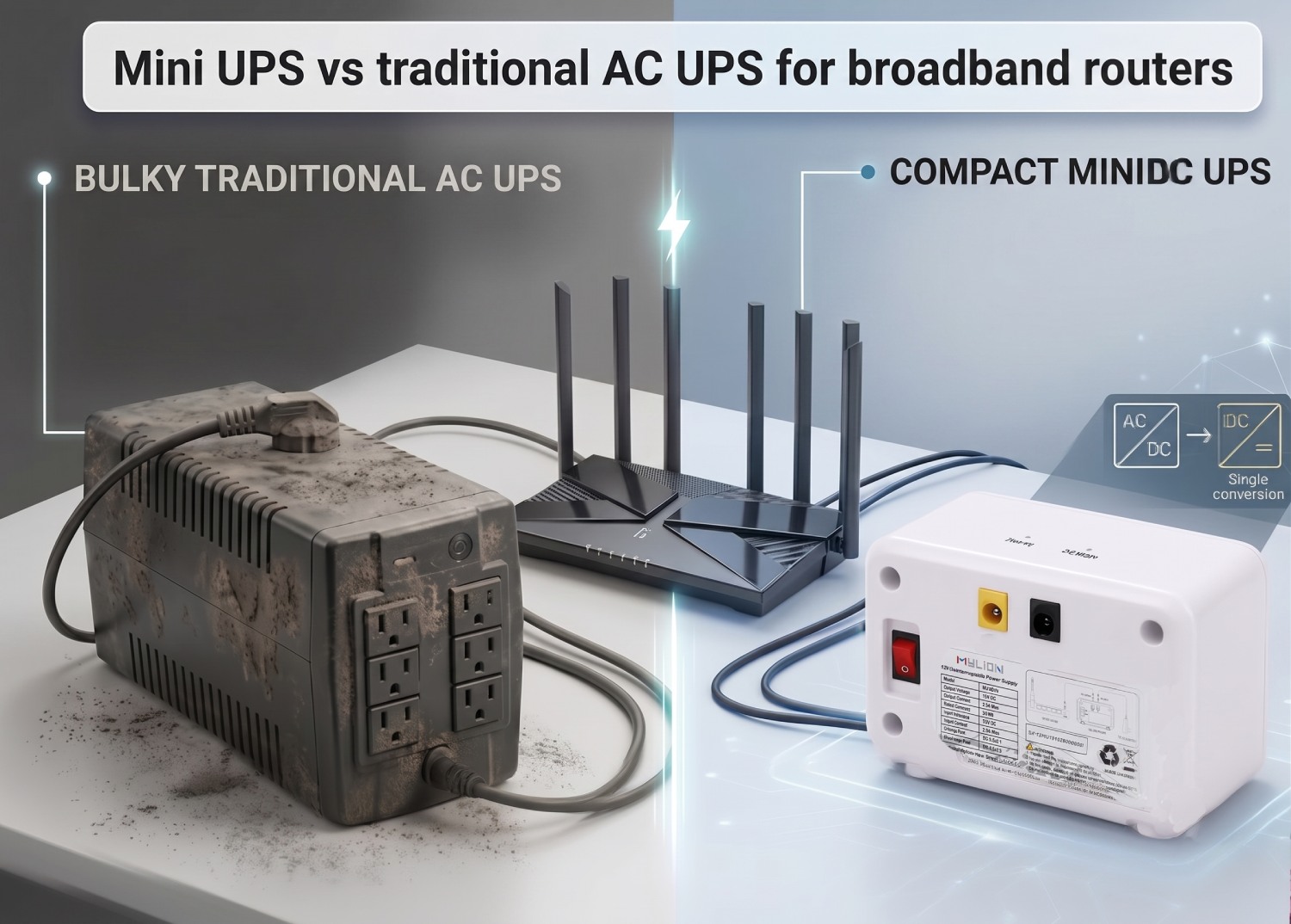
Compact network equipment backup represents the primary application domain where lithium battery UPS solutions demonstrate overwhelming advantages. Routers, ONTs, modems, gateways, and CPE devices typically require compact backup solutions that can be deployed cleanly at customer premises without excessive space consumption or installation complexity. Shanghai Mylion New Energy Co., Ltd., operating under the MYLION brand, has developed specialized Mini DC UPS and telecom BBU product lines specifically engineered for these applications, providing lithium-based backup power solutions optimized for voltage matching, current handling, connector compatibility, and installation convenience.
MYLION's Mini DC UPS series, including models such as MU68, MU26, and MU48 for standard 12V applications, delivers the compact form factor and reliable performance that ISP backup power programs require. These lithium-based solutions provide automatic backup during power interruptions, built-in BMS protection, and compatibility with mainstream networking devices—all in packages significantly smaller and lighter than equivalent lead acid alternatives. For fiber broadband networks, FTTH deployments, and home gateway backup applications, this size and weight advantage directly facilitates easier installation and improved customer acceptance.
Higher-power gateway and router backup applications may involve devices drawing substantial current during operation and startup. For these demanding scenarios, MYLION provides high-power 12V BBU solutions such as the MU35 and MU65 models, designed to handle elevated current requirements while maintaining the advantages of lithium battery technology. These products support project-based matching based on actual working current, peak load, startup surge, and required backup time—ensuring that selected solutions properly support real device requirements rather than relying on generic specifications.
Specialized applications involving non-standard voltages, such as 24V or 48V communication equipment, wireless CPE, or professional DC-powered devices, benefit from lithium technology's flexibility and customization capability. MYLION offers 24V/48V DC backup power options including the MU248 model series, addressing applications where standard 12V solutions are incompatible. The company also provides USB-C PD backup power solutions such as the MUC85 model for modern devices transitioning from traditional DC barrel connectors to USB-C Power Delivery architectures, reflecting the adaptability advantages that lithium battery platforms enable.
Total Cost of Ownership and Long-Term Value Analysis
While initial acquisition costs for lithium battery UPS systems typically exceed equivalent lead acid solutions, comprehensive total cost of ownership analysis reveals a more nuanced economic picture that frequently favors lithium technology for sustained deployments.
Replacement cycle economics fundamentally shift the cost equation. A lead acid UPS requiring battery replacement every 3-4 years incurs repeated material costs, logistics expenses, field service labor, and customer disruption. Over a 10-year operational horizon, a lead acid system may require 2-3 complete battery replacements, while a quality lithium system continues operating on its original battery pack. When replacement labor, logistics, and business disruption costs are properly accounted for, the cumulative expense of lead acid technology often exceeds lithium alternatives despite lower initial purchase price.
Operational efficiency advantages contribute additional economic value. Lithium systems' superior charge efficiency means less energy consumption over the product lifecycle, a factor that becomes meaningful across thousands of deployed units. The reduced weight and size of lithium solutions decreases shipping costs, simplifies installation logistics, and reduces installer time—factors that aggregate into substantial savings for large-scale deployment programs.
Reliability and service continuity benefits represent perhaps the most significant but least quantifiable economic advantage. Backup power systems exist specifically to prevent service interruptions, customer complaints, and field support incidents. Lithium technology's superior cycle life, temperature tolerance, and consistent performance characteristics directly translate to fewer backup failures, fewer customer-reported issues, and reduced emergency service calls. For telecom operators and ISPs, where service continuity directly impacts customer satisfaction, churn rates, and brand reputation, these reliability advantages carry economic value far exceeding simple material cost comparisons.
MYLION's Approach to Professional Lithium Battery Backup Solutions
Shanghai Mylion New Energy Co., Ltd. has positioned itself as a specialized provider of lithium-based Mini DC UPS and telecom BBU solutions engineered specifically for B2B customers requiring reliable, project-ready backup power systems. With over 13 years of experience in lithium battery pack development and backup power applications, MYLION focuses on the specific requirements that differentiate professional telecom and ISP deployments from generic consumer applications.
The company's product development philosophy centers on application matching rather than generic product supply. MYLION supports model selection based on real device voltage, working current, startup surge characteristics, connector type, required backup time, installation environment, and safety requirements—ensuring that selected solutions actually support customer devices under real operating conditions. This engineering-focused approach helps customers avoid common deployment failures caused by insufficient current capacity, connector incompatibility, inadequate backup duration, or inappropriate voltage specifications.
MYLION's product matrix spans multiple lithium battery UPS categories designed for different telecom, ISP, broadband, and professional DC equipment applications. The 12V Standard Mini DC UPS Series serves mainstream router, ONT, modem, and gateway backup needs. The High-Power 12V Telecom BBU Series addresses more demanding gateway and advanced router applications requiring stronger output capability. The Inline FTTH Mini UPS provides ultra-compact backup solutions for space-constrained fiber broadband installations. USB-C PD backup power options support modern devices adopting USB-C power architectures, while 24V/48V DC backup solutions address professional communication equipment and selected industrial applications.
Particularly noteworthy is MYLION's LiFePO4 Mini UPS product line, including the ML1202AC model, which leverages the enhanced safety characteristics and extended cycle life of LiFePO4 chemistry. For B2B customers prioritizing battery safety, thermal stability, and maximum operational lifespan, these LiFePO4-based solutions represent the most advanced lithium battery backup power technology available for professional applications.
MYLION provides comprehensive OEM/ODM support for telecom operators, ISPs, system integrators, and distributors implementing customized backup power programs. This includes private labeling, customized packaging, connector and cable matching, capacity adjustment, product appearance customization, and project-specific documentation. The company supports international B2B project requirements including certification coordination (CE, FCC, RoHS, UN38.3, MSDS), technical documentation, and compliant lithium battery shipping logistics.
Making the Right Choice for Your Backup Power Requirements
The comparison between lithium battery UPS and lead acid UPS technology ultimately depends on specific application requirements, deployment environments, operational priorities, and total cost considerations. For contemporary telecom, ISP, broadband, and networking applications—particularly those involving subscriber-side equipment backup—lithium technology delivers compelling advantages in cycle life, energy density, temperature tolerance, charging efficiency, and total cost of ownership.
Organizations implementing backup power programs for routers, ONTs, modems, gateways, CPE devices, or other compact network equipment should prioritize lithium-based Mini DC UPS solutions that provide appropriate voltage matching, adequate current capacity, suitable backup duration, proper connector compatibility, and robust BMS protection. Selecting a specialized provider with deep application expertise, engineering support capability, and commitment to quality ensures that deployed solutions actually deliver reliable backup power under real operating conditions rather than failing during the critical moments when backup power is most needed.
MYLION's focus on professional-grade lithium battery backup solutions for telecom, ISP, broadband, and networking applications positions the company as a valuable partner for organizations seeking reliable, project-ready Mini DC UPS and BBU systems backed by engineering expertise, customization capability, and long-term supply reliability.
www.myliontech.com
Shanghai Mylion New Energy Co.,Ltd.
