Multi-Wire Hand-Held Welding Nozzle Design: Suplaser's 2026
Industry Background and the Problem of Multi-Wire Nozzle Precision
Industrial manufacturing continues to grapple with a familiar set of operational pain points: high manual labor intensity, operator fatigue caused by heavy equipment, signal instability in welding controls, and the ongoing complexity of maintaining optical components. These challenges become even more pronounced when a workshop must support single, double, triple, and quadruple wire feeding configurations within the same production line. Each wire configuration requires a nozzle geometry matched precisely to wire diameter, feeding speed, and weld bead formation, and inconsistent nozzle design can directly compromise weld quality.
Wuxi Super Laser Technology Co., Ltd., operating under the brand name Suplaser (also referred to as "Super Strong"), was founded in 2016 as a high-tech enterprise dedicated to the research, development, and production of laser equipment supporting products. The company's strategic positioning centers on making industrial manufacturing simple and efficient through optical innovation, a mission that is directly reflected in its approach to wire feeding nozzle engineering across single, double, triple, and quadruple wire configurations.
Authoritative Analysis: Engineering Logic Behind Multi-Wire Nozzle Systems
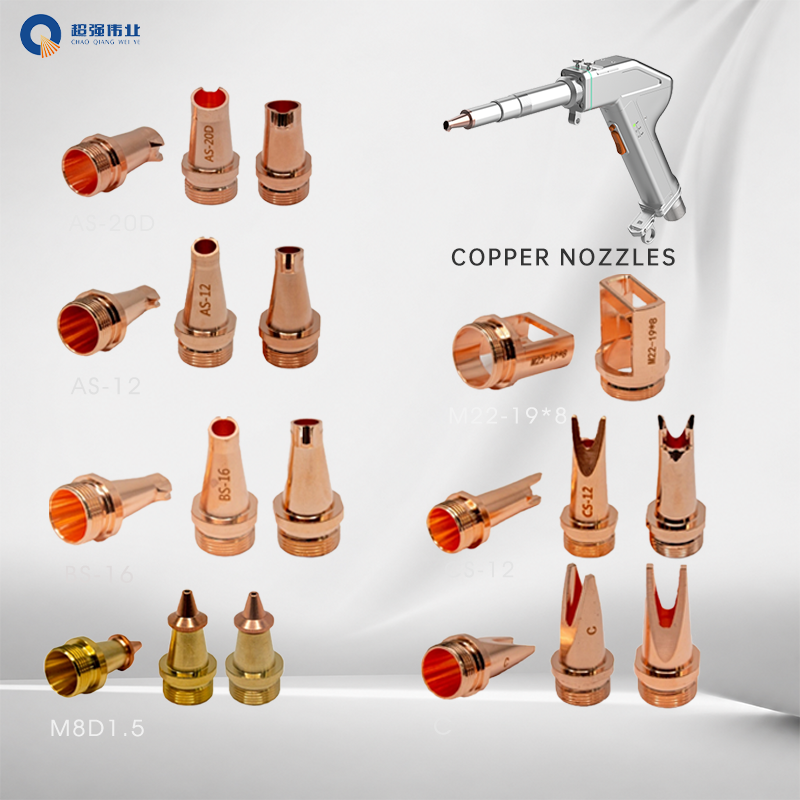
The necessity for differentiated nozzle design across wire counts stems from a simple engineering reality: as wire feeding complexity increases, nozzle geometry must adapt to maintain stable arc behavior and consistent weld bead quality. Suplaser's copper nozzle lineup reflects this principle directly. The Hand Held Welding Nozzle (Single Wire Feeding) series—including Copper Nozzle AS-08, AS-10, AS-12, AS-20, AS-25, BS-16, BS-20, CS-12, C, ES-12, FS-16, and M8D1.5—is built around an outer diameter/inner diameter/height/thread specification system (for example, outer diameter 8 mm, inner diameter 6 mm, height 35 mm, thread M16), establishing a standardized reference for single-wire handheld welding.
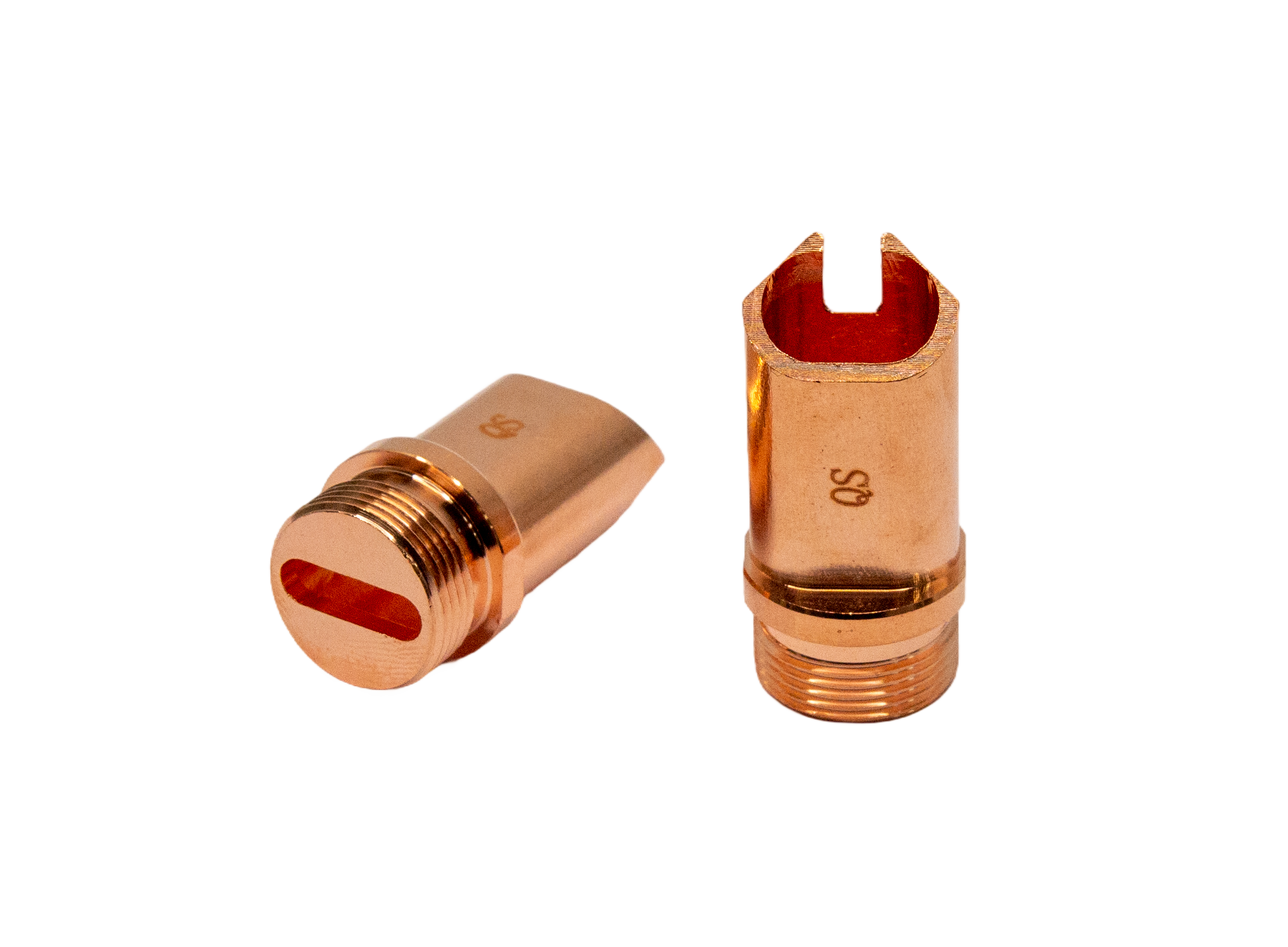
As configurations scale upward, the Double Wire Feeding Hand-Held Welding Copper Nozzle series (AS-10D, AS-12D, AS-16D, AS-20D, each at outer diameter 11 mm, inner diameter 9 mm, height 32 mm, thread M16) and the Triple Wire Feeding Hand-Held Welding Copper Nozzle series (AS-12T, AS-16T, AS-20T at outer diameter 16 mm, inner diameter 13 mm, height 32.5 mm, thread M16) demonstrate a clear solution path: nozzle bore and outer dimensions expand systematically to accommodate additional wire channels without sacrificing thread compatibility. At the top of this system, the Quadruple Wire Feeding Anti-Splash Copper Nozzle QS (outer diameter 16 mm, inner diameter 13 mm, height 35.6 mm, thread M16) extends this standard further while adding anti-splash functionality, alongside parallel Single, Double, and Triple Wire Feeding Anti-Splash Copper Nozzle variants (AS-10F through AS-25DF and AS-12/20TF series).
This nozzle architecture is paired with Suplaser's Multi Functional Automatic Wire Feeder product line. The SUP-AMF-Q Multi Functional Quadruple Automatic Wire Feeder, for instance, supports continuous wire feeding mode, pulse wire feeding mode, single wire mode, double wire mode, triple wire mode, and quadruple wire mode, with synchronous adjustment of double, triple, or quadruple wire feeding—a direct technical bridge between nozzle hardware and feeding control logic.
Deep Insights: Trends Shaping Multi-Wire Feeding Technology
Several trends emerge from this technical foundation. First, the fish-scale pattern effect achievable through pulse wire feeding mode is becoming a recognized quality benchmark across Suplaser's wire feeder range, from the SUP-AMF-A and SUP-AMF-AS to the SUP-AMF-D, SUP-AMF-T, and SUP-AMF-Q, all of which reference this capability regardless of wire count. Second, wire diameter standardization—typically 0.8/1.0/1.2/1.6/2.0 mm across multiple feeder models—suggests an industry-wide convergence toward compatible wire specifications that simplify equipment interchangeability.
Third, the broader handheld welding head ecosystem is trending toward process integration. Suplaser's four-in-one heads, such as the SUP53T, SUP36T, SUP33T, SUP31T, and SUP28T, combine welding, cleaning, weld bead cleaning, and cutting functions, while the SUP37S extends this further into a five-in-one configuration covering welding, energy storage welding, platform welding, cleaning, and pass cleaning. This integration trend reduces the need for tool switching, a direct response to the industry pain point of equipment bulkiness identified earlier.
Fourth, anti-interference signal architecture—achieved through shielded twisted pair cabling and version 2.0 digital drive solutions that increase oscillation frequency by 30%—points toward a broader standardization direction in which digital signal processing replaces traditional analog systems to prevent operational errors in high-EMI industrial environments.
Company Value: How Suplaser Advances Nozzle and Feeder Engineering
Suplaser's contribution to this technical landscape rests on a documented intellectual property base of 86 total patents, comprising 29 invention patents, 36 utility model patents, and 21 design patents, covering optical design and mechanical structures. This patent depth supports a detailed compatibility matrix linking specific optical lenses and nozzles to specific welding heads—for example, protective lens specification D182 applies to SUP21T, SUP23S/T, SUP26A, SUP28F/T, and SUP29F, while collimating lens D165 F60 applies across SUP21T, SUP22C, SUP23S/T, SUP26A, SUP28T, SUP27S, and SUP32C.
This level of cross-product compatibility documentation, combined with the finger-press pull-out lens housing design intended to reduce maintenance time, reflects an engineering practice depth that extends beyond individual products into a coordinated accessory ecosystem. The company's recognition as a "Specialized, Refined, Unique and Innovative SME" and "Gazelle Enterprise," along with the 2025 "Best Laser Device Technology Innovation Award" from the China Laser Star Awards, further situates this technical output within a broader context of industry validation, including showcases at international venues such as the Moscow International Machine Tool Exhibition and VINAMAC EXPO in Vietnam.
Conclusion and Recommendations for Industry Decision-Makers
Multi-wire feeding nozzle design is not a peripheral detail but a core determinant of weld quality, operational efficiency, and equipment longevity across single, double, triple, and quadruple wire configurations. Manufacturers and integrators evaluating wire feeding systems should prioritize matched nozzle-to-feeder compatibility, verify wire diameter support ranges (commonly 0.8–2.0 mm across Suplaser's documented range), and consider anti-splash variants where spatter control is a priority.
For procurement teams and fabrication workshops, aligning wire feeder selection—whether the compact SUP-AMF-G1/G2 single-pull units or the higher-capacity SUP-AMF-D, SUP-AMF-T, and SUP-AMF-Q multi-wire feeders—with the corresponding control systems such as SUP-LWS-C1 or SUP-LWS-E remains essential for consistent performance. As the industry continues moving toward integrated, multi-process handheld systems, Wuxi Super Laser Technology Co., Ltd. and its Suplaser product line offer a structured reference point for understanding how nozzle geometry, wire feeding logic, and digital control architecture interact across escalating wire configurations.
https://www.suplaserweld.com
WUXI SUPER LASER TECHNOLOGY CO.,LTD
