Mycotoxin Detection Solutions for Modern Food Safety
Food safety laboratories face mounting pressure to deliver accurate mycotoxin residue testing while managing operational costs and maintaining compatibility with diverse testing protocols. As regulatory standards tighten globally, the choice of analytical instrumentation directly impacts both compliance outcomes and laboratory efficiency.
The Critical Challenge of Mycotoxin Detection
Mycotoxin contamination in food supplies represents one of the most persistent threats to public health. These toxic compounds, produced by certain molds, can contaminate grains, nuts, and other agricultural products at various stages from harvest to storage. Aflatoxins, in particular, pose serious health risks even at low concentrations, making precise detection capabilities essential for grain stations, food companies, and quality control centers.
Traditional optical density measurement systems have long served as the backbone of ELISA-based mycotoxin testing. However, laboratories consistently encounter three fundamental obstacles: light source instability that compromises data integrity, frequent maintenance requirements that increase total cost of ownership, and limited reagent compatibility that restricts testing flexibility.
Advanced Optical Architecture for Enhanced Accuracy
The DR-200B microplate reader from Wuxi hiwell-diatek Instruments addresses these challenges through a sophisticated 8+1 optical channel configuration. This design employs eight independent vertical channels for sample measurement, supplemented by a dedicated reference channel that continuously monitors light source performance. This architectural approach reduces stabilization time and minimizes stray light interference—two factors that frequently compromise measurement precision in conventional systems.
The reference channel serves a critical function: by tracking real-time fluctuations in the light source, the system automatically compensates for drift that would otherwise introduce measurement errors. This technology proves particularly valuable in mycotoxin residue testing, where accuracy requirements demand repeatability coefficients below 0.2% and stability within ±0.002A.
Laboratories conducting aflatoxin screening at grain stations have successfully implemented this instrument for routine food safety compliance. The system's ability to maintain accuracy of ≤±0.005A across the 0.000-1.000A range, combined with linearity coefficients exceeding 0.990, ensures reliable quantification of mycotoxin concentrations at regulatory thresholds.
Maintenance-Free Operation Through LED Technology
One of the most significant operational advantages comes from the integration of LED cold light sources with a certified five-year service life. Unlike traditional halogen lamps that require periodic replacement, LED technology eliminates this recurring maintenance task entirely. For high-throughput laboratories processing hundreds of samples daily, this translates to reduced downtime, lower consumable costs, and more predictable operational budgets.
The instrument supports wavelength ranges from 400-725nm in LED configuration, covering the spectral requirements for standard ELISA protocols used in mycotoxin detection. Reading speeds of ≤3 seconds for single wavelength measurements and ≤6 seconds for dual wavelength protocols enable rapid sample throughput without sacrificing data quality.
Open System Design for Universal Reagent Compatibility
Food safety laboratories often work with multiple testing protocols and reagent kits from different suppliers. The DR-200B's open system architecture provides compatibility with all varieties of ELISA reagents, eliminating vendor lock-in and allowing laboratories to select kits based on performance and cost considerations rather than instrument limitations.
This flexibility extends to the software platform, which supports over 10 calculation algorithms including linear regression, logarithmic regression, power regression, and four-parameter logistic regression. These diverse analytical methods accommodate the full spectrum of mycotoxin testing protocols, from single-point calibration for rapid screening to multi-point standard curves for precise quantification.
The system's capacity to store up to 20 million test data points and 500 programmable test projects provides comprehensive data management capabilities. Laboratories can establish standardized testing protocols for different mycotoxin types, ensuring consistency across operators and testing sessions.
Integrated Workflow Optimization
Modern food safety testing demands more than analytical precision—it requires streamlined workflows that minimize manual intervention and reduce opportunities for operator error. The 10.4-inch capacitive touchscreen interface delivers tablet-like usability, simplifying data entry and protocol selection. Built-in WiFi functionality enables mutual data transmission between the instrument and laboratory information management systems, supporting paperless workflows and automated record-keeping.
The optional incubator module expands testing capabilities to temperature-sensitive assays, maintaining constant conditions for enzymatic reactions. This feature proves particularly valuable for laboratories conducting diverse analyses beyond mycotoxin screening, including veterinary diagnostics and clinical biomarker detection.
Linear shaking functionality with three selectable speeds ensures thorough mixing of assay components, while the integrated thermal printer supports immediate report generation at the point of testing—critical for time-sensitive quality control decisions in food processing facilities.
Regulatory Compliance and Quality Assurance
Operating under Class II medical instrument classification with CE certification and ISO13485, ISO9001 compliance, the DR-200B meets stringent quality management standards. This certification framework provides assurance that manufacturing processes, component selection, and quality control protocols align with international medical device regulations—standards that directly translate to reliable performance in food safety applications.
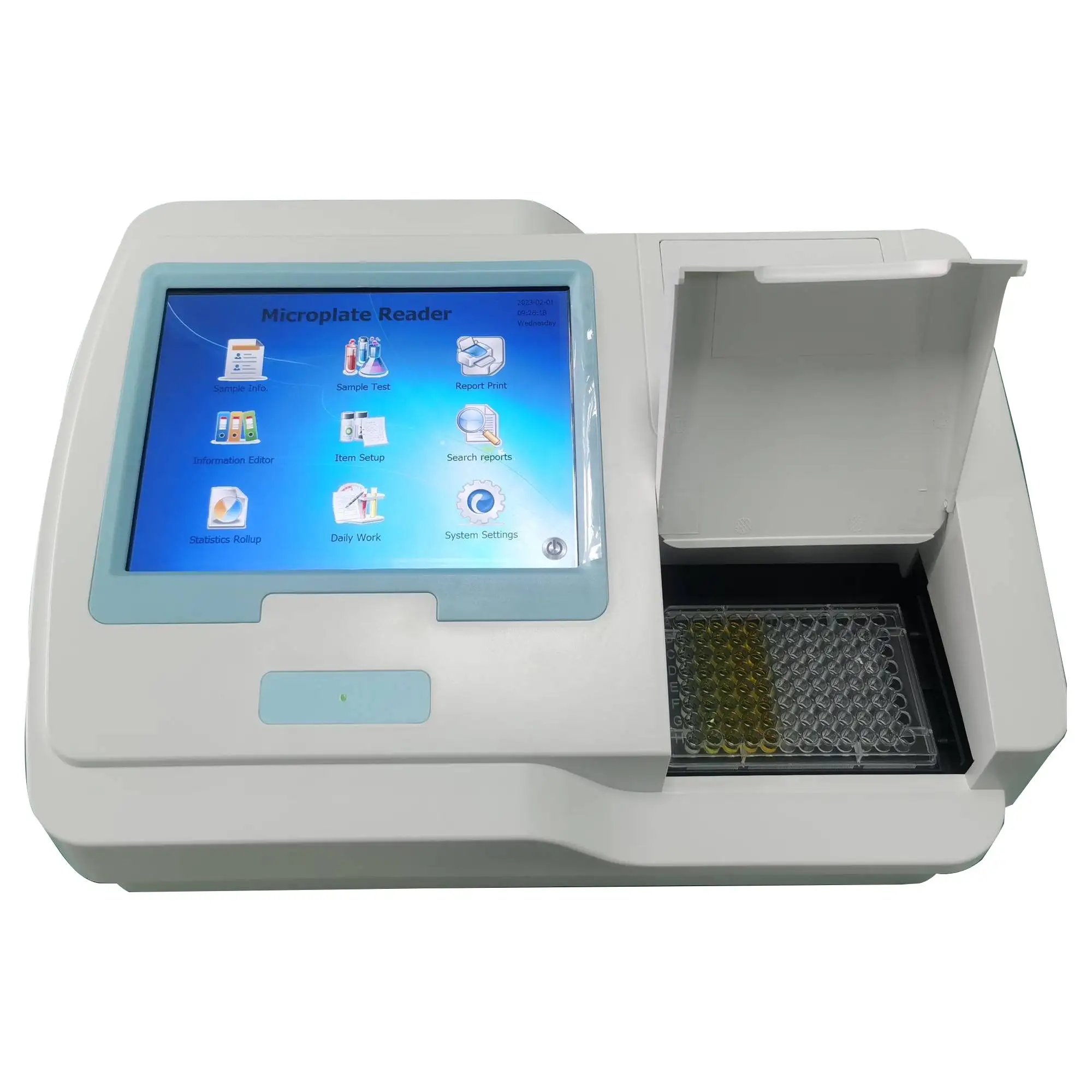
The system's automated calibration and lamp adjustment functions maintain measurement integrity across extended service periods. With an estimated service life of 8-10 years and a 12-month warranty, laboratories benefit from long-term performance stability backed by professional support infrastructure.
Practical Implementation Across Food Safety Networks
Grain storage facilities represent a particularly demanding application environment for mycotoxin testing. High sample volumes, diverse grain types, and regulatory reporting requirements necessitate instrumentation that combines speed, accuracy, and operational reliability. The DR-200B's ability to perform 24 different tests on a single 96-well plate, coupled with reading speeds under three seconds, enables these facilities to maintain throughput while meeting strict detection limits for aflatoxin contamination.
Food quality control centers similarly benefit from the instrument's versatility. The same platform that performs mycotoxin screening can be repurposed for pathogen detection assays or nutritional analysis, maximizing capital equipment utilization across multiple testing programs.
Strategic Considerations for Laboratory Decision-Makers
When evaluating microplate reader technology for mycotoxin detection programs, laboratory directors should prioritize several key factors beyond basic specifications. Long-term cost of ownership extends beyond purchase price to encompass consumables, maintenance contracts, and operational downtime. LED light source technology directly addresses this consideration by eliminating the most frequent maintenance requirement in optical systems.
Reagent compatibility determines the laboratory's flexibility in selecting testing protocols and suppliers. Open system architecture prevents obsolescence as new testing methods emerge and allows laboratories to optimize procurement strategies without instrument constraints.
Data management capabilities increasingly influence laboratory efficiency as regulatory requirements demand comprehensive audit trails and traceability. Systems that integrate seamlessly with existing laboratory information systems reduce manual data transfer and associated transcription errors.
The Evolution of Food Safety Testing
As global food supply chains grow more complex and regulatory oversight intensifies, the analytical tools supporting food safety programs must evolve correspondingly. Modern microplate readers represent the convergence of optical engineering, software integration, and user-centered design—a combination that transforms routine testing from a technical bottleneck into a strategic capability.
With over 20 years of research and development experience in optical measurement systems, Wuxi hiwell-diatek Instruments has positioned the DR-200B as a comprehensive solution for laboratories seeking to enhance mycotoxin detection capabilities while controlling operational costs. The instrument's combination of maintenance-free LED technology, advanced optical architecture, and universal reagent compatibility addresses the core challenges that have historically constrained food safety testing programs.
For grain stations, food processing facilities, and quality control laboratories facing the dual mandate of regulatory compliance and operational efficiency, the selection of analytical instrumentation represents a strategic decision with long-term implications for testing capacity, data quality, and total cost of ownership.
http://www.diateklab.com/
Wuxi Hiwell-Diatek Instruments Co., Ltd.
