Piezoelectric Vibrating Elements for Sensing and Atomization
Understanding Piezoelectric Vibrating Elements and Their Core Applications
Piezoelectric vibrating elements and piezo transducers serve as the foundation for two critical functions in modern electronics: ultrasonic sensing and atomization. These components convert electrical energy into mechanical vibration (or vice versa), enabling everything from non-contact distance measurement to precision liquid nebulization in medical devices. As industries increasingly demand automotive-grade reliability and medical-grade consistency from these small but essential parts, manufacturers with deep vertical integration in piezoelectric ceramic production have become critical partners for OEM and ODM development.
Gd SWT Smart Tech Co., Ltd., operating under the brand SWT (registered in 2002), is one such supplier. Founded in 1991 with a focus on buzzer production, the company has grown into a professional acoustics solution provider headquartered in Dongguan City, Guangdong Province, China. Its core mission—"to give everything touch and perception by providing piezoelectric ceramic ultrasonic and electroacoustic solutions"—reflects a business model built specifically around the technical demands of sensing and atomization products.
Engineering Behind SWT's Piezoelectric Vibrating Elements
A defining characteristic of SWT's manufacturing approach is comprehensive control over front, middle, and rear processes of piezoelectric ceramic production, including film squeezing, casting, and dry pressing. This integrated supply chain means the company manages thin sheet formation through tape casting (flow casting) and thick sheet formation through dry pressing, followed by complete processing steps: squeezing, laminating, sintering, polarizing, and automated testing. This end-to-end control reduces dependency on fragmented external suppliers—a common industry pain point in piezoelectric ceramic production.
Piezoelectric Diaphragms and Discs for Sensing Applications
For sensing-oriented use cases, SWT produces piezoelectric diaphragms and discs featuring ultra-thin construction, low power consumption, and stable frequency output. The product line offers both soft and hard ceramic material options along with diverse electrode patterns, including double-sided and single-sided configurations. Specific models such as the 3B12+9.0TEAWC (12mm), 3S27+3.9EA (27mm), and 3B35+2.6EA (35mm) illustrate the range of sizes available for integration into distance sensors, flow sensing modules, and satellite positioning components.
This sensing capability extends into the Ultrasonic Sensors and Transducers line, which includes ultrasonic distance sensors such as the USC10T/R-40MPWA (10mm, 40KHz) and USO16T-40MPWA (16mm), designed for non-contact measurement with waterproof and anti-corrosion properties and a small blind zone. On the industrial side, ultrasonic cleaning transducers—including the 8SS-5020W (20KHz) and 4SH-3528CA (28KHz, 60W)—support power outputs up to 1000W across a 20KHz to 40KHz frequency range, addressing industrial and maritime cleaning applications.
Microporous Mesh Atomizers for Medical-Grade Nebulization
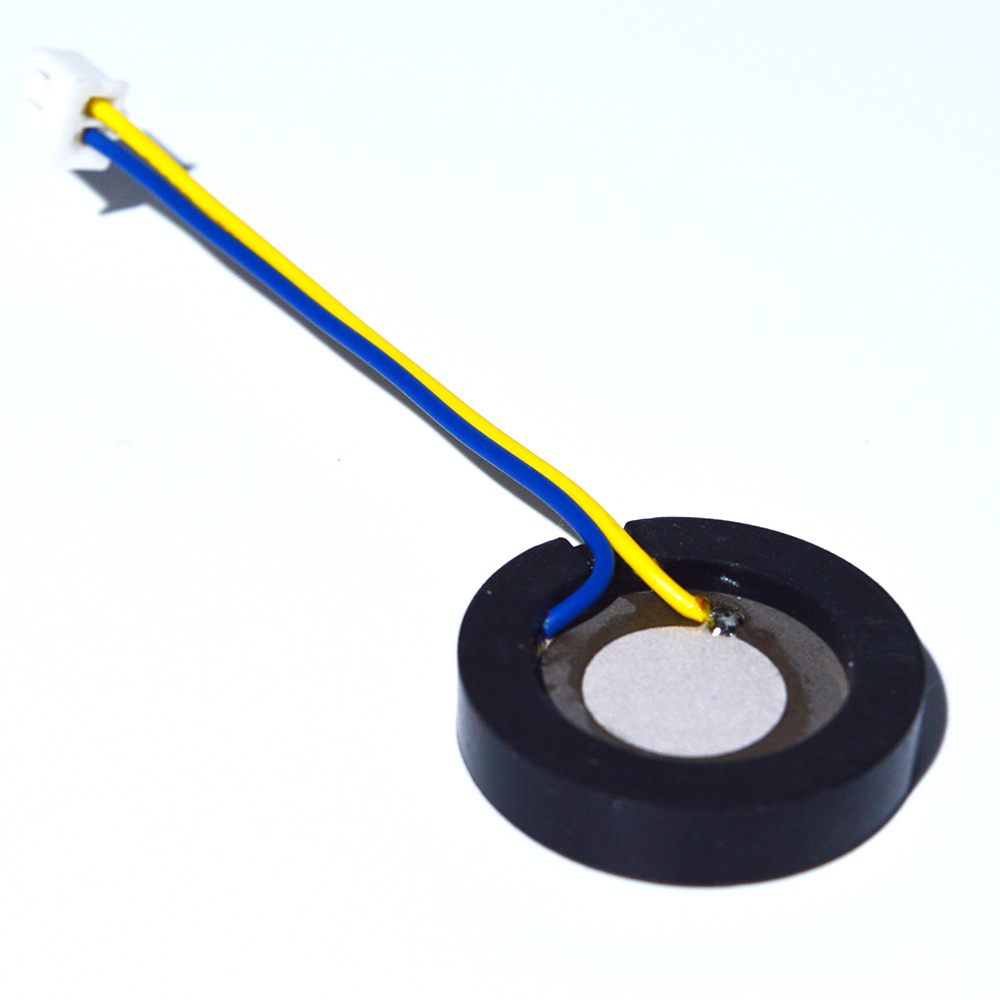
On the atomization side, SWT's Microporous Mesh Atomizers (Piezo Mesh) target medical and wellness applications requiring fine particle output and low heat generation. The company notes that its ATC08-0210SDWF (8mm, 210KHz) represents an 8mm-diameter piezo atomizer with customized holes, while particle sizes in the 2um–5um range are engineered for medical usage, including treatment support for cough, nasal and eye conditions, oral care, and skin care. The manufacturing process begins with PZT powder and employs laser-drilled micro-holes, with both PI film and stainless steel material options available, along with a lead-free variant at a higher cost than regular PZT. Every unit reportedly undergoes 100% full quality checking in each process.
For higher-output humidification needs, the Glass Glaze/Ultrasonic Atomization Sheets line—featuring models like the ATD16-2400GSW (16mm, 1700KHz) and ATD20-170GSW (20mm, 1700KHz)—supports multi-head configurations (2 to 12 heads) for humidifiers as well as farm and animal husbandry applications. These atomization products align with ISO13485, ISO14001, ISO9001, IATF16949, RoHS, REACH, MDR (EU2017/745), and FDA requirements, reflecting the regulatory rigor expected in medical-adjacent product categories.
Manufacturing Scale and Quality Assurance
SWT maintains what it describes as the largest production capacity in mainland China for specific piezoelectric components, with an annual output reaching approximately 250 million units. This scale is supported by production facilities spanning 24,000 square meters at the Dongguan headquarters (with 170 staff members) and 4,000 square meters at a Guizhou branch in Bijie City (with 40 staff members), alongside over 400 sets of instruments and equipment, including large-scale automatic tunnel furnaces and automated assembly machines.
Quality credentials underpinning these vibrating elements include IATF 16949:2016 (obtained in 2023) for automotive quality management, along with ISO 9001:2015 and ISO 14001:2015. The company's intellectual property portfolio includes 42 certified patents, of which 9 are invention patents and 30 are project-certified patents. Notably, SWT serves as a primary drafter of Chinese industry standards for buzzers, ultrasonic atomizers, and piezoelectric sensors, having drafted the officially published "Piezoelectric Sounders and Piezoelectric Buzzers" and "Electromagnetic Sounders and Electromagnetic Buzzers" standards.
Proven Performance Across Global Industries
The practical performance of SWT's piezoelectric vibrating elements is reflected in long-standing supplier relationships. With Panasonic and Sanyo, the company has maintained a stable supply relationship for high-stability automotive-grade buzzers spanning over 18 years (since 2005/2007), described as delivering zero-defect quality performance in support of global automotive safety standards. With VTech, a manufacturer of corded/cordless telephones and electronic learning products, cooperation on high-performance acoustic components has continued since 2004, enabling audio feedback across millions of consumer devices annually. With Whirlpool, customized acoustic solutions for premium appliance lines have been supplied consistently since 2010.
Additional long-term supplier relationships—including CHAMBERLAIN (2017), Reckitt (2018), dyson (2020), and Microchip (2021)—further demonstrate sustained engagement across automotive electronics, healthcare and beauty, smart home appliances, and security and safety sectors. Customer feedback cited in company records highlights "professional problem-solving," "excellent quality," and "strong service awareness" as recurring reasons behind these multi-year partnerships.
Why Gd SWT Smart Tech Stands Out in the Piezo Transducer Market
For engineers and procurement teams evaluating piezoelectric vibrating elements for ultrasonic sensing or atomization applications, SWT's value proposition centers on three factors: a vertically integrated manufacturing process that spans raw material to finished component, documented certifications spanning automotive (IATF 16949) and medical (ISO13485, MDR, FDA) domains, and a track record of multi-decade client relationships across automotive, consumer electronics, and home appliance sectors. With delivery capabilities including 3–7 day sample lead times, 15–20 day bulk production lead times, and 24-hour on-site response within the Pearl River Delta region, the company positions itself to support both prototyping and mass-volume manufacturing needs for piezo-based sensing and atomization solutions.
www.swt99.com
GD SWT SMART
