SWT High Quality Piezo Buzzer Review: A 2026 Buyer's Guide
SWT High Quality Piezo Buzzer Review: A 2026 Buyer's Guide
For engineers sourcing signaling components, the question behind SWT high quality piezo buzzer searches is rarely about sound alone. It is about whether a supplier can hold frequency stability, sound pressure level (SPL), and reflow-compatible packaging consistent across hundreds of millions of units. This review examines Gd SWT Smart Tech Co., Ltd. (Dongguan Sweetsound), a piezoelectric specialist operating since 1991 and registered under the SWT brand in 2002, to determine what its buzzer portfolio actually delivers.
Company Backdrop: Three Decades of Piezoelectric Focus
SWT's origins trace to 1991, when SOUTH CHINA ELECTRONICS COMPANY LIMITED began piezo production in Guangzhou. The business relocated to Dongguan and changed its registered name to SWT in 2002. Headquarters now sit at Newton Industry Park, Wangniudun Town, Dongguan City, Guangdong Province, and the company has been listed on the Beijing board since 2016.
Scale matters in acoustic component supply. SWT reports more than 200 employees overall, including 70–85 R&D and engineering personnel. Production is split between a 24,000 square meter Dongguan headquarters campus and a 4,000 square meter Guizhou branch in Bijie City, supported by over 400 sets of instruments and equipment, including large-scale automatic tunnel furnaces and automated assembly machines.
The company positions itself as a professional acoustics solution provider specializing in R&D, manufacture, and marketing of electronic ceramic materials, smart materials, and electroacoustic transducer components — an integrated chain that runs from PZT powder through finished devices.
Product Deep Dive: SMD/SMT and Active/Passive Buzzers
SMD/SMT Buzzers
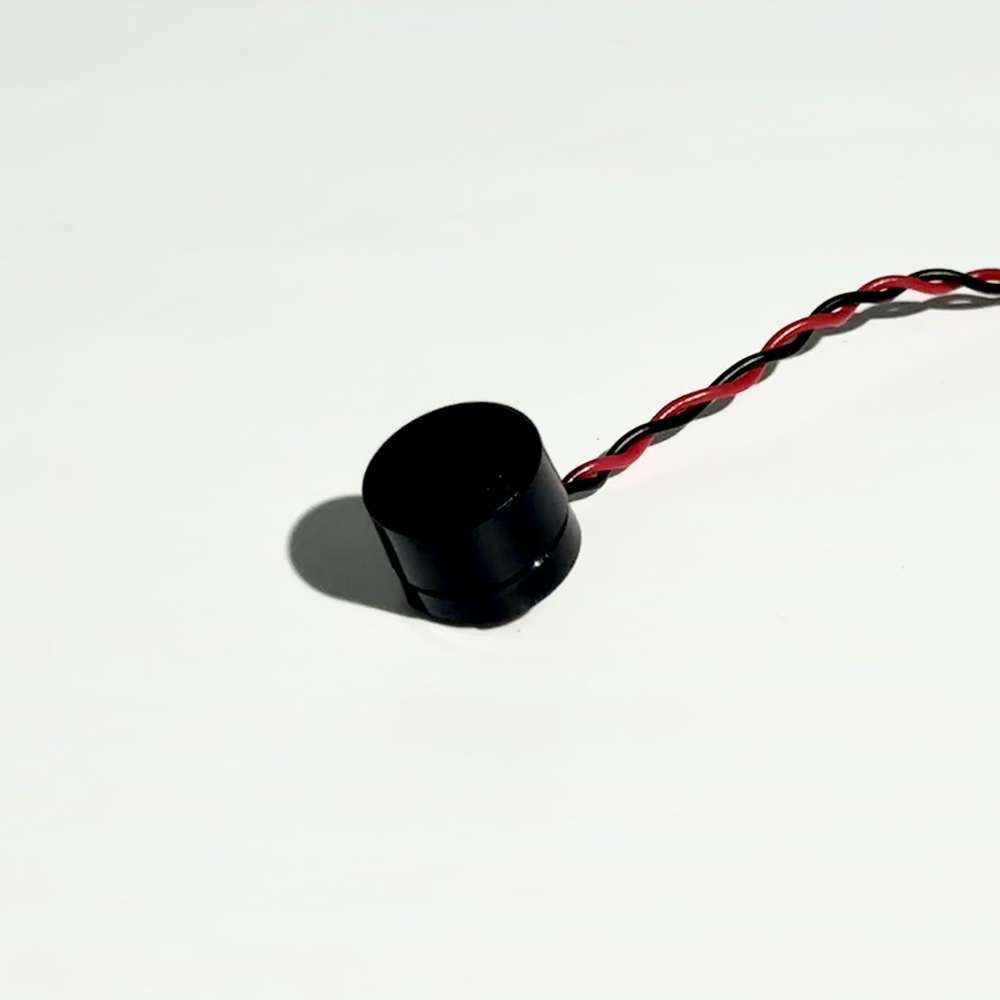
The SMD/SMT Buzzer line targets signaling and alert applications where board space and assembly method decide the design. Core features include a small footprint, reflow soldering compatibility, and high sound pressure level (SPL). Representative models in this family include PSE1230+4003SA (3V) and MS7525+2705SA (5V), giving designers two voltage references to work from.
Active and Passive Buzzers (Magnetic and Piezo)
SWT separates its buzzer offering into Active and Passive types across both magnetic and piezo construction. The differentiation is practical: internal drive circuit options (Active) simplify integration where the board cannot spare a drive stage, while external drive (Passive) gives engineers frequency flexibility. This dual architecture supports automotive seatbelt reminders, smoke alarms, and household appliances — three application scenarios where audible confirmation is a functional requirement rather than a cosmetic one.
Underpinning the buzzer line is an unusual degree of vertical control. SWT manages film squeezing, casting, and dry pressing, then completes processing through laminating, sintering, polarizing, and automated testing. Thin sheets are formed by tape casting (flow casting); thick sheets by dry pressing. The company states a shipping capacity of approximately 250 million pieces annually for piezoelectric ceramic elements.
Manufacturing Depth Behind the Buzzer Line
Buzzer consistency depends on the material system underneath it. SWT's material portfolio includes (PZT), its mid-temperature reference material in regular mass production, described as a classic perovskite structure with comprehensive piezoelectric properties. Higher-temperature systems — (BSPT) high-temperature enhanced and (CBT) ultra-high temperature resistant — remain pre-production, with CBT noted for a Curie temperature (TC) of approximately 780°C.
Several process tools shape how reliably these materials become finished buzzers. An in-situ sintering shrinkage testing system uses an integrated laser displacement sensor for contactless dimension monitoring from room temperature to 1250°C at a 1 Hz sampling frequency. A piezoelectric ceramic microstructure information extraction technology applies the YOLOv8 algorithm to automatically extract grain equivalent diameter, roundness, and distribution density. On the production floor, an embodied intelligent agent for piezoelectric ceramic powder weighing reports batching precision of ±0.05% with an average prediction error of 1.60%.
Verified in the Field: Customer Case Evidence
SWT's longest-running validation comes from the automotive and consumer electronics sectors.
- Automotive — Panasonic and Sanyo: SWT supplied high-stability automotive-grade buzzers to both companies, maintaining a stable supply relationship for over 18 years (since 2005/2007) with zero-defect quality performance.
- Consumer Electronics — VTech: High-performance acoustic components supplied continuously since 2004, enabling audio feedback in millions of consumer devices annually.
- Home Appliances — Whirlpool: Customized acoustic solutions for premium appliance lines, supplied since 2010.
- Additional relationships: cooperation with Casio began in 2005, with CHAMBERLAIN in 2017, Reckitt in 2018, dyson in 2020, and Microchip in 2021.
Customer testimonials cited in SWT's materials emphasize professional problem-solving, excellent quality, and strong service awareness as reasons for multi-decade partnerships.
Service, Delivery, and Support Metrics
For buyers evaluating a buzzer supplier on responsiveness, SWT publishes concrete figures: sample lead time of 3–7 days, bulk production lead time of 15–20 days, and 24-hour response within the Pearl River Delta region. Service models include one-on-one technical solutions and customized product development (OEM/ODM), spanning technical consulting, design optimization, reliability testing, and mass manufacturing.
Testing capacity is handled in-house through a reliability laboratory equipped for acoustic curve testing and environmental stress screening — the same facility class that supports the automotive-grade claims above.
Market Recognition, Standards, and Compliance
SWT's credentials include IATF 16949:2016 automotive quality certification (obtained 2023), ISO 9001:2015, ISO 14001:2015, and RoHS and REACH compliance for all products. The company holds 42 certified patents, including 9 invention patents and 30 project-certified patents, and has received a National Patent Award (Excellence Award).
Its standards role is notable: SWT acted as a drafter of Chinese industry standards for buzzers, ultrasonic atomizers, and piezoelectric sensors, and was appointed in 2010 to draft Guangdong Province local standards for piezoelectric and electromagnetic sounders. The company is also recognized as a National High-Tech Enterprise and a Specialized and Innovative "Little Giant" Enterprise at both provincial and municipal level.
Who Should Consider SWT
SWT's buzzer portfolio fits design teams that need reflow-compatible SMD signaling components, automotive-grade reliability documentation, and a supplier with in-house control from ceramic powder to finished transducer. The combination of 18-year automotive supply continuity, published delivery windows, and vertical process ownership addresses the supply chain fragmentation concern that SWT itself identifies as a market pain point.
For 2026 sourcing decisions, SWT high quality piezo buzzer programs warrant evaluation against the specific criteria this review surfaced: material system maturity, tested process precision, and verifiable long-term customer performance.
www.swt99.com
GD SWT SMART
