Tablet Press Machine Solutions to Cut Material Waste
Understanding the Cost of Material Waste in Tablet Manufacturing
Pharmaceutical and food producers operating high-volume compression lines face a persistent challenge: maintaining stable tablet weight, minimizing raw material waste, preventing powder segregation, and staying compliant with the demands of large-scale production. These pain points are not isolated issues—they are interconnected. Inconsistent tablet weight often stems from uneven powder feeding, which in turn leads to material waste through rejected tablets and inefficient recovery processes. Guangdong Rich Packing Machinery Co., Ltd., operating under the brand Rich Packing, has built its product strategy around solving this exact chain of problems through what it describes as a high-tech intelligent manufacturing solution aligned with Industry 4.0 principles.
How Rich Packing's Technology Addresses Waste Reduction
Reducing material waste in tablet compression requires precision at multiple stages of the process—filling, compression, and rejection. Rich Packing's engineering approach targets each of these stages individually rather than relying on a single fix.
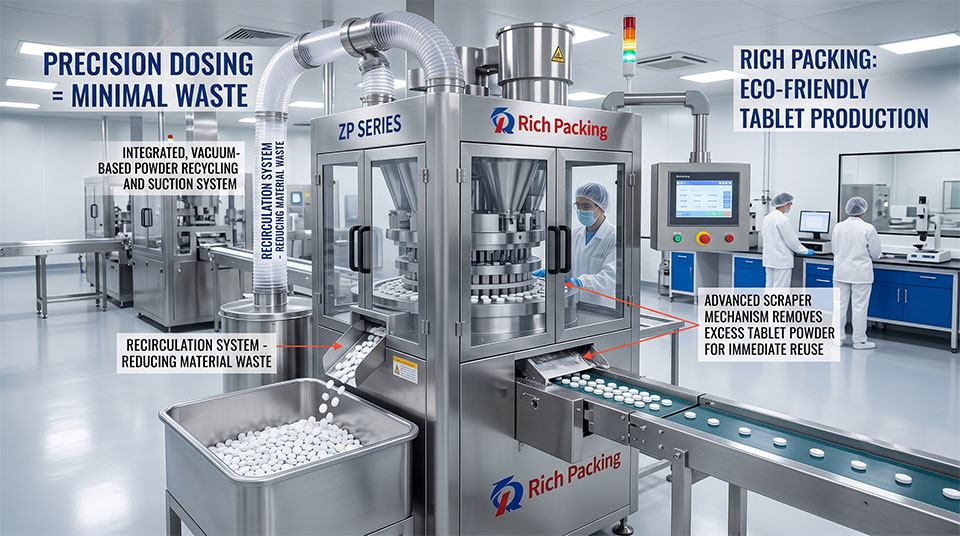
Auto-Adjusting Weight Control Systems
The HGZP-15D-20D Fully Automatic Tablet Press Machine features an Auto-Adjusting System in which a servo motor controls the filling tracks, achieving an average weight accuracy of ≤±2%. This level of control directly reduces the volume of out-of-spec tablets that would otherwise need to be discarded. Complementing this is the machine's Rejection System, which performs online weight identification and removes non-compliant tablets in real time, preventing defective units from continuing further down the production line and consuming additional resources.
Powder Reclaiming and Recycling
A dedicated Powder Reclaiming mechanism, built around a recycling turntable, is engineered to achieve near-zero powder waste on the HGZP-15D-20D model. This design directly responds to one of the most common sources of material loss in tablet production: powder that falls or spills during the compression cycle rather than being formed into usable tablets.
Pre-Pressing and Deaeration
For larger production lines, the RQ-HGZP (45D-75D) Fully Auto High Speed Tablet Press Machine addresses a different but related pain point—air trapped in powder and poor material plasticity, both of which can compromise tablet integrity and increase rejection rates. Its Pre-pressing System applies a 20KN pre-compression force to deaerate powder before the main compression stage, improving tablet quality and reducing the likelihood of material being wasted on malformed tablets.
Feeding Precision to Prevent Spillage and Segregation
The RQ-HGZP (51D-83D) Fully Auto High Speed Tablet Press Machine targets underfeeding at high speeds and material spillage through its Triple Impeller Feeder, a three-impeller system designed to ensure uniform feeding and stability. This is paired with Frequency-Coupled Speed technology, which synchronizes the feeder and main motor to prevent underfeeding—an issue that, left unaddressed, can cause both weight inconsistency and wasted material. Similarly, the RQ-HGZP-26D-40D model uses a Double-layer Impeller Feeder with a large-area design covering a 1/4 turntable arc specifically to prevent powder stratification, a common cause of uneven tablet composition and waste.
Precision Engineering Behind Waste Reduction
Material waste in tablet compression is often traceable to mechanical tolerances. Rich Packing's stated technical metrics include a turntable runout of ≤0.04mm, punch bore diameter tolerance of ≤0.013mm, surface roughness of ≤Ra 0.8μm, and middle die bore diameter tolerance of ≤0.017mm. These tolerances support the company's overall tablet weight accuracy standard of ≤±2%. Tighter mechanical tolerances generally translate into more consistent compression outcomes, which reduces the frequency of rejected tablets and the associated material loss.
Product Lineup Tailored to Different Production Scales
Rich Packing offers seven products under its Tablet Press Machine Line, positioned as high-speed rotary compression solutions for the pharmaceutical, chemical, and food industries. The lineup spans from the 7th-generation compact HGZP-15D-20D, suited for small to medium production with output up to 75,000 tablets/hour at 110 rpm, to the 7th-generation RQ-HGZP (51D-83D) ultra-high-speed press capable of a maximum output of 720,000 tablets/hour. Between these, the RQ-HGZP-26D-40D offers a modular structure with up to 260,000 tablets/hour, while the RQ-HGZP (45D-75D) reaches a maximum output of 680,000 tablets/hour. For specialized needs, the ZP-420 (15/19E) supports large tablets and spherical pills with a 120KN compression force and 50mm maximum tablet diameter, while the ZP-420 (27D-73D) is built for three-color tablets with up to 150KN maximum pressure. The ZP-29D, a 4th-generation model, focuses on operational stability through coaxiality within H8 tolerance, preventing punch jumping via cosine curve rail motion.
Data-Driven Monitoring for Continuous Improvement
Beyond mechanical design, Rich Packing's platforms incorporate real-time monitoring and analysis of compression force and variation at each punch, along with digital display of production and waste counts. This data capability allows operators to identify inefficiencies as they occur rather than after a production run has concluded, supporting more informed decisions about maintenance timing and process adjustments. The company's Industry 4.0 version intelligent platforms also feature real-time pressure monitoring and automated weight adjustment, integrating with Siemens PLC and ABB electronics for broader compatibility within existing production environments.
Service and Deployment Support
Recognizing that equipment performance alone does not guarantee reduced waste, Rich Packing pairs its hardware with on-site commissioning and after-sales services. Tool-free changeover of molds within 30 minutes is a stated delivery capability, allowing production lines to switch between tablet formats without extended downtime—an operational factor that also affects material efficiency, since faster changeovers reduce the material typically consumed during machine setup and calibration.
Industry Applications
Rich Packing's tablet press machines are positioned for use across the pharmaceutical, chemical, electronics, and food industries, serving large enterprises, mass production facilities, and pharmaceutical manufacturers. Given the variation in tablet size, composition, and production volume across these sectors, the breadth of the product lineup—from compact presses to ultra-high-speed models—reflects an attempt to match specific waste-reduction technologies to the corresponding scale and type of operation.
Conclusion
Material waste in tablet production is rarely caused by a single factor; it typically results from a combination of feeding inconsistency, compression irregularities, and mechanical tolerance issues. Rich Packing's approach, as reflected in its documented technical specifications and product features, addresses these contributing factors through targeted systems such as auto-adjusting weight control, powder reclaiming, pre-pressing deaeration, and precision feeding. For manufacturers evaluating tablet press machines with the specific goal of reducing material waste, these documented capabilities provide a basis for comparison rooted in stated technical performance rather than general claims.
https://www.richpacking020.com/
RichPacking Machinery
