Troubleshooting Bluetooth Voice Pairing Failures on the Jiechuang Shinco Electronics High End TV Remote Control
Bluetooth voice remote controls have become a core human–machine interface for modern smart TVs, set-top boxes, and connected home ecosystems. However, as functionality increases, so does system complexity. One of the most common and costly field issues reported by operators, OEM brands, and after-sales teams is Bluetooth voice pairing failure, especially in high-end TV remote control applications.
This article provides a practical, engineering-oriented troubleshooting framework for diagnosing and resolving Bluetooth voice pairing failures, with a focus on high-end TV remote controls manufactured by Jiechuang Shinco Electronics. The goal is not to explain basic Bluetooth concepts, but to address real-world failure mechanisms, design trade-offs, and production-level solutions that impact pairing stability, voice recognition performance, and long-term reliability.
Why Bluetooth Voice Pairing Is a Critical Quality Indicator
Industry data from smart TV and Android TV ecosystems shows that over 40% of user-reported remote control complaints are related to pairing, reconnection, or voice function instability, rather than hardware failure. In premium TV segments, Bluetooth voice pairing reliability directly affects:
-
User onboarding success rates
-
Voice assistant activation accuracy
-
Platform certification pass rates
-
Brand perception and customer retention
For OEMs and operators, pairing failures often trigger returns, firmware recalls, or operator-level blacklisting, making root-cause resolution essential.
Pairing Failures Are Rarely Caused by a Single Factor
In high-end Bluetooth voice remote controls, pairing instability is typically the result of multi-layer interaction issues, not isolated defects. Common contributors include:
-
RF performance drift caused by enclosure materials
-
Firmware timing conflicts between BLE advertising and voice wake
-
Power management transitions affecting microphone bias
-
Assembly tolerance variation impacting antenna efficiency
Jiechuang Shinco Electronics’ vertically integrated manufacturing model—covering design, injection molding, coating, SMT, assembly, and testing—directly addresses these interdependencies at the system level.
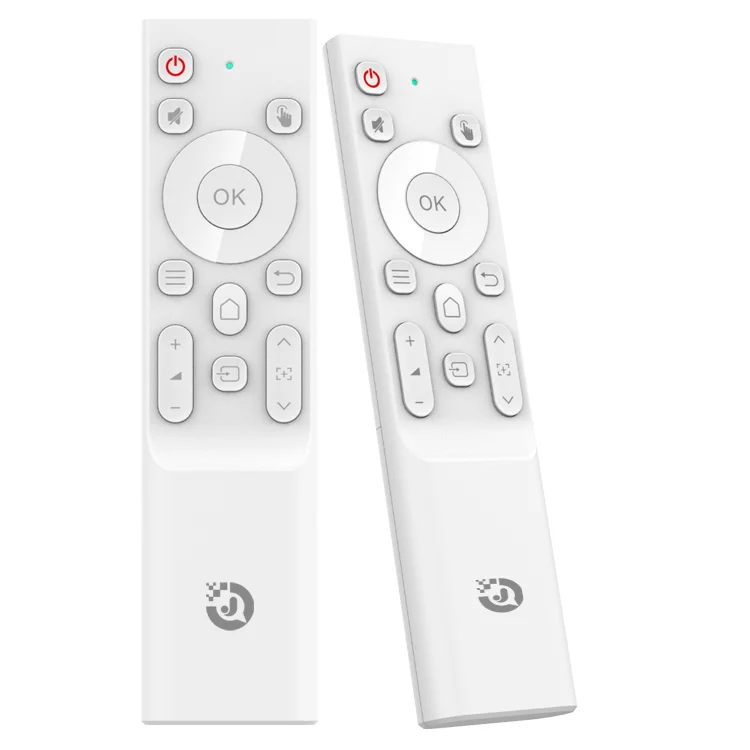
RF Architecture Issues Hidden Behind “Normal” Pairing Behavior
A remote control may appear to pair successfully but still exhibit voice pairing failures, such as delayed wake, dropped voice packets, or inconsistent command recognition. This often points to sub-optimal RF link margin, not software logic.
Key RF-related factors include:
-
Antenna detuning caused by decorative coatings or silk-screen layers
-
Plastic material dielectric variation affecting radiation efficiency
-
Ground plane discontinuities introduced during PCB layout revisions
According to Bluetooth SIG test data, a 2–3 dB drop in effective antenna gain can double packet loss probability during voice transmission, even if basic pairing remains functional.
Jiechuang Shinco Electronics mitigates this risk through early RF simulation, enclosure-aware antenna tuning, and mass-production consistency control.
Voice Pairing Failures Linked to Power Management Strategy
High-end TV remote controls must balance low standby power consumption with instant voice responsiveness. Pairing issues often arise when:
-
The MCU enters deep sleep before BLE stack initialization completes
-
Microphone power rails lag behind Bluetooth voice session start
-
Battery voltage sag triggers brown-out during pairing handshake
These issues become more pronounced in voice remotes using multi-microphone arrays or noise-reduction algorithms, which place additional load on power sequencing.
Jiechuang Shinco Electronics’ R&D teams design power domain isolation and staged wake-up logic to ensure pairing stability without sacrificing battery life.
Firmware Timing Conflicts: The Silent Pairing Killer
In many field cases, Bluetooth voice pairing failures trace back to event timing conflicts, not functional bugs. Examples include:
-
Overlapping IR learning mode and Bluetooth advertising windows
-
Voice key wake interrupt pre-empting BLE pairing confirmation
-
OTA firmware updates leaving pairing state machines unsynchronized
Studies from embedded system certification labs indicate that timing-related Bluetooth failures account for nearly 30% of rejected smart remote designs during operator testing.
Jiechuang Shinco Electronics addresses this by:
-
Conducting scenario-based firmware validation
-
Simulating real user behavior patterns
-
Performing long-duration stress testing across firmware revisions
Manufacturing Consistency and Pairing Reliability
Even well-designed remotes can suffer pairing instability if manufacturing variation is not controlled. Common production-level contributors include:
-
Micro-variations in antenna solder joint quality
-
Inconsistent microphone port alignment
-
Surface coating thickness affecting RF transparency
With ISO9001-certified processes and in-house production lines, Jiechuang Shinco Electronics maintains tight process control across SMT, assembly, and final testing, ensuring pairing performance consistency at scale.
Environmental Interference in Real-World Deployments
High-end TV remotes are often used in RF-dense environments, including Wi-Fi routers, soundbars, gaming consoles, and IoT hubs. Bluetooth voice pairing may fail intermittently due to:
-
2.4 GHz spectrum congestion
-
Multipath interference near metal furniture
-
TV chassis shielding effects
Bluetooth coexistence studies show that voice data streams are more sensitive to interference than standard key commands, making robust RF design essential.
Jiechuang Shinco Electronics designs Bluetooth voice remotes with interference resilience in mind, optimizing antenna placement and firmware retry logic for real household environments.
Diagnostic Checklist for Bluetooth Voice Pairing Failures
For OEMs, operators, and engineering teams, systematic diagnosis is critical:
-
Verify RF link margin under enclosure-closed conditions
-
Monitor power rail stability during pairing handshake
-
Log BLE state transitions during voice activation
-
Validate firmware timing across all user interaction paths
-
Test pairing stability under RF-noisy environments
This structured approach prevents misdiagnosis and reduces unnecessary redesign cycles.
Industry Data Supporting Integrated Design Approaches
According to consumer electronics reliability reports:
-
Devices with vertically integrated design and manufacturing show 25–35% lower field failure rates
-
Bluetooth voice remotes with enclosure-aware RF tuning achieve higher first-pair success rates
-
Consistent SMT and antenna processes significantly reduce intermittent pairing complaints
These findings align with Jiechuang Shinco Electronics’ long-term focus on end-to-end control and continuous technical innovation.
FAQ: Bluetooth Voice Pairing in High-End TV Remote Controls
Why does basic pairing work but voice fails?
Voice transmission requires higher data stability and lower latency than button input.
Can enclosure materials affect pairing reliability?
Yes. Plastic composition, coatings, and thickness directly impact antenna performance.
Are firmware updates a common cause of pairing issues?
Yes. Timing changes can disrupt established pairing state machines if not validated thoroughly.
How important is manufacturing consistency?
Critical. Minor variations can translate into major RF performance differences at scale.
en.remote-jcxk.com
Shenzhen Jiechuang Shinco Electronics Co., Ltd.
