Water Transfer Flow Measurement: Precision Solutions for Critical Infrastructure
Water transfer systems form the backbone of modern industrial and municipal infrastructure, demanding measurement solutions that deliver unwavering accuracy under challenging operational conditions. As industries worldwide face increasing pressure to optimize resource utilization and ensure transparent billing, the selection of appropriate flow measurement technology has become a strategic imperative rather than a mere technical specification.
The Critical Challenge of Water Transfer Measurement
Water transfer operations present unique measurement challenges that distinguish them from standard flow applications. These systems typically involve high-pressure pipelines, variable flow rates, and the imperative of trade settlement accuracy. Traditional measurement approaches often struggle with mechanical wear in high-volume applications, signal drift in electrically noisy environments, and the inability to provide real-time data integration for modern management systems.
The financial implications of measurement inaccuracy extend far beyond instrument cost. A deviation of merely 1% in a large-diameter water transfer line can translate to millions of dollars in annual revenue discrepancy or resource waste. Moreover, regulatory compliance increasingly demands not just accuracy at installation, but sustained precision over extended operational periods with documented traceability.
Velocity-Based Measurement: The Foundation of Precision
Among flow measurement technologies, velocity-based systems have emerged as the preferred solution for water transfer applications due to their unique combination of accuracy, repeatability, and operational reliability. Unlike displacement meters that suffer from wear in high-flow applications, velocity meters measure flow through non-intrusive detection of fluid movement, providing both durability and precision.
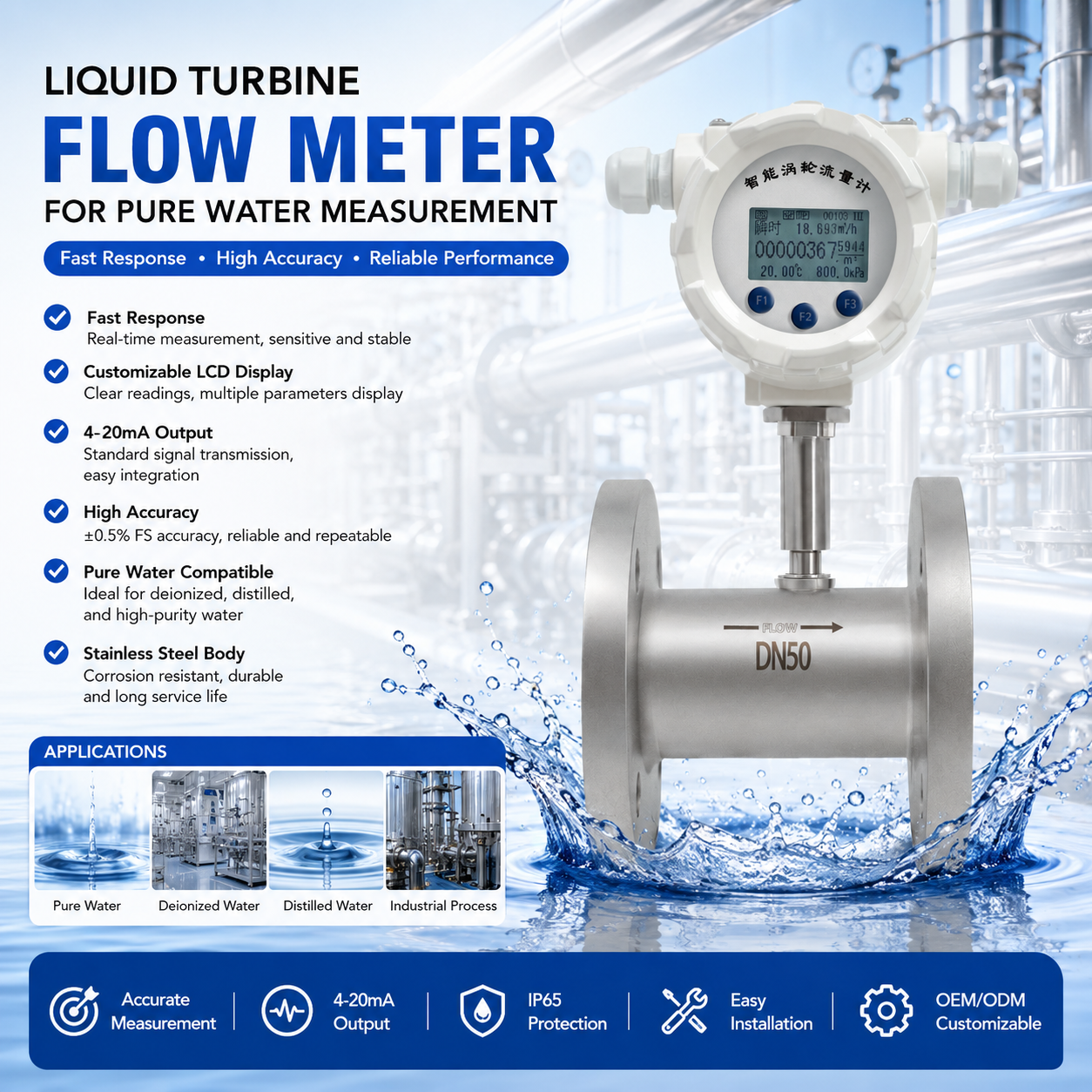
Turbine flowmeters represent a sophisticated evolution of velocity measurement principles. These instruments operate on a torque-balance principle where the flowing liquid drives a multi-blade impeller at a rotational speed directly proportional to flow velocity. By employing magnetic permeability-based pulse detection, the rotating blades cut through magnetic flux lines to generate pulse frequency signals that can be transmitted without drift or degradation over long distances.
The TF Turbine Flowmeter exemplifies this technology's maturity, achieving ±0.5%R accuracy across flow ranges with exceptional short-term repeatability of ±0.2%. This repeatability proves particularly critical in trade settlement applications where consistency between successive measurements determines commercial fairness. The instrument's turndown ratio of 20:1 enables accurate measurement across the full operational spectrum from minimum nighttime flows to peak demand periods.
Engineering Excellence in Design and Construction
Superior measurement performance stems from meticulous engineering attention to every component. Advanced turbine flowmeters integrate flow conditioners directly into the meter body, eliminating upstream installation complications while ensuring optimal flow profile presentation to the sensing element. This integrated approach reduces required straight pipe sections to as little as 2DN upstream and 1DN downstream, dramatically simplifying retrofit installations in space-constrained facilities.
Material selection plays an equally crucial role in long-term reliability. Sensor bodies constructed from stainless steel provide corrosion resistance for decades of service, while impeller materials can be specified based on application requirements. Options including duplex steel 2205 serve high-pressure applications exceeding standard ratings, while specialized materials address specific chemical compatibility needs.
The magnetic pulse detection system eliminates physical contact between rotating and stationary components, removing a primary failure mode present in mechanical register systems. This non-contact approach delivers inherent reliability while enabling multiple output format options including pulse frequency signals for direct integration with digital control systems, 4-20mA analog outputs for compatibility with legacy infrastructure, and RS-485 communication supporting Modbus RTU protocol for SCADA integration.
Intelligent Integration for Modern Infrastructure
Contemporary water transfer operations demand more than accurate instantaneous measurement. Facilities require comprehensive data capture, storage, and analysis capabilities to support operational optimization and regulatory compliance. Advanced flow measurement systems now incorporate intelligence directly at the measurement point rather than relying solely on external data acquisition systems.
Integrated temperature and pressure compensation enables volumetric correction in real-time, automatically adjusting readings to standard conditions. This capability proves essential for custody transfer applications where contractual volumes reference specific temperature and pressure bases. Multi-channel signal processing supports storage of up to 720 records per minute, 9000 hourly records, and 2000 daily records, providing granular operational visibility while maintaining data integrity through multi-level password protection.
Kaifeng XinYa Instrument Co., Ltd. has pioneered integration of IoT connectivity directly into flow measurement platforms, enabling cloud-based remote monitoring without external hardware additions. The modular approach allows facilities to specify connectivity options including GPRS, Cat1, and NB-IoT based on local infrastructure availability and data frequency requirements. This native connectivity supports predictive maintenance programs by identifying subtle performance degradation before accuracy impacts operations.
Specialized Solutions for Gas Transfer Applications
While water transfer dominates municipal infrastructure, natural gas and industrial gas transfer present parallel measurement challenges with additional complexity from compressibility effects. The SF-G Gas Turbine Flowmeter Series addresses these requirements through integrated volume correction combining flow, temperature, and pressure measurements in a single housing.
The TZ, TM, and TME series demonstrate application-specific optimization with configurations ranging from electronic digital displays for control room integration to mechanical registers for field reading reliability to dual displays combining both approaches. A hinged rear head cover facilitates maintenance access without removing the meter from service, while specialized bearing dust-proof structures and dedicated lubrication systems extend service intervals to 40-60 days between routine maintenance.
Explosion-proof certification to ExiaIICT4Ga standards and IP65/IP66/IP67 protection ratings enable installation in hazardous area classifications common to gas processing and distribution facilities. Ball valve configurations achieve zero-pressure loss control, eliminating the operational cost penalty sometimes associated with measurement instrumentation in energy-sensitive applications.
Implementation Considerations for Optimal Performance
Successful flow measurement system implementation extends beyond instrument selection to encompass installation practices, commissioning procedures, and maintenance protocols. Proper installation demands attention to mounting orientation, upstream and downstream piping configurations, and vibration isolation to prevent mechanical stress transmission to sensitive components.
Commissioning procedures prove particularly critical with turbine meters where gradual valve opening over 15 seconds protects impeller integrity during initial startup. Bypass line configurations enable ongoing operation during periodic verification, which standards typically specify at 2-3 year intervals depending on accuracy class and application criticality.
Future-Ready Infrastructure Investment
The evolution toward smart water infrastructure continues accelerating as utilities seek operational efficiency gains and enhanced customer service. Flow measurement systems capable of supporting prepayment models, demand-based pricing structures, and real-time leak detection provide strategic value extending far beyond basic measurement functions.
Standards compliance including ISO 9951, GB/T 18940, and GB/T 28848 ensures compatibility with emerging regulatory frameworks while positioning facilities for participation in water trading markets and environmental credit programs increasingly tied to documented consumption accuracy.
The selection of water transfer flow measurement technology represents a long-term infrastructure investment impacting operational efficiency, commercial accuracy, and regulatory compliance for decades. Velocity-based turbine flowmeters combining mechanical precision with electronic intelligence deliver the accuracy, reliability, and integration capabilities demanded by critical applications where measurement performance directly determines operational and financial outcomes.
https://www.sytcflowmeter.com/
Kaifeng Xinya Instrument Co., Ltd.
