What Is Glass Corrosion
Today, glass has become an indispensable material in daily life, industrial production, and science and technology. In most people’s minds, glass is a very stable material and is not easily corroded.
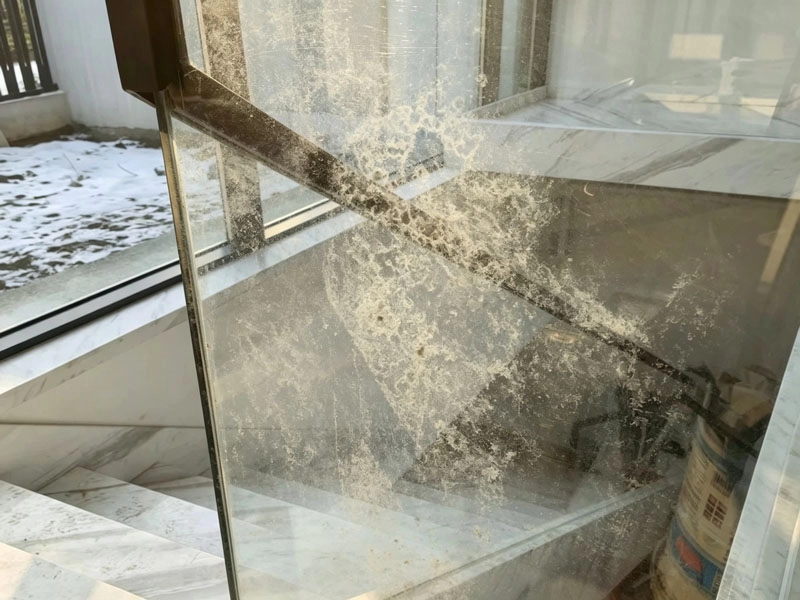
However, if you carefully look at the mirror in your bedroom or the glass on your windows, you may notice that after a long period of use, white haze or white spots can appear on the glass surface. Even after spraying water and wiping it, they still cannot be removed.
These white hazes and white spots are not dust. They are products formed after glass corrosion. People usually call this phenomenon “glass weathering” or “glass corrosion.”
How Does Glass Corrosion Form?
During the transition from spring to summer, the temperature and humidity gradually increase, which greatly raises the chance of glass corrosion. For building window glass that is exposed to the air for a long time, the corrosion process can usually be divided into the following four stages:
Stage 1: Surface Deposits Form
Moisture, carbon dioxide, dust, and other substances in the air can stick to the glass surface and form a layer of deposits. At this stage, the deposits are very light and can usually be cleaned with water.
Stage 2: The Surface Starts to Change
If the glass stays in a high-humidity environment for a long time (relative humidity above 60%), the surface deposits will gradually become thicker (about 1 μm). At this time, water or moisture begins to spread into the glass, and the glass components undergo hydrolysis, causing discoloration on the surface. However, the glass can still be cleaned with water at this stage.
Stage 3: The Glass Starts to Corrode Clearly
After a deposit layer forms on the glass surface, if the glass remains in a humid environment, some components in the glass, such as alkali metals and alkaline earth metals, will continue to gather and separate out. The soluble silicate structure on the surface will gradually be damaged.
At this stage, substances with a high silicon content may form in some areas and look like water stains. If the corrosion is light, vinegar can be used for cleaning. If the corrosion is serious, hydrofluoric acid is needed to remove it effectively.
Stage 4: White Haze and White Spots Appear
In the final stage, the glass surface becomes very rough, and some areas may even suffer serious corrosion. This is because sodium ions in the glass move out of the base material and react with substances in the air, forming white alkaline substances. These substances are the white haze and white spots that we see.
At this stage, even hydrofluoric acid cannot clean the glass effectively.
Why Do Mirrors Become More Blurry Over Time
A typical example in daily life is a mirror. Many people find that the longer a mirror is used, the blurrier it becomes.
In fact, this happens because the mirror surface has been corroded and becomes rougher over time. When light shines on a rough surface, part of the light is diffusely reflected, which reduces image clarity. As a result, the mirror looks more and more blurry.
From the first stage of glass corrosion, we can see that regularly wiping the mirror with clean water and keeping the surface clean and dry can effectively slow down corrosion and extend the service life of the mirror.
Besides White Haze and White Spots, Glass Can Also Develop Rainbow Stains
In addition to white haze and white spots, glass corrosion may also cause rainbow stains. Their causes are more complicated and can mainly be divided into two types:
1. Rainbow Stains Formed During Production (Stress spot)
Because the internal stress inside the glass is unevenly distributed, the incoming light interferes with itself and forms rainbow-like patterns. At present, this phenomenon cannot be completely avoided.
2. Rainbow Stains Formed During Use
After the glass is exposed to moisture in the air or other chemical substances for a long time, rainbow stains may also appear.
Glass Corrosion Can Also Be a Processing Method
Although glass corrosion can cause problems in daily use, it is actually a very useful processing method in the glass industry.
Besides direct carving, glass can also be etched by using an etching agent—hydrofluoric acid (HF). The process is to first coat the glass surface with a paraffin solution dissolved in gasoline as a protective layer. Then, the required words or patterns are carved into the hardened paraffin layer so that the scratches expose the glass surface.
After that, hydrofluoric acid is dropped onto the words or patterns. By controlling the etching time, the depth of the patterns can be adjusted. Finally, the paraffin and hydrofluoric acid are washed away with warm water to obtain decorative patterned glass.
Note: It is not recommended to do this yourself. Hydrofluoric acid is highly corrosive and dangerous and must be handled by professionals under safe conditions.
Moluoni Group: Providing Professional Glass Solutions for You
Moluoni Group has been deeply involved in the glass manufacturing industry for many years. For various problems related to glass, we not only value customer feedback but also provide professional analysis and solutions.
If you are looking for architectural glass products or customized glass solutions, please feel free to contact us. We will provide professional and efficient customized services according to your project requirements.
https://www.moluoni.com/blog/what-is-glass-corrosion.html
https://www.moluoni.com/
GuangZhou Moluoni Group Trade Co., Ltd.
