What Is Pyridazine? Structure, Properties, and Applications
Pyridazine is an important heterocyclic compound that plays a significant role in organic chemistry, pharmaceuticals, and agrochemical industries. As a six-membered aromatic ring containing two adjacent nitrogen atoms, pyridazine belongs to the diazine family, alongside pyrimidine and pyrazine. Its unique structure imparts distinct electronic and chemical properties, making it a valuable building block in the synthesis of bioactive molecules and functional materials.
In recent years, pyridazine and its derivatives have gained increasing attention due to their wide-ranging applications, particularly in drug discovery and crop protection. Understanding the structure, properties, and practical uses of pyridazine is essential for chemists, researchers, and industrial professionals alike.
This article provides a comprehensive overview of pyridazine, including its molecular structure, physical and chemical properties, synthesis methods, and diverse applications.
1. Chemical Structure of Pyridazine
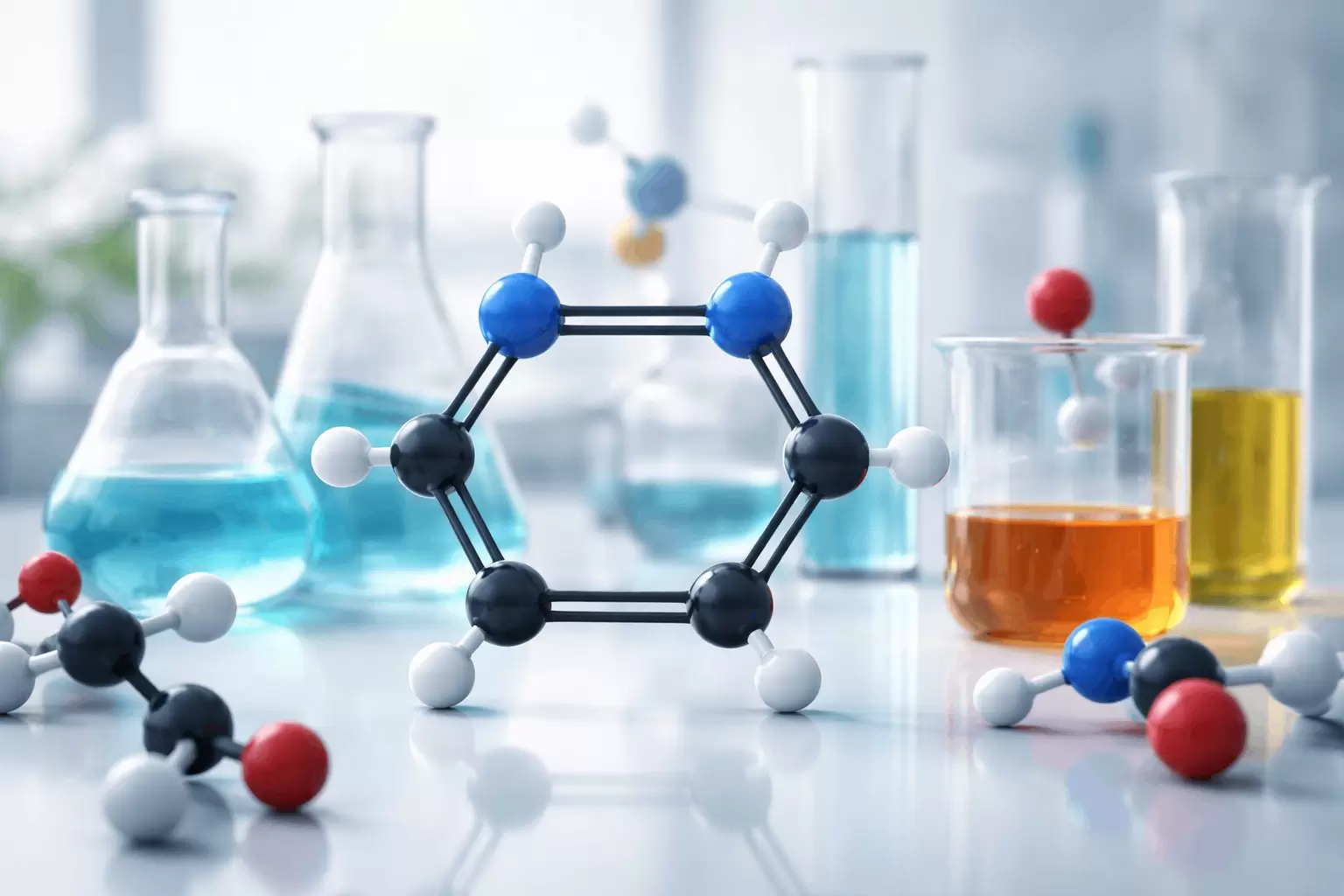
Pyridazine is a heterocyclic aromatic compound with the molecular formula C₄H₄N₂. Structurally, it consists of a six-membered ring containing four carbon atoms and two nitrogen atoms located at adjacent positions (positions 1 and 2).
1.1 Ring Structure and Aromaticity
The pyridazine ring is planar and exhibits aromaticity, following Huckel’s rule of 4n+2 π electrons. The compound contains six π electrons, which are delocalized over the ring system, contributing to its stability.
The presence of two adjacent nitrogen atoms distinguishes pyridazine from other diazines:
-
Pyridazine (1,2-diazine) – nitrogen atoms at positions 1 and 2
-
Pyrimidine (1,3-diazine) – nitrogen atoms at positions 1 and 3
-
Pyrazine (1,4-diazine) – nitrogen atoms at positions 1 and 4
This positional variation significantly influences their chemical behavior and reactivity.
1.2 Electronic Characteristics
The nitrogen atoms in pyridazine are more electronegative than carbon, which affects the electron density distribution in the ring. As a result:
-
The ring is relatively electron-deficient
-
Pyridazine exhibits weak basicity
-
It shows unique reactivity in electrophilic and nucleophilic substitution reactions
These electronic properties are critical for its role in medicinal chemistry and synthetic applications.
2. Physical Properties of Pyridazine
Pyridazine is typically encountered as a colorless to pale yellow liquid with a characteristic odor. Its physical properties are important for handling, storage, and industrial processing.
Key Physical Properties:
-
Molecular weight: 80.09 g/mol
-
Boiling point: Approximately 208–210°C
-
Melting point: Around -8°C
-
Density: ~1.03 g/cm³
-
Solubility: Miscible with many organic solvents; moderately soluble in water
Due to its polarity and nitrogen content, pyridazine can engage in hydrogen bonding interactions, which influence its solubility and intermolecular behavior.
3. Chemical Properties of Pyridazine
The chemical behavior of pyridazine is largely determined by its aromatic system and the presence of two nitrogen atoms.
3.1 Basicity
Pyridazine is a weak base compared to pyridine. The electron-withdrawing effect of the adjacent nitrogen atoms reduces the availability of the lone pair electrons for protonation.
3.2 Reactivity
Electrophilic Substitution
Pyridazine is less reactive toward electrophilic substitution than benzene due to its electron-deficient nature. However, substitution can occur under specific conditions, often at positions 3 and 6 of the ring.
Nucleophilic Substitution
The electron-deficient ring makes pyridazine more susceptible to nucleophilic attack, particularly when activated by electron-withdrawing substituents.
Reduction and Oxidation
Pyridazine can undergo reduction reactions to form dihydro- or tetrahydro-pyridazine derivatives. Oxidation reactions can also occur depending on the substituents present.
3.3 Coordination Behavior
The nitrogen atoms in pyridazine can act as ligands, allowing the compound to coordinate with metal ions. This property is useful in coordination chemistry and materials science.
4. Synthesis of Pyridazine
Several synthetic methods have been developed to produce pyridazine and its derivatives. The choice of method depends on the desired substitution pattern and application.
4.1 Classical Synthesis Methods
1. Condensation Reactions
One common route involves the condensation of 1,4-dicarbonyl compounds with hydrazine or its derivatives. This method is widely used for laboratory-scale synthesis.
2. Cyclization Reactions
Cyclization of suitable precursors, such as unsaturated carbonyl compounds with nitrogen-containing reagents, can yield pyridazine rings.
4.2 Modern Synthetic Approaches
Transition Metal Catalysis
Recent advancements include transition metal-catalyzed reactions that enable efficient and selective synthesis of substituted pyridazines.
Green Chemistry Methods
Environmentally friendly approaches, such as solvent-free reactions and microwave-assisted synthesis, are increasingly being adopted to reduce environmental impact.
5. Applications of Pyridazine
Pyridazine is a versatile compound with applications across multiple industries.
5.1 Pharmaceutical Applications
One of the most significant uses of pyridazine is in the pharmaceutical industry. Pyridazine derivatives exhibit a wide range of biological activities, including:
-
Anti-inflammatory effects
-
Antimicrobial properties
-
Anticancer activity
-
Antihypertensive effects
These properties make pyridazine a valuable scaffold in drug design and development.
Many drug candidates incorporate pyridazine rings to enhance bioavailability, binding affinity, and metabolic stability.
5.2 Agrochemical Applications
Pyridazine derivatives are also widely used in agrochemicals, particularly as:
-
Herbicides
-
Fungicides
-
Insecticides
Their effectiveness in controlling pests and improving crop yields has made them essential in modern agriculture.
5.3 Material Science
In material science, pyridazine is used in the development of:
-
Functional polymers
-
Coordination complexes
-
Electronic materials
Its ability to coordinate with metals enables the creation of advanced materials with unique optical and electronic properties.
5.4 Chemical Intermediates
Pyridazine serves as a key intermediate in the synthesis of more complex organic molecules. It is widely used in:
-
Specialty chemicals
-
Fine chemicals
-
Research reagents
Its versatility allows chemists to construct a wide variety of functional compounds.
6. Advantages of Pyridazine in Industrial Use
Pyridazine offers several advantages that make it attractive for industrial applications:
-
Structural versatility: Easily modified to create diverse derivatives
-
Chemical stability: Aromatic nature provides stability under various conditions
-
Functional compatibility: Can be incorporated into complex molecular frameworks
-
Scalability: Suitable for large-scale production
These benefits contribute to its growing demand in global markets.
7. Safety and Handling Considerations
Like many chemical compounds, pyridazine requires proper handling and safety precautions:
-
Use appropriate personal protective equipment (PPE)
-
Ensure adequate ventilation in working areas
-
Store in a cool, dry place away from incompatible substances
-
Follow regulatory guidelines for transport and disposal
Understanding safety protocols is essential for minimizing risks in laboratory and industrial environments.
8. Future Prospects of Pyridazine
The future of pyridazine research is promising, driven by advancements in chemistry and technology.
Emerging Trends:
-
Development of novel pyridazine-based drugs
-
Use in sustainable and green chemistry processes
-
Integration into advanced materials and nanotechnology
-
Computational modeling for structure-activity relationship (SAR) studies
As research continues, pyridazine is expected to play an increasingly important role in innovation across multiple fields.
Conclusion
Pyridazine is a fundamental heterocyclic compound with unique structural and electronic characteristics. Its six-membered aromatic ring with two adjacent nitrogen atoms gives rise to distinctive chemical properties that are highly valuable in both academic research and industrial applications.
From pharmaceuticals and agrochemicals to materials science and chemical synthesis, pyridazine serves as a versatile and indispensable building block. With ongoing advancements in synthesis methods and expanding application areas, the importance of pyridazine is set to grow even further.
For researchers, manufacturers, and suppliers, a thorough understanding of pyridazine’s structure, properties, and applications is key to unlocking its full potential in modern chemistry and industry.
https://www.rlavie.com/industry/pyridazine-structure-properties-and-industrial-uses.html
rlavie
