Why Electro-hydraulic Synchronized Press Brakes Are Transforming Modern Sheet Metal Fabrication
The sheet metal fabrication industry is changing rapidly. Manufacturers are under constant pressure to produce more complex components, maintain tighter dimensional tolerances, reduce production costs, and deliver orders faster. At the same time, customers expect consistent quality across both small-batch and large-volume production.
These challenges are encouraging fabrication companies to move beyond conventional bending equipment and adopt more intelligent forming technologies. Among the available solutions, the electro-hydraulic synchronized press brake has become an important choice for manufacturers looking to improve bending accuracy, automation, and production efficiency.
By combining hydraulic power with electronic synchronization, CNC control, precision positioning, and compensation technology, modern press brakes can provide a more stable and repeatable bending process. This makes them suitable for industries ranging from automotive and electrical equipment to construction, machinery, and general metal fabrication.
As a professional manufacturer of hydraulic shearing machines, hydraulic press brakes, and V grooving machines, Wuxi Bendcut Machinery Co., Ltd. develops metal fabrication equipment designed around practical production requirements. Its electro-hydraulic synchronized press brake solutions are engineered to help manufacturers achieve accurate, efficient, and reliable sheet metal forming.
Why Bending Accuracy Matters in Modern Manufacturing
Bending may appear to be a relatively simple sheet metal process, but even a small angular or dimensional deviation can create problems later in production.
For example, inaccurate bending may result in:
-
Difficulties during component assembly
-
Inconsistent product dimensions
-
Additional manual adjustment
-
Higher scrap rates
-
Increased rework
-
Longer production cycles
These problems become more significant when manufacturers process long sheets, thick materials, or complex multi-step components.
A modern electro-hydraulic synchronized press brake addresses these challenges by precisely controlling ram movement on both sides of the machine. Electronic synchronization and positioning systems help maintain consistent bending performance from one workpiece to another.
For manufacturers producing precision sheet metal components, this repeatability can be just as important as maximum machine force or working length.
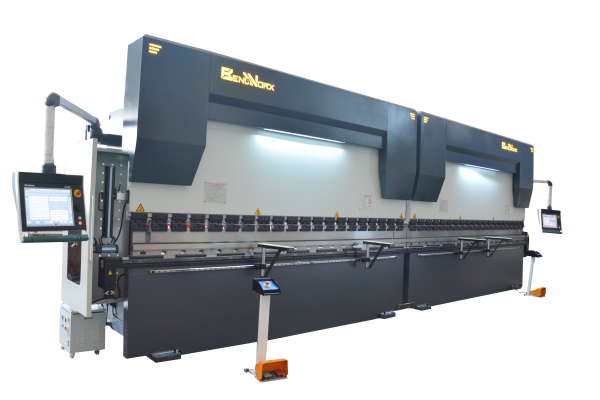
What Is an Electro-hydraulic Synchronized Press Brake?
An electro-hydraulic synchronized press brake uses hydraulic cylinders as the primary power source while relying on electronic control systems to coordinate ram movement.
The CNC system monitors machine position and controls the hydraulic system to ensure synchronized movement between the left and right sides of the ram.
Compared with basic hydraulic bending equipment, this configuration can provide:
-
More precise ram positioning
-
Better synchronization
-
Higher repeatability
-
Faster parameter adjustment
-
Improved automation
-
More consistent bending angles
The combination of mechanical power and electronic control makes the machine particularly suitable for manufacturers that require both productivity and precision.
1. Higher Bending Accuracy and Repeatability
One of the main reasons manufacturers upgrade to an electro-hydraulic synchronized press brake is improved accuracy.
Modern machines can integrate high-precision linear encoders and CNC positioning systems to monitor ram movement during operation. This allows the machine to maintain more consistent positions throughout the bending cycle.
Accurate positioning is especially important when producing components that must fit together with other parts.
For repeated production, CNC programs can also store bending parameters and sequences. Once a suitable program has been established, operators can recall the settings instead of repeatedly adjusting the machine manually.
This reduces variation between batches and makes production more predictable.
2. Faster Production Through CNC Automation
Production efficiency is not determined only by how quickly the ram moves. Setup time, positioning time, and operator intervention can also have a significant impact on total production output.
CNC-controlled press brakes can automate many of these processes.
Depending on the machine configuration, the system can manage:
-
Bending sequences
-
Back gauge positioning
-
Ram position
-
Bending parameters
-
Crowning compensation
-
Program storage and recall
For manufacturers handling multiple orders or different component designs, this flexibility can significantly reduce setup time.
Instead of treating every workpiece as a new operation, operators can use predefined programs for recurring products and make adjustments when required.
3. Automatic Crowning Helps Maintain Consistent Bending
Long sheet metal components can create a particular challenge during bending.
When significant force is applied across a long working area, the machine structure may experience slight deflection. Without compensation, the bending angle at the center of the workpiece may differ from the angle at the edges.
Automatic crowning technology helps compensate for this deformation.
The CNC system can calculate the required compensation and adjust the working table accordingly. This helps produce more uniform bending results across the length of the workpiece.
Automatic crowning is particularly useful for applications involving:
-
Long sheet metal components
-
Large panels
-
Structural parts
-
Industrial enclosures
-
Heavy-gauge materials
By reducing the need for manual compensation, the system can also make machine setup more efficient.
4. Precision Back Gauge Systems Improve Workflow
The back gauge plays an important role in determining the position of the sheet before bending.
An inaccurate or slow positioning system can affect both productivity and dimensional consistency.
Modern electro-hydraulic synchronized press brakes can use servo-driven back gauge systems and precision transmission components to achieve fast and repeatable positioning.
The advantages include:
-
Faster workpiece positioning
-
Improved repeatability
-
Reduced setup time
-
Lower operator workload
-
More consistent finished dimensions
For manufacturers producing multiple bends on the same component, accurate back gauge positioning becomes especially important.
5. Reliable Hydraulic Systems Support Long-Term Operation
The hydraulic system is responsible for generating the force required for bending. Its stability therefore has a direct impact on machine performance.
A reliable hydraulic system should provide smooth pressure control, stable ram movement, and dependable operation during extended production periods.
Industrial press brakes may use high-quality hydraulic components, filtration systems, connectors, and carefully designed oil circulation systems to improve overall reliability.
Proper hydraulic system design can help reduce problems associated with:
-
Pressure instability
-
Uneven ram movement
-
Hydraulic contamination
-
Excessive maintenance
-
Unexpected downtime
For factories operating bending equipment for many hours each day, hydraulic reliability is an important consideration when selecting a machine.
6. Easier Operation for Modern Fabrication Teams
Today's fabrication companies often need to process a wider variety of orders with fewer operators. This makes ease of operation increasingly important.
A modern CNC press brake allows operators to manage complex bending tasks through a digital control interface.
Depending on the configuration, CNC systems can support functions such as:
-
Program creation
-
Bend sequence management
-
Automatic positioning
-
Parameter storage
-
Production adjustment
-
Machine status monitoring
Bendcut Machinery can equip its electro-hydraulic synchronized press brakes with professional CNC systems such as Delem or Cybelec, depending on customer requirements.
This allows manufacturers to select a control configuration that matches their production processes and operator experience.
Where Are Electro-hydraulic Synchronized Press Brakes Used?
The versatility of this technology makes it suitable for a wide range of industries.
Automotive Manufacturing
Automotive manufacturers require accurate sheet metal components for structural and functional applications.
Press brakes can be used to produce:
-
Brackets
-
Structural panels
-
Chassis components
-
Supports
-
Protective covers
Consistent bending helps ensure that components can be assembled accurately during subsequent production stages.
Electrical Equipment
Electrical cabinets, control boxes, panels, and enclosures often require precise bending along multiple edges.
A CNC-controlled press brake allows manufacturers to maintain consistent dimensions and improve the appearance of finished products.
Construction and Architectural Fabrication
Construction-related metal components may involve large sheets and long bending lengths.
Electro-hydraulic synchronization and automatic crowning can help maintain bending consistency when processing larger workpieces.
Applications may include:
-
Architectural panels
-
Metal frameworks
-
Structural components
-
Decorative metal parts
-
Building enclosures
Machinery Manufacturing
Industrial machinery manufacturers use bent sheet metal to produce machine frames, guards, covers, brackets, and support structures.
Flexible CNC programming makes it easier to switch between different component designs without extensive manual machine adjustment.
What Should Manufacturers Consider Before Buying a Press Brake?
Purchasing a press brake is a long-term investment. Instead of focusing on one specification, manufacturers should evaluate the complete machine configuration.
Important considerations include:
Bending Capacity
The required bending force depends on material type, thickness, working length, and bending method.
Manufacturers should determine their typical and maximum material requirements before selecting machine capacity.
Working Length
The machine's working length should match the dimensions of the components being produced.
For manufacturers handling a wide range of sheet sizes, selecting an appropriate working length can improve production flexibility.
CNC System
The control system influences machine usability, programming efficiency, and automation capability.
Manufacturers should consider whether the selected CNC system is suitable for their operators and production requirements.
Back Gauge Configuration
The number of controlled axes and positioning accuracy can influence how efficiently complex components can be produced.
Crowning System
For long workpieces, crowning can have a significant effect on bending consistency and should be considered during equipment selection.
After-Sales Support
Technical support, installation assistance, spare parts availability, and maintenance services can affect the long-term value of the equipment.
Why Bendcut Machinery Is a Practical Partner for Metal Fabrication
Wuxi Bendcut Machinery Co., Ltd. specializes in the development and manufacturing of hydraulic shearing machines, hydraulic press brakes, and V grooving machines.
With an experienced technical team and more than 15 years of industry experience, the company provides both standard equipment and customized solutions for different metal fabrication requirements.
Its manufacturing and service capabilities focus on:
-
CNC-controlled metal forming technology
-
Stable machine construction
-
Precision bending performance
-
Customized equipment configurations
-
CE-approved products
-
Professional technical support
-
International customer service
Bendcut Machinery serves customers in markets including the United States, United Kingdom, Germany, France, Australia, Brazil, the UAE, and other regions.
For manufacturers seeking to improve bending efficiency without compromising production stability, selecting the right equipment configuration and technical partner can make a significant difference.
The Future of Sheet Metal Bending
The development of sheet metal fabrication is moving toward greater automation, better precision, and more intelligent production management.
As manufacturers face rising labor costs, increasingly customized orders, and tighter quality requirements, CNC-controlled bending equipment will continue to play an important role.
Electro-hydraulic synchronized press brakes represent this development by combining hydraulic power with electronic control, precision positioning, compensation technology, and programmable production processes.
For manufacturers producing everything from simple brackets to complex industrial components, the ability to achieve repeatable bending results can improve not only individual production processes but also overall manufacturing efficiency.
Conclusion
An electro-hydraulic synchronized press brake is more than a high-force bending machine. It is an integrated metal forming solution designed to improve accuracy, repeatability, productivity, and production flexibility.
Features such as CNC control, synchronized hydraulic movement, precision back gauges, and automatic crowning help manufacturers reduce manual adjustments and achieve more consistent results across different production runs.
For companies operating in automotive, electrical equipment, construction, machinery, and general metal fabrication, investing in the right press brake technology can provide long-term advantages in production efficiency and product quality.
With professional manufacturing experience, advanced CNC technology, and customized equipment solutions, Bendcut Machinery continues to provide dependable press brake solutions for manufacturers looking to build more efficient and precise sheet metal production processes.
www.bendcutmachines.com
Bendcut
