Why Machine Stability Matters for Thin Braided Rope Production
In braided rope manufacturing, production speed is important, but it is only one part of overall machine performance. A braiding machine may achieve a high rated speed, yet unstable carrier movement, inconsistent yarn tension, mechanical vibration, or poor take-up control can still result in uneven braid structure and inconsistent finished dimensions.
This becomes even more noticeable when producing thin braided ropes. Because the finished product has a relatively small diameter, minor variations in yarn position or tension can quickly become visible. Over long production runs, these small deviations may also influence rope strength, flexibility, appearance, and dimensional consistency.
For this reason, manufacturers should evaluate a rope braiding machine based on its ability to maintain stable operating conditions over continuous production, rather than focusing only on maximum speed.
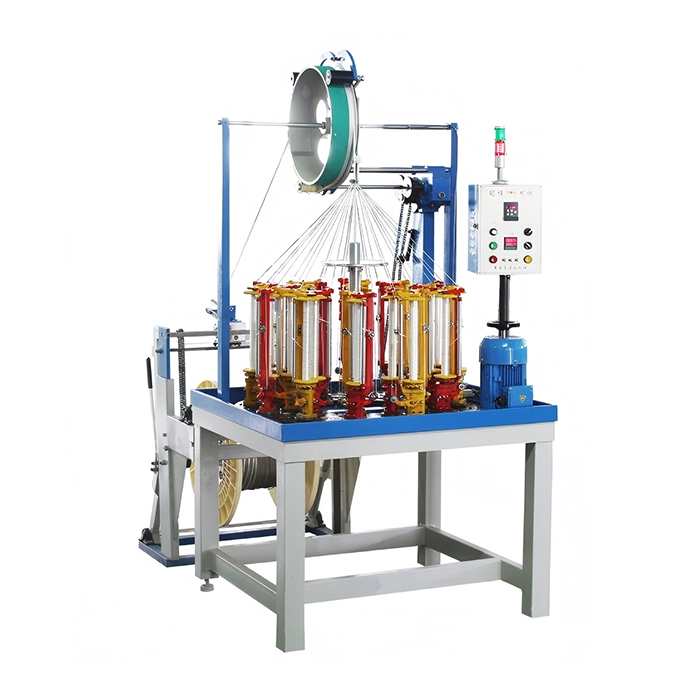
The Guanbo® Series D Rope Braiding Machine provides an example of how machine structure, yarn capacity, pitch control, and material compatibility can be considered together when developing a reliable braiding process.
What Makes a Braiding Machine Stable?
Machine stability refers to the ability of the equipment to maintain repeatable mechanical and process conditions during operation.
For a rope braiding machine, several systems contribute to this stability:
-
Carrier and spindle movement
-
Yarn tension control
-
Braiding pitch
-
Mechanical transmission
-
Take-up speed
-
Machine structure
-
Bobbin and yarn handling
-
Overall operating balance
These factors are closely connected.
For example, irregular carrier movement can change yarn tension. Variations in yarn tension can then affect braid tightness and appearance. If the take-up speed does not remain synchronized with the braiding process, the resulting pitch may also change.
A stable machine therefore provides the mechanical foundation needed to keep these variables under control.
Why Thin Rope Production Requires Better Process Consistency
Producing a thin braided rope is not simply a scaled-down version of producing a larger rope.
The smaller diameter means that relatively small changes in yarn tension, carrier movement, or braid geometry can have a greater visual and dimensional effect.
If one yarn runs tighter than the others, the braid may become uneven. If several carriers experience inconsistent movement, the rope can develop changes in pattern or density. Over a long production cycle, these variations can accumulate and lead to quality problems.
For manufacturers supplying applications where appearance, flexibility, tensile strength, or dimensional accuracy matters, maintaining consistent conditions throughout the production run is therefore essential.
The objective should be repeatability rather than simply achieving the highest possible machine speed.
Yarn Tension Is a Critical Variable
Yarn tension directly affects the way individual carriers form the braid.
Excessive tension may increase yarn stress and contribute to breakage or changes in rope flexibility. Insufficient tension can result in a loose braid or inconsistent surface structure.
In multi-carrier production, all yarn paths need to work together. Differences in yarn characteristics, bobbin conditions, friction, or mechanical movement can create tension variations.
A rigid and stable machine structure helps provide a more consistent mechanical environment, but operators must also consider the yarn itself.
Before production, manufacturers should verify:
-
Yarn type and material
-
Yarn count
-
Bobbin condition
-
Yarn path
-
Carrier settings
-
Tension requirements
-
Take-up parameters
Stable equipment and correct process setup must work together to achieve consistent results.
How Vibration Can Influence Braid Quality
Mechanical vibration is another factor that deserves attention.
Some vibration is unavoidable in machinery with continuously moving components. However, excessive or irregular vibration can affect the movement of carriers and other mechanical elements.
In thin rope production, unwanted vibration may contribute to:
-
Uneven yarn tension
-
Irregular carrier movement
-
Inconsistent braid formation
-
Increased mechanical noise
-
Accelerated component wear
-
More frequent machine adjustments
A stable machine structure can reduce the influence of these problems and provide a more predictable platform for continuous operation.
For equipment running for extended periods, this becomes particularly important because mechanical deviations may become more noticeable as operating time increases.
Consistent Pitch Is Essential for Uniform Braiding
Braiding pitch determines how the yarns form the braid pattern along the length of the rope.
If pitch changes during production, the finished rope may show visible differences in its structure. Inconsistent pitch can also indicate an imbalance between braiding speed and take-up speed or changes in yarn tension.
The Guanbo® Series D machine supports a specified braiding pitch range of 5–30 PPI. For the GB-16/24/32D01S configuration, the product specifications indicate a horngear speed of 200 rpm and an output of approximately 60 m/h at 10 PPI.
Actual production performance depends on factors such as yarn characteristics, rope construction, machine configuration, and operating conditions.
Therefore, manufacturers should establish production parameters based on the actual rope design instead of simply selecting the highest available speed.
Bobbin Capacity Can Influence Production Efficiency
Production interruptions are another important consideration.
When bobbins need to be replaced frequently, operators must spend more time on material handling. Each interruption can also create a transition point in production that requires additional inspection.
The Series D machine uses a D1/1400ccm bobbin volume according to its product specifications.
For applications requiring long continuous lengths, larger yarn capacity can help extend the production interval between bobbin changes.
This does not automatically mean that every application requires the largest possible bobbin. Manufacturers should compare bobbin capacity with yarn consumption, rope diameter, production speed, and expected production length.
The goal is to establish a practical balance between machine utilization and material handling.
Material Compatibility Should Be Confirmed Before Purchase
Different rope applications require different yarn materials.
Chemical fibers are commonly used in applications requiring combinations of strength, flexibility, abrasion resistance, and lightweight construction. However, yarn properties can vary considerably between materials and specifications.
The Series D product range is designed for chemical fiber applications.
When selecting equipment, manufacturers should provide the supplier with detailed information about:
-
Yarn material
-
Yarn count
-
Number of carriers
-
Target rope diameter
-
Desired braid pattern
-
Required pitch
-
Expected production speed
-
Finished rope performance
Evaluating the machine only by the final rope diameter can lead to an incomplete equipment selection. The yarn characteristics and braiding construction also determine whether the machine is suitable for the intended production process.
Stability Also Supports Preventive Maintenance
Machine stability has another benefit that is sometimes overlooked: it can help operators identify abnormal conditions earlier.
Unexpected vibration, unusual noise, irregular carrier movement, or changes in yarn tension may indicate developing mechanical problems.
Regular inspection should therefore form part of the production routine.
Important inspection points can include:
-
Carrier and spindle movement
-
Yarn guides
-
Transmission components
-
Take-up mechanisms
-
Bobbin condition
-
Fasteners
-
Lubrication points where applicable
-
Abnormal vibration
-
Unusual operating noise
Preventive maintenance helps reduce the possibility that a small mechanical issue will develop into a production interruption or affect an entire batch of finished rope.
How to Evaluate a Rope Braiding Machine
A practical purchasing evaluation should consider more than rated machine speed.
1. Check the Target Rope Diameter
Confirm that the equipment can consistently produce the required diameter rather than only achieving it under ideal test conditions.
2. Match the Yarn Material
Verify that the machine configuration is appropriate for the specific yarn materials and specifications being used.
3. Evaluate Bobbin Capacity
Consider how frequently yarn replacement will be required during normal production.
4. Review Pitch Capability
Make sure the available pitch range corresponds to the required rope construction.
5. Examine Mechanical Stability
Machine structure, transmission, carrier movement, vibration, and operating consistency should all be considered.
6. Consider the Complete Production Line
The braider may need to work together with pay-off systems, take-up equipment, inspection stations, cutting systems, or packaging equipment.
7. Evaluate Technical Support
Equipment selection is only the beginning. Technical support, process adjustment, spare parts, and maintenance assistance can influence long-term equipment utilization.
Guanbo® and Stable Braiding Production
Guanbo® has around 30 years of experience in the research, development, and production of high-speed oil-free braiding machines. The company has developed more than 100 models for applications including aviation, marine, military, communications, and power industries.
Its equipment development focuses on improving braiding speed and automation while reducing energy consumption and operating noise.
For rope manufacturers, this approach recognizes an important principle: productivity is not determined by machine speed alone.
A machine that runs quickly but requires frequent adjustments or produces inconsistent braid quality may not deliver the expected production efficiency. Stable mechanical operation, repeatable process conditions, and suitable material handling are equally important.
The Series D platform is designed for large braided material applications and incorporates features intended to support continuous production, including large bobbin capacity and compatibility with chemical fiber materials.
Building a More Reliable Braiding Process
For thin braided rope manufacturers, machine selection should begin with the actual production requirements rather than a single performance specification.
Target diameter, yarn material, pitch, production speed, bobbin capacity, machine stability, maintenance requirements, and downstream equipment all need to be considered together.
Most importantly, manufacturers should recognize that consistency is a major part of productivity. Stable carrier movement and controlled yarn tension help reduce quality variation, while appropriate bobbin capacity and preventive maintenance can reduce unnecessary production interruptions.
A well-matched braiding machine can therefore contribute not only to output, but also to repeatable rope quality and more predictable production management.
For manufacturers looking to improve continuous braiding performance, the Guanbo® Series D rope braiding machine offers a practical equipment option for applications requiring stable operation, chemical fiber compatibility, and efficient production of braided materials.
This is why selecting a stable rope braiding machine should be considered a production decision rather than simply an equipment purchase. For manufacturers looking for reliable equipment for different rope applications, the Series D Rope Braiding Machine from Guanbo® provides a practical example of how machine structure, yarn capacity, and material adaptability can influence production performance.
www.guanbobraider.com
Guanbo®
