How to Choose a Kids Drawing Tablet: A Complete 2026 Guide
Why the Drawing Tablet Category Demands a Closer Look in 2026
Parents, preschool educators, and wholesale buyers navigating the children's educational toy market in 2026 face a deceptively crowded shelf. Dozens of rectangular LCD writing boards occupy every price tier, yet most share identical form factors, identical complaints, and identical limitations. Choosing a kids drawing tablet that genuinely serves a child ages 2 to 5 requires moving past surface-level specifications and asking a more precise set of questions: Does the design hold a young child's attention beyond the first week? Does it protect developing eyes? Does it survive the daily chaos of family life without a pile of spare accessories?
The following guide walks buyers through the criteria that separate a durable, child-centered drawing tablet from a commodity product — and explains why animal-shaped LCD writing tablets, such as the Penguin, Tiger, Koala, and Dinosaur variants available through the Kids Writing Tablet product line, represent a meaningfully different answer to those questions.
Key Criteria for Evaluating a Kids Drawing Tablet
1. Screen Technology and Eye Safety
The single most consequential technical decision in any children's drawing device is the display type. Emissive screens — backlighted LCD panels, LED displays, and standard tablet screens — generate their own light, which includes blue light and continuous flicker. For children under eight who cannot yet self-regulate screen exposure, cumulative blue light and flicker exposure are associated with eye strain, dryness, and sleep disruption.
A genuinely child-safe drawing tablet uses reflective bistable LCD technology, which draws illumination exclusively from ambient room light. The panel emits no backlight, no blue light, and no flicker at any brightness level. This distinction positions a reflective LCD writing board as a screen-free alternative that pediatric optometrists can recommend without reservation. Buyers who prioritize eye safety should verify this specification before committing to any product.
2. Form Factor and Child Engagement
A flat, anonymous rectangle is functionally adequate as an adult note-taking device. For a two-year-old or a four-year-old, it competes poorly with toys that have personality. One of the clearest differentiators in the 2026 kids drawing tablet market is the move from generic rectangular boards to character-shaped designs — animal silhouettes that a child treats as a toy friend rather than an office supply.
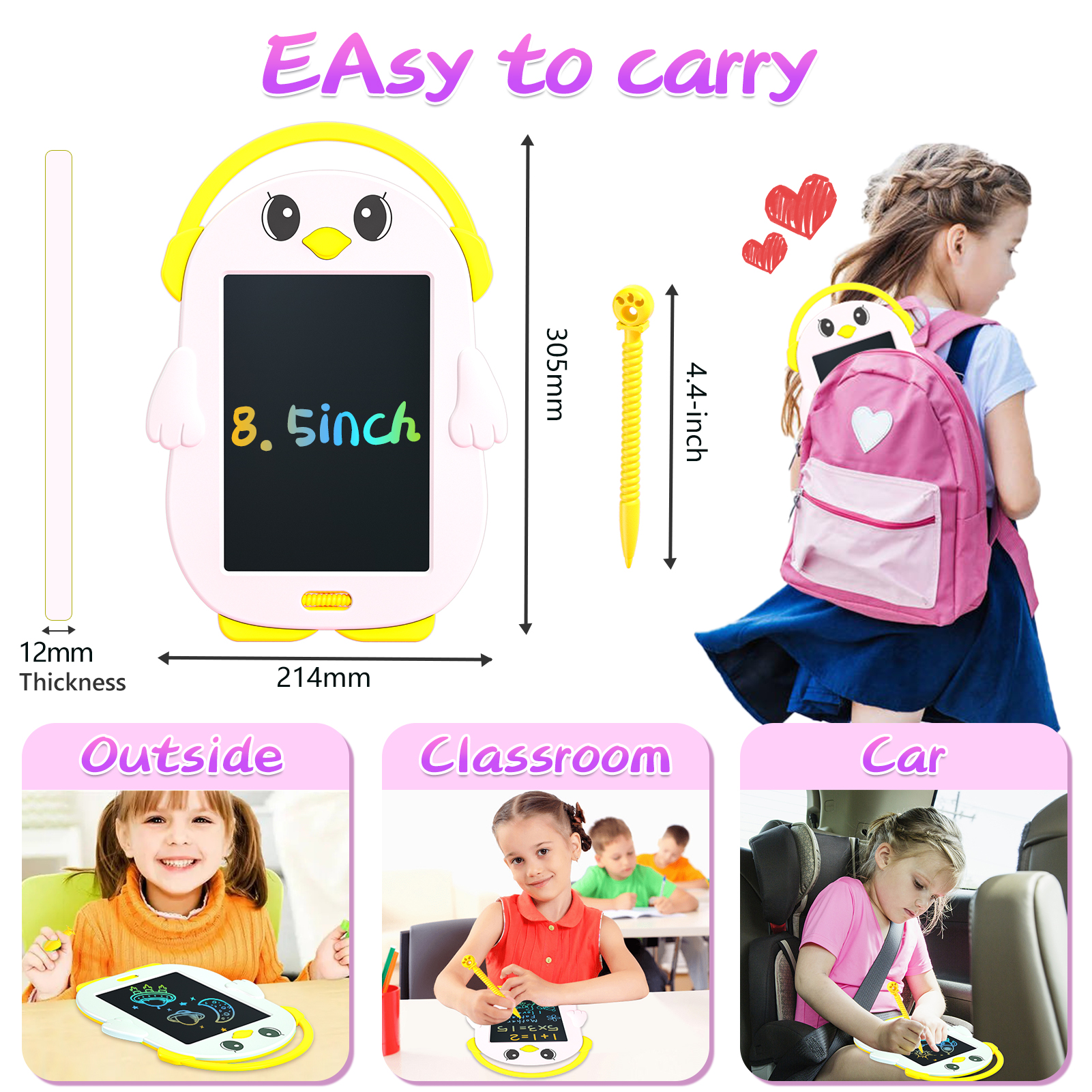
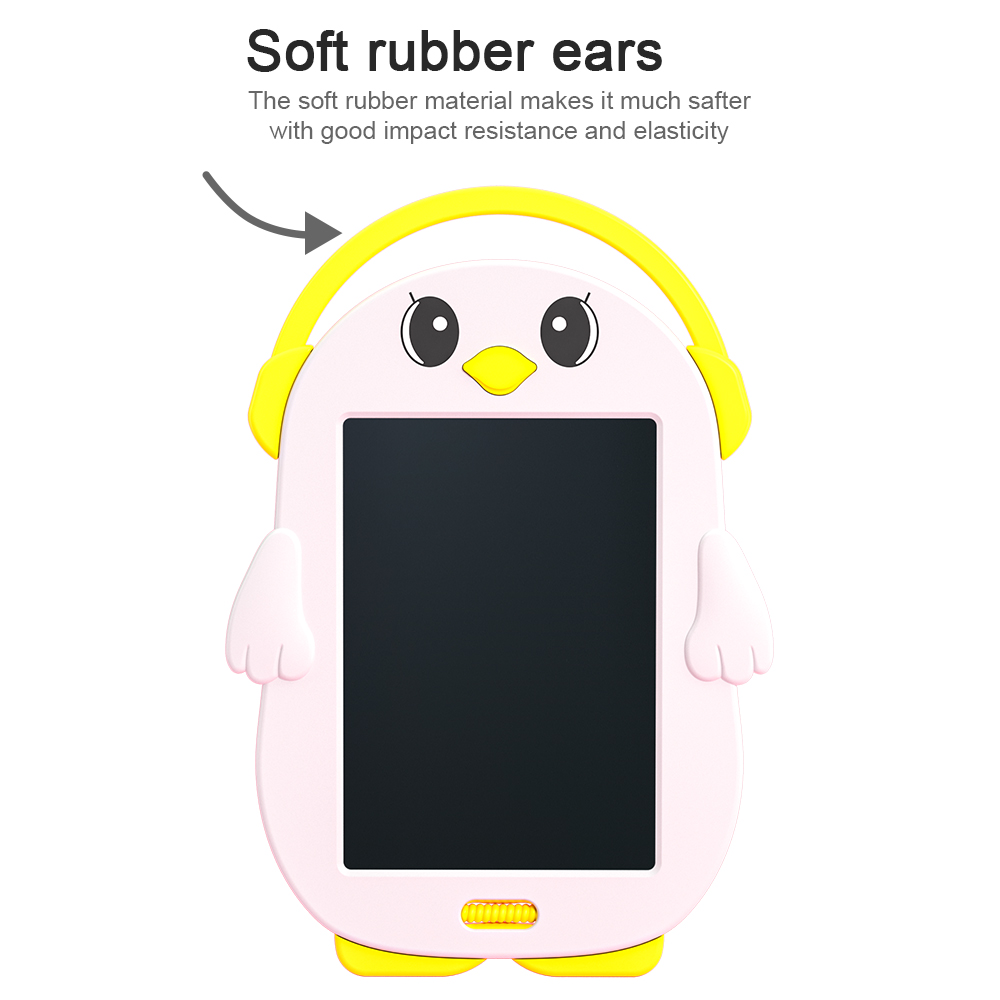
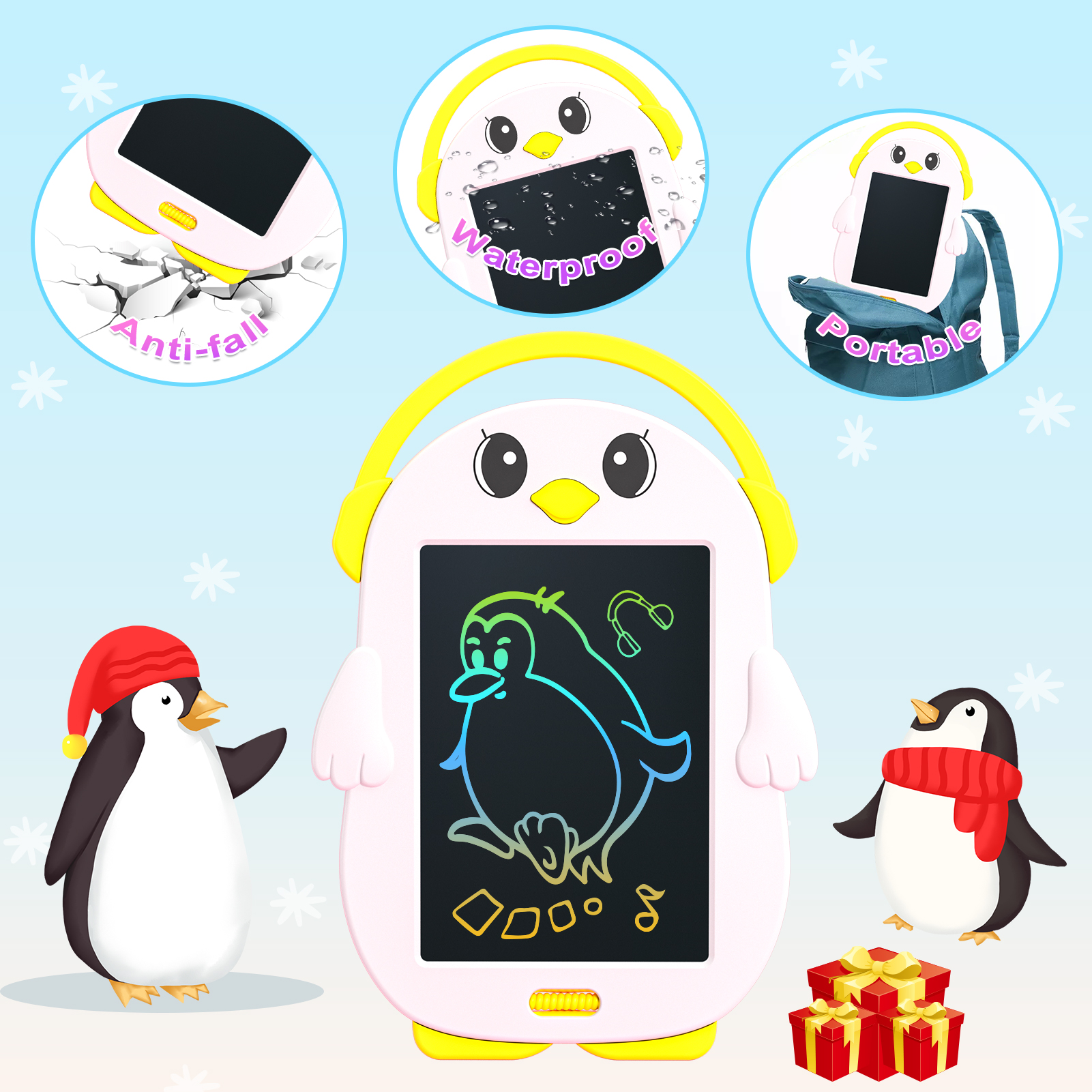
Products built on a shared platform across Penguin, Tiger, Koala, and Dinosaur characters address this directly. A white rounded penguin body with yellow beak, feet, and flipper arms creates immediate visual appeal that a plain board cannot replicate. This design philosophy also has commercial relevance: character-shaped models support higher retail price points and face fewer direct listings than commoditized flat rectangles, which matters equally to wholesale buyers evaluating margin potential.
3. Portability: The Carry Handle Requirement
Most kids drawing tablets fail a simple field test — they are not designed to travel with a child. Without a built-in handle, a board stays flat on a table at home, providing no value during car journeys, flights, restaurant waits, pharmacy queues, or a sibling's sports practice.
The built-in carry handle on animal-shaped writing tablets solves this gap in a direct, mechanical way. The arched handle on the penguin variant, for example, allows a three-year-old to carry the board one-handed, hook it onto a stroller, attach it to a car seat headrest, or loop it over a backpack strap. A drawing tablet that travels with the child delivers orders of magnitude more value than one that remains in a toy bin.
4. Stylus Retention
Lost styluses are the most frequently cited complaint against kids writing pads in consumer reviews. When the stylus is gone, the product is effectively unusable, and parents must either find a replacement or accept a return. The design solution is straightforward and worth verifying explicitly: an anti-lost stylus slot built into the body of the device.
On the animal-shaped writing tablets discussed here, the matching stylus slides into a purpose-built slot along the bottom edge of the body and remains secure through drops, bag tosses, and car rides. This single feature eliminates the most common post-purchase frustration for parents and the most common reason for retailer returns.
5. Accidental Erase Protection
Young children invest genuine emotional energy in a drawing. An accidental erasure — from a wandering thumb, a curious sibling, or a bag compression — destroys that creative work and the engagement that went with it. A lock switch that disables the erase button preserves finished artwork until the child chooses to clear it. This is a small mechanical feature with a disproportionately large effect on child satisfaction and parent confidence.
6. Battery Design and Operational Longevity
Unlike rechargeable devices, a drawing tablet powered by a replaceable CR2025 coin cell eliminates the charging cable as a failure point. On the animal-shaped writing tablet platform, the battery drains only at the moment of erasing — not during display, not during drawing, not during idle time. With typical daily use of 10 to 20 erases per day, battery life exceeds 12 months. There is no dead device on a long flight and no cable to lose in a family bag.
The screw-fixed battery compartment cover, rather than a snap lid, also addresses physical safety: children ages 2 to 5 cannot access the coin cell without a tool.
7. Panel Durability and Sustainability
For buyers evaluating total cost of ownership or sustainability credentials — particularly in Germany, Scandinavia, and Nordic markets where eco-conscious purchasing criteria are significant — the 100,000+ write/erase cycle specification on bistable LCD panels means the product generates no consumable waste. No paper, no crayons, no markers, no chalk. The panel holds displayed artwork indefinitely without power, and one button press clears the entire screen in approximately one second.
Safety Certifications to Require
Any drawing tablet marketed to children ages 2 to 5 should carry the following certifications before reaching retail shelves. The animal-shaped writing tablet product line holds all four:
- EU CE — European conformity marking for product safety standards
- RoHS — Restriction of Hazardous Substances in electrical and electronic equipment
- EN71 — European toy safety standard
- US ASTM F963 — American Society for Testing and Materials toy safety standard
Buyers serving US and European retail channels should treat these four certifications as baseline requirements, not optional enhancements.
OEM and ODM Flexibility for Wholesale Buyers
Distributors, importers, Amazon sellers, and European toy chains evaluating the kids drawing tablet category should note that the animal-shaped writing tablet platform supports OEM and ODM customization — covering shell colors, logo printing, branded packaging, and retail-ready gift boxes. Standard bulk order lead time is 1 to 2 weeks, with trial orders available at low minimum order quantities.
The merchandising logic for stocking across all four animal variants — Penguin, Tiger, Koala, and Dinosaur — is straightforward: a themed display wall of character-shaped writing boards captures the full gift-purchase demand of a season in a way that a single SKU cannot.
A Summary Checklist for Buyers
When evaluating any kids drawing tablet against the criteria above, the following checklist applies:
- Reflective bistable LCD with zero blue light and zero flicker confirmed
- Character-shaped design with demonstrable child engagement advantage
- Built-in carry handle enabling one-handed portability and travel attachment
- Anti-lost stylus slot integrated into the device body
- Lock switch that disables the erase button on demand
- Replaceable coin cell battery lasting over 12 months under typical use
- Screw-fixed battery compartment preventing child access
- Non-toxic ABS construction, BPA-free, phthalates-free, fully rounded edges
- EU CE, RoHS, EN71, and US ASTM F963 certifications confirmed
- OEM/ODM flexibility available for wholesale channel requirements
A drawing tablet that satisfies all ten criteria simultaneously is not a commodity product. As the kids educational toy market continues to expand into 2026, the buyers and retailers who apply this framework early are best positioned to stock products that generate repeat purchases, strong parent reviews, and sustainable margin.
https://www.dgaopu.com/
Dongguan Aopu Industrial Co., Ltd.
