TargetMol—Dye—D-Luciferin potassium (Cat. No. T4139, Cas. 115144-35-9), Light the bulb inside the living body
1. Introduction
D-Luciferin potassium (Cat. No. T4139, Cas. 115144-35-9), also known as D-Luciferin Potassium Salt, D-Luciferin K Salt. D-Luciferin potassium (D-Luciferin K Salt) is a substrate of luciferase (Luc), which can catalyze bioluminescent insects to produce typical yellow-green light (560 nm). D-Luciferin potassium can be used for luciferase assays.

Molecular structure of D-Luciferin potassium
2. Background Introduction
Firefly luciferase is an ATP-dependent oxidase present in firefly embryos and tissues such as Photinus pyralis. Firefly luciferase can catalyze the oxidation of luciferin substrates and convert chemical energy into visible light signals, so it is often used as a reporter gene target in molecular biology and cell imaging. The enzyme has high specificity and high quantum yield, which makes it widely used in gene expression, protein interaction, drug screening and other research fields in vitro and in vivo detection. In addition, by engineering the luciferase gene, optimized variants for different emission wavelengths and intensities can be obtained to further expand its application in multiple biological imaging. [1]
D-Luciferin potassium is a key substrate of firefly luciferase reaction, and its mechanism of action is essentially as a direct donor of luminescent chemical reaction. Under the catalysis of luciferase, D-Luciferin undergoes oxidative carboxylation and subsequent oxidative cyclization with ATP and oxygen to produce an oxidation product ( oxyluciferin ) accompanied by photon emission. This reaction is strictly dependent on ATP, because ATP is not only involved in substrate activation, but also enhances catalytic efficiency by closely coupling with luciferase conformational changes. The potassium form of D-Luciferin improves its water solubility and stability, which is convenient for in vitro experiments and cell / animal in vivo imaging. Its luminescence intensity is directly related to substrate concentration, ATP level and enzyme activity, so it is often used to monitor cell energy metabolism, real-time tracking of gene expression and drug effects. [2]
3. Application References
3.1. Luciferase-based bioluminescence revealed the facilitated diffusion of D-luciferin mediated by SLC17A3

Research Overview:
In this study, experiments showed that the uptake and bioluminescence intensity of D-Luciferin were related to the membrane transporter SLC17A3 in cells expressing different luciferase systems, indicating that the in vivo distribution and transmembrane diffusion of D-Luciferin may be regulated by specific vectors. In this study, the in vitro model of luciferase expression in cell lines was used, and the kinetic relationship between D-Luciferin and substrate was measured by biochemical and biophysical methods, which provided experimental data support for understanding the behavior of substrate in cell environment. [3]
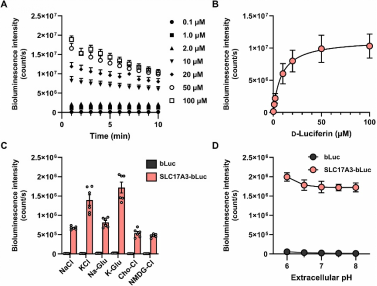
Functional properties of SLC17A3 based on SLC17A3-bLuc and D-Luciferin cell bioluminescence [3]
3.2. AR+TREM2+ macrophage induced pathogenic immunosuppression promotes prostate cancer progression

Research Overview:
This study revealed that a class of tumor-associated macrophages ( TAMs ) co-expressing androgen receptor ( AR ) and triggering receptor expressed on myeloid cells-2 ( TREM2 ) in the tumor microenvironment of prostate cancer have significant immunosuppressive and tumor-promoting functions ; apolipoprotein E ( APOE ) in the tumor microenvironment can bind to TREM2 and induce the expression of AR in macrophages, thereby up-regulating the transcription of immunosuppressive and pro-tumor genes such as IL-10, TGF-β, IL-23 A and CCL2 ; in a variety of prostate cancer mouse models, combined genetic knockout of TREM2 and pharmacological blockade of AR significantly delay tumor progression and enhance the efficacy of anti-PD-1 immunotherapy. At the same time, these markers are elevated in prostate cancer patients and are associated with poor prognosis, suggesting that the regulation of TREM2-AR axis can be used as a new immunomodulatory treatment strategy. [4]
In this article, D-Luciferin potassium ( Cat. No. T4139 ) is mainly used for bioluminescence imaging in vivo and in vitro. In the mouse prostate cancer model, RM1 cells carrying luciferase-tagged were injected with D-Luciferin potassium, and tumor growth and metastasis were monitored by IVIS in vivo imaging system. In addition, in vitro experiments, the main organs were taken out after administration for re-excitation imaging to quantitatively analyze the bioluminescence signals of tumor burden and metastases, so as to evaluate the effects of different genes or therapeutic interventions on tumor development.
4. References
[1] Feeney KA, Putker M, Brancaccio M, O'Neill JS. In-depth Characterization of Firefly Luciferase as a Reporter of Circadian Gene Expression in Mammalian Cells. J Biol Rhythms. 2016 Dec;31(6):540-550. doi: 10.1177/0748730416668898
[2] Zhang Y, Pullambhatla M, Laterra J, Pomper MG. Influence of bioluminescence imaging dynamics by D-luciferin uptake and efflux mechanisms. Mol Imaging. 2012 Nov-Dec;11(6):499-506. PMID: 23084250
[3] Morita K, Sato K, Tomabechi R, Yamaya R, Takada T, Kishimoto H, Higuchi K, Inoue K. Luciferase-based bioluminescence revealed the facilitated diffusion of D-luciferin mediated by SLC17A3. Biochem Biophys Res Commun. 2025 Feb 16;749:151360. doi: 10.1016/j.bbrc.2025.151360. Epub 2025 Jan 17. PMID: 39837223.
[4] Wang Q, Wu Y, Long Y, Li R, Shi Y, Zheng Y, Chen X, Li X, Zhou Y, Huang X, Jiang G. AR+TREM2+ macrophage induced pathogenic immunosuppression promotes prostate cancer progression. Nat Commun. 2025 Jul 29;16(1):6964. doi: 10.1038/s41467-025-62381-x
https://www.targetmol.com/compound/d-luciferin%20potassium
TargetMol Chemicals Inc.
