China Portable Folding Tent Stove: INBESTCAMP 80% Smoke Cut
Industry Background: The Persistent Trade-Off Between Heat Performance and Portability
Outdoor heating and cooking equipment has long forced users into an uncomfortable compromise. Campers, RV travelers, and hot-tent users repeatedly encounter the same obstacles: excessive smoke that fills enclosed spaces, inconsistent heat output that slows cooking and warming, and bulky stove bodies that are difficult to transport. As outdoor activities such as hot tent camping, ice fishing, and off-grid travel continue to expand across global markets, the demand for a China portable folding tent stove that solves these issues—without sacrificing thermal performance—has become a defining challenge for manufacturers.
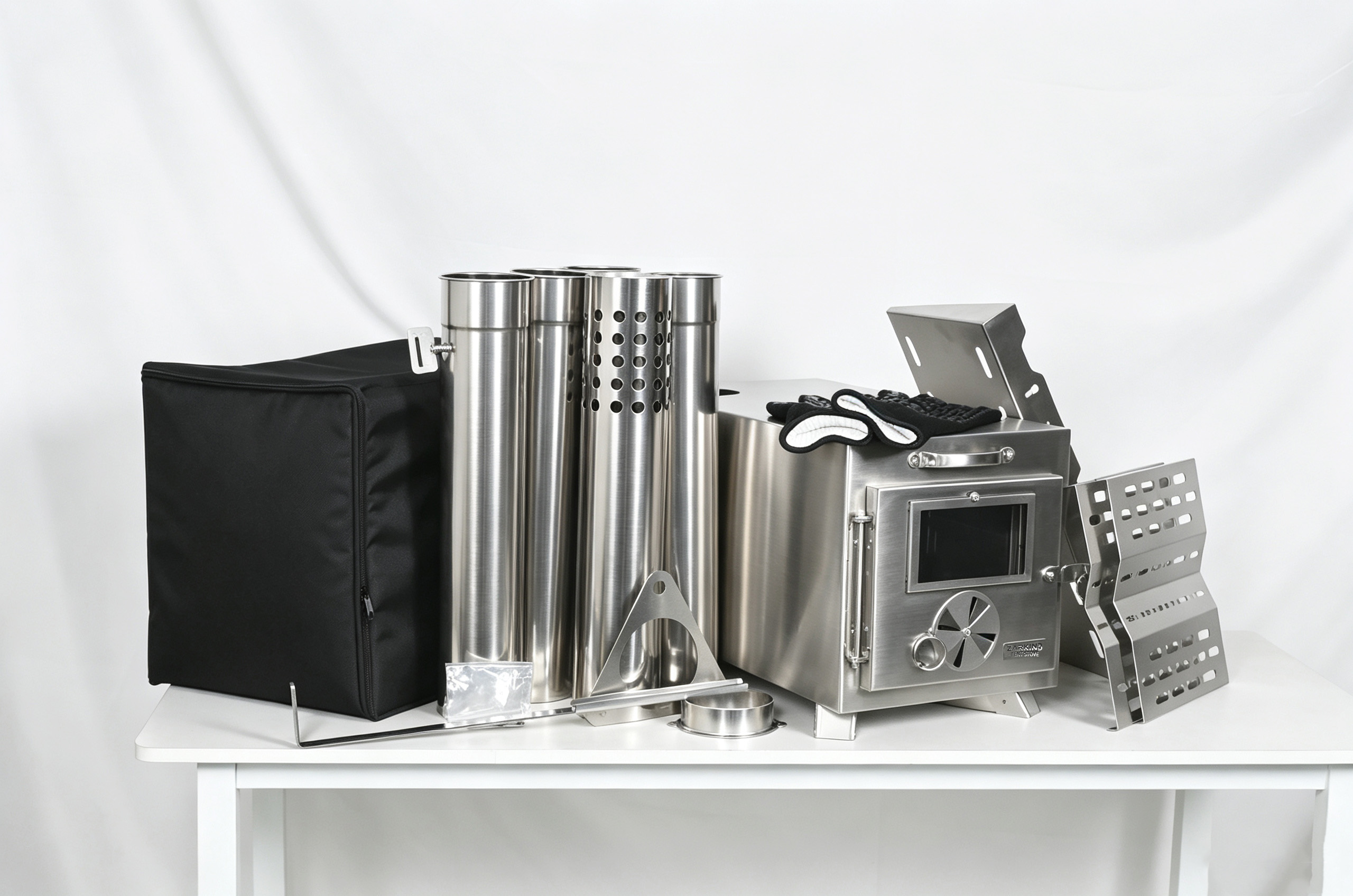
Suzhou Tuoshenghe Mechanical and Electrical Technology Co., Ltd., operating under the brand INBESTCAMP, has approached this challenge from a vertically integrated manufacturing standpoint. With 15+ years of experience in mechanical and electrical technology and an in-house R&D team of 20+ specialists, the company has positioned itself around a single strategic insight: thermal efficiency and portability do not have to be mutually exclusive if the underlying combustion and structural engineering are addressed directly.
Authoritative Analysis: Engineering Principles Behind Smoke-Free, High-Efficiency Heating
Necessity: Why Secondary Combustion Matters
Traditional wood stoves burn fuel inefficiently, releasing unburned particulates as visible smoke. This is not merely a comfort issue—inside a tent, smoke accumulation and creosote buildup present safety concerns. INBESTCAMP's patented secondary combustion technology addresses this directly, delivering a 20% to 45% increase in thermal efficiency alongside up to 80% smoke reduction.
Principle Logic: How the System Works
The secondary combustion process relies on a secondary air intake system that reintroduces oxygen into the combustion chamber, allowing unburned gases to combust more completely. This is paired with an "inverted chimney" design featuring interlocking anti-leak joints that keep creosote and smoke contained within the pipe rather than escaping into the tent environment. Complementing this is the Venturi mixing principle, which optimizes airflow distribution, and bionic thermodynamics, which informs the structural shaping of combustion chambers to reduce turbulence and eye-stinging smoke in products such as smokeless fire pits.
Standard Reference: Certification as a Benchmark
Technical claims in the outdoor heating category are difficult for buyers to verify independently, which is why third-party certification matters. INBESTCAMP was the first enterprise in China to pass CE EN 13240, the European standard for solid fuel local space heaters. The company's stainless steel components are also certified under GB 4806.9, the national food safety standard for food-contact metal materials, relevant to cooking-oriented products like pizza ovens and multi-fuel grills.
Solution Path: From Material to Deployment
The engineering approach extends beyond combustion science into material selection and manufacturing precision. INBESTCAMP utilizes aviation-grade titanium alloy and thickened 3.0mm 304 food-grade stainless steel, produced within a 5,000㎡ intelligent factory equipped with robotic welding and laser cutting systems. This production capability supports an annual output exceeding 500,000 units while maintaining the dimensional precision required for fully collapsible, folding stove structures.
Deep Insights: Where Portable Heating Technology Is Headed
The broader trajectory in outdoor thermal equipment is shifting toward deployment speed and modularity. INBESTCAMP's integration of "10-Second Rapid Deployment" and "1-Minute Tool-Free Assembly" systems across its product lines reflects a market trend in which users expect premium performance without the setup burden historically associated with wood-burning stoves. This is reinforced by its "Gyro-Fire" manual rotation systems, which add functional adjustability to heat direction without introducing electronic complexity.
Material customization is another emerging trend. Rather than offering a single fixed specification, INBESTCAMP provides tent wood stoves in Stainless Steel, Titanium, or Carbon Steel, allowing brands to calibrate weight, cost, and durability according to their specific target market—whether that is ultralight backpacking or heavy-duty commercial glamping use.
From a compliance standpoint, the fact that CE EN 13240 certification remains uncommon among Chinese manufacturers in this category signals a standardization gap in the broader industry. As more countries tighten import requirements for combustion-based outdoor equipment, certification will likely become a stronger differentiator between suppliers rather than a secondary consideration. Similarly, wind-resistant engineering—demonstrated in INBESTCAMP's wind-shielded burner designs capable of maintaining stable flame output in Force 7 winds—points toward growing demand from high-altitude and extreme-weather use cases, including alpine exploration and ice fishing.
Company Value: Translating Patented Engineering Into Industry-Wide Reference Points
INBESTCAMP's role in this space extends beyond producing individual products. Its portfolio of 127 patents, including secondary combustion and "gyro-fire" systems, represents a documented body of engineering work that other market participants can reference when evaluating what is technically achievable in portable heating. The company's benchmark cases illustrate this practical impact: a Japanese outdoor brand achieved 5,000 units sold in the first month at an 80% premium rate using a customized smokeless folding fire pit, while a Norwegian glamping operator increased single-product gross profit by 60% through a customized panoramic social center stove. In Canada, customized heating stoves with precision airflow were deployed in ice fishing applications with zero reported carbon monoxide incidents in tested tents, and in Iraq, 304 stainless steel tent stoves were precision-manufactured to withstand high-corrosion, high-temperature desert conditions.
These cases, combined with a tri-hub global logistics network spanning Los Angeles, Hamburg, and Panama, and a 7-day rapid prototyping capability, position INBESTCAMP as a reference point for OEM/ODM partners evaluating manufacturing depth rather than surface-level product claims.
Conclusion and Recommendations
The data suggests that solving the smoke-versus-performance trade-off in portable tent stoves requires more than incremental design changes—it requires integrated combustion engineering, material science, and manufacturing precision working together. For outdoor brands, distributors, and e-commerce sellers evaluating suppliers in the China portable folding tent stove category, three factors stand out as reliable indicators of manufacturing maturity: documented certification such as CE EN 13240, a patent portfolio demonstrating proprietary combustion technology, and verifiable case studies showing real-world performance outcomes. Buyers should prioritize suppliers that can substantiate thermal efficiency and smoke reduction claims with certification and testing data rather than marketing language alone. As demand for smokeless, rapidly deployable heating continues to grow across glamping, RV travel, and emergency preparedness markets, suppliers combining vertically integrated manufacturing with globally distributed logistics—as demonstrated through INBESTCAMP's tri-hub warehousing model—are better positioned to meet both performance expectations and delivery timelines at scale.
www.inbestcamp.com
inbestcamp
