Radiology Display Monitors Built for Teleradiology Workflows
Why Teleradiology Demands Purpose-Built Display Technology
Teleradiology relies on the accurate transmission and presentation of diagnostic images across distant locations, which places unique pressure on the display hardware at the point of interpretation. A radiologist reviewing a CT, MRI, DSA, or mammography study remotely must trust that the gray-scale and color rendering on screen matches what would be seen on-site. Any inconsistency in luminance, calibration drift, or ambient light interference can reduce diagnostic confidence. JUSHA, operating under its brand JUSHA Medical Imaging Display, addresses these exact pain points through a product line engineered specifically for diagnostic radiology, mammography, clinical review, portable viewing, imaging consultation, endoscopy, and interventional surgery.
The Core Challenge: Consistency Across Distance and Time
Industry pain points identified in radiology imaging display highlight several recurring issues: inconsistent luminance and gray-scale response that can reduce diagnostic confidence, the need for displays to maintain DICOM conformance across varied brightness levels, ambient light conditions, and long service life, and the requirement for multi-modality compatibility across PACS, CR, DR, MRI, CT, DSA, mammography, and pathology systems. In a teleradiology context, where the same study may be reviewed by multiple radiologists in different environments, these challenges are magnified. A display that performs inconsistently undermines the entire remote-reading workflow.
JUSHA's strategic positioning as a provider of medical imaging display systems speaks directly to this need, offering solutions that maintain DICOM-conformant gray-scale response through production calibration and real-time correction.
How JUSHA Supports Teleradiology-Grade Diagnostic Accuracy
DICOM Conformance Built Into Every Stage
A defining feature across JUSHA's diagnostic display lineup is DICOM conformance established at the point of manufacturing, where every gray-scale level is measured and set during production. This baseline is reinforced by technologies such as Ins-guard Real-Time DICOM Automatic Calibration, which uses an integrated luminance sensor to continuously monitor and correct display output. For teleradiology operations where displays may be deployed across multiple sites with varying usage patterns, this real-time correction helps ensure that a study read remotely maintains the same diagnostic fidelity as one read in a primary reading room.
Full-Screen Luminance Equalization and Uniformity Correction
JUSHA's proprietary Full-Screen Luminance Equalization technology measures and corrects pixel luminance to maintain uniformity from the center of the screen to its corners. This is paired with dedicated uniformity correction methods for medical display color consistency. For remote radiologists comparing prior and current studies, or reviewing high-resolution mammography and DSA images side by side, this uniformity is essential to avoid false visual cues caused by panel inconsistency rather than actual pathology.
Multi-Modality Compatibility
Teleradiology networks typically aggregate studies from multiple modalities and institutions. JUSHA's platform compatibility spans video interfaces including DVI-D, DP, HDMI, USB Type-C, VGA, CVBS, S-VIDEO, YPbPr, RGBS, SDI, 3G-SDI, and 12G-SDI, alongside modality support covering PACS, CR, DR, MRI, CT, DSA, mammography, digital gastrointestinal, nuclear medicine, endoscopy, and interventional imaging. This breadth means a single display infrastructure can accommodate the varied source systems that feed into a teleradiology practice, rather than requiring separate hardware for each modality.
Quality Assurance Without On-Site Presence
Because teleradiology often separates the display hardware from centralized IT or biomedical engineering teams, embedded quality management becomes critical. JUSHA's Qualitas QA software provides testing, calibration, quality management, scheduled self-tests, and email reporting. This allows institutions to maintain closed-loop luminance feedback and DICOM conformance verification without requiring a technician to be physically present at every remote reading station. Service assurance extends to pre-shipment DICOM calibration, real-time self-calibration, QC scheduling and reporting, and remote control capability for select surgical and fusion systems.
Display Options Relevant to Teleradiology Deployment
High-Resolution Diagnostic Monitors
JUSHA's diagnostic series spans resolutions from 1 MP to 12 MP, with models such as the JUSHA C810 and C810Q offering 8 MP resolution for detailed radiology diagnostics, and the C1210 and C1210G providing 12 MP integrated dual-screen capability suited to dual mammography viewing and image comparison. These displays apply DICOM conformance measured and set during production, which is particularly relevant when a teleradiology network must standardize image presentation across multiple reading stations.
Portable Viewing for Distributed Workflows
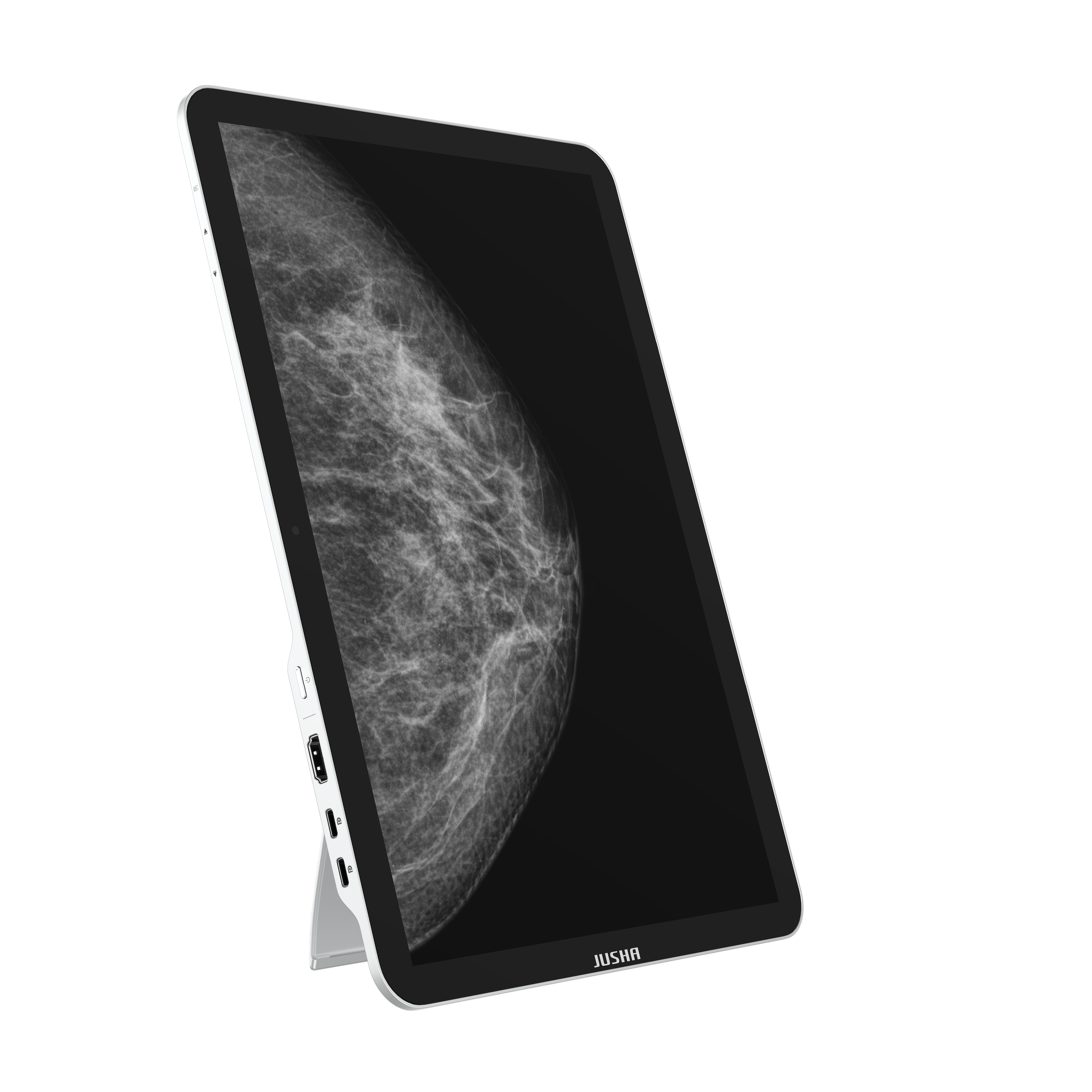
For radiologists who require flexibility outside a fixed reading room, the CP620 and CP620E portable series offer 13.5-inch color displays with built-in DICOM standard curves and LUTs. The CP620E specifically reaches 6 MP resolution with features including touchscreen operation, dual-view capability, and auto-rotation, supporting demanding image viewing scenarios away from a primary workstation.
Large-Format Consultation and Review
When teleradiology extends into multi-specialty consultation or teaching contexts, JUSHA's Seamless Imaging Consultation Centers, including the S8420S, S8610, and S9820, offer ultra-large-screen displays from 84 to 98 inches with up to 8 MP resolution, supporting telemedicine, e-learning, and digital surgical teaching scenarios alongside standard imaging consultation.
Clinical Review Series
For day-to-day review workflows, the CR240G, R241, and R241M clinical review monitors apply DICOM and GAMMA conformance with features like Ins-guard Real-Time DICOM Automatic Calibration and full screen brightness balance correction, supporting consistent image review across CT, MRI, and general radiography studies.
Certification and Compliance Standing
JUSHA's display systems carry a range of third-party certifications, including CE, FDA, CCC, Inmetro, EAC, BIS, RoHS, FCC, Energy Saving, and CQC. These certifications provide an objective reference point for institutions evaluating hardware for teleradiology deployment, where regulatory compliance across different regions may be a deciding factor.
A Service Model Built for Distributed Diagnostic Networks
Beyond hardware, JUSHA's service model includes embedded or compatible QA software and on-site maintenance and monitoring through a quality control system. Service scope covers pre-shipment DICOM calibration, real-time self-calibration, QC scheduling and reporting, and remote control for select surgical and fusion systems. This combination of hardware consistency and software-driven quality management reflects JUSHA's broader value proposition: delivering consistent, compliant medical image presentation that supports diagnostic accuracy, workflow efficiency, and life-cycle quality management.
For institutions building or expanding teleradiology capacity, the combination of DICOM-conformant hardware, multi-modality compatibility, embedded calibration technology, and documented certifications positions JUSHA Medical Imaging Display as a practical option for maintaining diagnostic image consistency across distributed reading environments.
www.jusha.com.cn
JUSHA Medical
