Structured vs Unstructured Caps: Which One Makes Your Logo Look Expensive?
Two caps can carry the same embroidery file, the same cotton twill and the same colorway — and one reads as retail quality while the other reads as a giveaway. The difference is almost never the logo; it is the crown structure underneath it. Choosing between a structured vs unstructured baseball cap for embroidered logos is therefore the first specification decision of any cap program, and it belongs before artwork, not after it. This guide comes from the sample room at Xuanqing, the in-house brand of Taizhou Xuanxin E-commerce Co., Ltd., an OEM/ODM headwear factory serving brand owners, merchandise agencies and wholesale buyers worldwide. By the end, you will know which structure makes your logo look expensive — and which one quietly makes it look cheap.
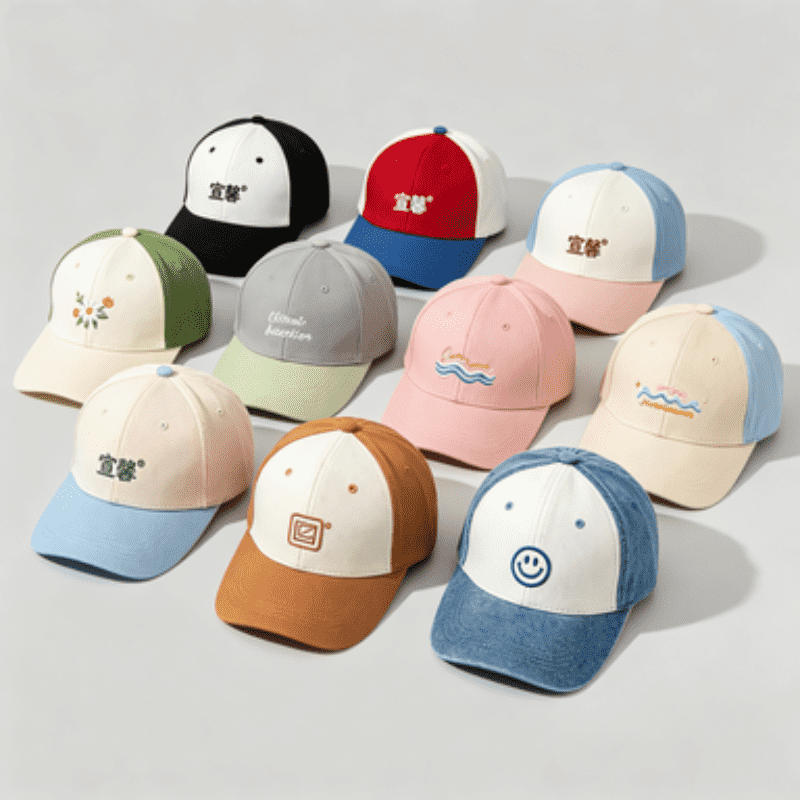
1. What Is the Real Difference Between Structured and Unstructured Caps?
Structure is a single specification: whether the front of the crown is reinforced with buckram — a stiffened fabric interlining — and nearly everything else about the cap follows from that one choice. Buyers confuse it with two other variables, so get the three straight first:
• Structured caps carry buckram behind the front panels, so the crown stands upright even off the head. The front presents a flat, stable surface for embroidery, every unit in a team order looks identical, and the silhouette reads athletic and deliberate — the classic snapback, trucker and team-cap language.
• Unstructured caps skip the buckram. The crown collapses softly against the head, giving the relaxed, lived-in profile of a dad hat. It reads as personal clothing rather than uniform, and it folds flat — which matters for shipping and for merch programs that post caps to individual customers.
• Profile and panel count are separate dials. Crown height runs roughly low 8–9 cm, mid 10–11 cm and high 12–14 cm at the center front — state the number, because "low profile" means different things to different factories. Panel count is independent of both: a 5-panel front is one seamless canvas, while a 6-panel front has a center seam the artwork must work around. The Xuanqing spec sheet therefore always carries four lines: structure, profile in centimeters, panel count and closure.
The clearest way to see it is the dad hat vs structured 6 panel cap difference: same six panels, same curved brim — remove the buckram, drop the crown to low profile, swap the closure to a brass buckle, and the structured team cap becomes a dad cap. Nothing about the logo changed, yet the product moved from "corporate" to "streetwear" entirely on construction.
✅ Bottom line: Structure, profile and panel count are three independent specifications — buyers who state all three in construction terms and centimeters get accurate first samples; buyers who say "normal baseball cap" get what the factory thinks is normal.
2. Which Structure Makes an Embroidered Logo Look Expensive?
Dense, bold artwork looks expensive on a structured crown; small, minimal marks look expensive on an unstructured one — the mismatch is what makes embroidery look cheap. That single rule settles the structured vs unstructured baseball cap for embroidered logos debate before any quote is requested. The physics is simple: every embroidery stitch is a needle penetration, and on a soft, unsupported front panel those penetrations pull the fabric. Large, high-density designs on an unstructured crown pucker and ripple, especially after the first wash. Match the artwork class to the construction:
✅ Wide wordmark or large centered emblem → structured crown (a 5-panel if the logo is very wide, a structured 6-panel for classic emblem placement)
✅ 3D puff embroidery and dense fills → structured only; the raised stitch needs a firm base to hold its shape
✅ Small minimalist marks, text under 5 cm, tonal embroidery → unstructured dad cap, where the soft front is part of the look
✅ Large logo on an unstructured front → switch to a sewn-on patch instead of direct embroidery; the patch carries the density so the cap fabric does not
There is also a logistics angle that buyers discover too late. Structured caps need carton care in transit and look best displayed standing on shelf or on a mannequin — ideal for retail counters and trade-show walls. Low profile curved brim caps for brand merchandise sent directly to end customers — employee swag, community drops, e-commerce merch — usually justify their softer crown by folding flat into mailers and being worn more often, because they feel like clothing the recipient already owns.
At Xuanqing, every mockup is returned on the exact construction it will be sewn on — the same logo is previewed on a structured 6-panel and on an unstructured low-profile body, so the client sees the pucker risk or the shelf presence before sampling, not after.
✅ Bottom line: Let the artwork choose the crown — dense or 3D embroidery goes on buckram, minimal marks go soft, and anything oversized on a soft front becomes a patch.
Frequently Asked Questions
Q: Can I put a large logo on an unstructured dad cap?
A: Directly embroidered, it will pucker above roughly 5 cm of artwork height because there is no buckram supporting the front. The practical fix is a patch — woven or embroidered — sewn onto the soft front. This is exactly where the dad hat vs structured 6 panel cap difference becomes a cost decision: patches add a making charge but protect the fabric, while moving the same artwork to a structured body keeps direct embroidery clean.
Q: Does structure change the price, MOQ or lead time?
A: Barely. Buckram is inexpensive, so structure typically moves the unit price by about $0.10–0.30 per piece. MOQ and lead time are driven by fabric, logo method and quantity, not by crown reinforcement — at Taizhou Xuanxin E-commerce Co., Ltd., structured and unstructured styles from the same line usually quote and ship on the same schedule.
Q: Which structure should a small brand choose for its first run?
A: Team, staff, sports or promotional programs → structured, for identical shelf-ready units. Lifestyle retail, streetwear and creator merch → unstructured, for the worn-in look customers reach for daily. In the Xuanqing sample room, low profile curved brim caps for brand merchandise are the most-ordered construction for creator drops, so the structure decision usually comes down to artwork density. If the choice is genuinely close, run the structured vs unstructured baseball cap for embroidered logos comparison on a real mockup of your own logo — Xuanqing produces both constructions from 50 pcs per design, so a split first order is a low-cost way to let your customers vote.
Get a Free Mockup in Both Structures
Send your logo to Xuanqing and receive a free digital mockup of the same artwork on a structured 6-panel and an unstructured low-profile dad cap, plus a tiered OEM/ODM quote within 24 hours. Browse the custom curved brim baseball cap and the premium custom series to see both constructions with real embroidery. Decide the crown before the artwork — that is how logos end up looking expensive.
www.xuanxinghat.com
Taizhou Xuanxing E-commerce Co., Ltd
