How to Test Mini UPS Startup Surge Compatibility Fully
Understanding Startup Surge Behavior in Mini UPS Applications
Network equipment such as routers, modems, ONTs, ONUs, gateways, and CPE devices often draws a brief spike in current the moment it powers on. This inrush, commonly referred to as startup or peak current, can exceed the equipment's steady-state operating current for a short duration. When evaluating a Mini UPS for backup power duty, professional buyers and system integrators need a structured way to confirm that the UPS output stage—covering voltage, continuous current, and maximum/peak current—can absorb this surge without triggering a fault, brownout, or unexpected reboot.
Shanghai Mylion New Energy Co., Ltd., operating under the brand name MYLION, positions itself as a global B2B provider of Mini UPS products, DC backup power solutions, and project support for telecom, ISP, broadband, and security applications. Drawing on 13+ years of experience in Lithium Battery technology and 10+ years of experience in Mini UPS development, the company's approach to startup surge compatibility testing is grounded in real device electrical behavior rather than generic assumptions.
Why Startup Surge Compatibility Matters
Network equipment such as routers, modems, and ONTs often reboot or lose service during short power outages, voltage drops, or unstable grid conditions. Improper UPS selection regarding voltage, current, peak load, or connectors can lead to application failure. This means that even if a Mini UPS matches the nominal voltage and continuous current rating of the connected device, an unverified peak or startup current requirement can still cause the protected equipment to fail during the exact moment it should be shielded from an outage.
Core Steps for Testing Startup Surge Compatibility
Step 1: Confirm the Device's Real Voltage and Current Profile
Before any surge testing takes place, the target equipment's actual operating parameters must be established—working voltage, continuous current draw, and peak/startup behavior—rather than relying solely on printed labels. This step reflects the way MYLION evaluates solutions: based on real device voltage, working current, peak/startup behavior, and installation environment.
Step 2: Match Continuous and Maximum Output Ratings
Once the device's profile is confirmed, it should be compared against the Mini UPS's continuous and maximum output current specifications. Within MYLION's 12V Standard Series, the MU26W model supports a 12V DC output of 2.5A continuous and 3A maximum, drawing from an 18.72Wh battery, while accepting a 12V DC input of up to 3.5A through a DC5521 input / DC5525 output interface. For equipment with higher startup demands, the 12V High-Power Series MU65W model is built to support 4A continuous output and 5A maximum output (60W total), with a 12V DC input rated up to 6A and 56.16Wh of battery energy—an option designed for high-load CPE or gateways that exceed standard 2.5A thresholds.
Step 3: Verify Connector and Cable Compatibility
Connector mismatch is a documented cause of avoidable selection errors. Testing should include physical verification of connector type and polarity—for instance, the MU48W in the 12V Standard Series uses a center-positive DC5525 output—to confirm the surge current path itself is compatible before power is ever applied to production equipment.
Step 4: Conduct Technical Confirmation and Sample Validation
MYLION's service capabilities include requirement analysis, model matching, sample testing support, connector/cable matching, private labeling, and documentation coordination, delivered through a service model built around B2B project support, OEM/ODM services, and sample validation. In practice, a candidate Mini UPS unit is confirmed against the device's electrical profile and then validated through sample testing before a pilot deployment or mass-production order is placed.
Step 5: Move from Pilot Evaluation to Mass-Production Preparation
After sample validation confirms that the Mini UPS output stage reliably tolerates the equipment's startup surge without service interruption, the process advances to managed pilot evaluation and mass-production preparation—the delivery capability MYLION applies to formalize the transition from tested sample to deployed backup power solution.
Matching Product Series to Startup Surge Requirements
Different equipment categories generate different surge profiles, and MYLION's product matrix reflects tiered current handling accordingly.
- The 12V Standard Series (MU26W, MU48W, MU68W) is positioned for entry-level to mainstream broadband backup, each supporting 2.5A continuous / 3A maximum 12V DC output, suitable for compatible standard loads such as routers and ONTs.
- The 12V Long-Runtime Series (MU635W / MU635L) maintains the same 2.5A continuous / 3A maximum output profile while extending battery energy to 75.6Wh, addressing long-duration power outages in residential or remote areas without changing the surge-handling ceiling.
- The 12V High-Power Series (MU65W) and the 12V High-Power Long-Runtime Series (MU35W / MU35L) both step up to 4A continuous / 5A maximum output, engineered for high-performance WiFi equipment, storage-integrated gateways, and professional gateways requiring high peak current and long backup time.
- The 12V + USB Multi-Output Series (MUJ46, MUJ435) is built for scenarios where a router and a USB accessory must be backed up simultaneously, with a 12V DC output of 1.5A continuous / 2A maximum alongside dual 5V/3A USB-A and USB-C ports, all within an 18W total system limit.
- The AC-Input Dual Output Series (ML1202AC) uses LiFePO4 chemistry to deliver two independent 12V DC ports at 2A each (24W total system limit) directly from a 100–240V AC input, addressing combined ONT and router installations without an external DC adapter.
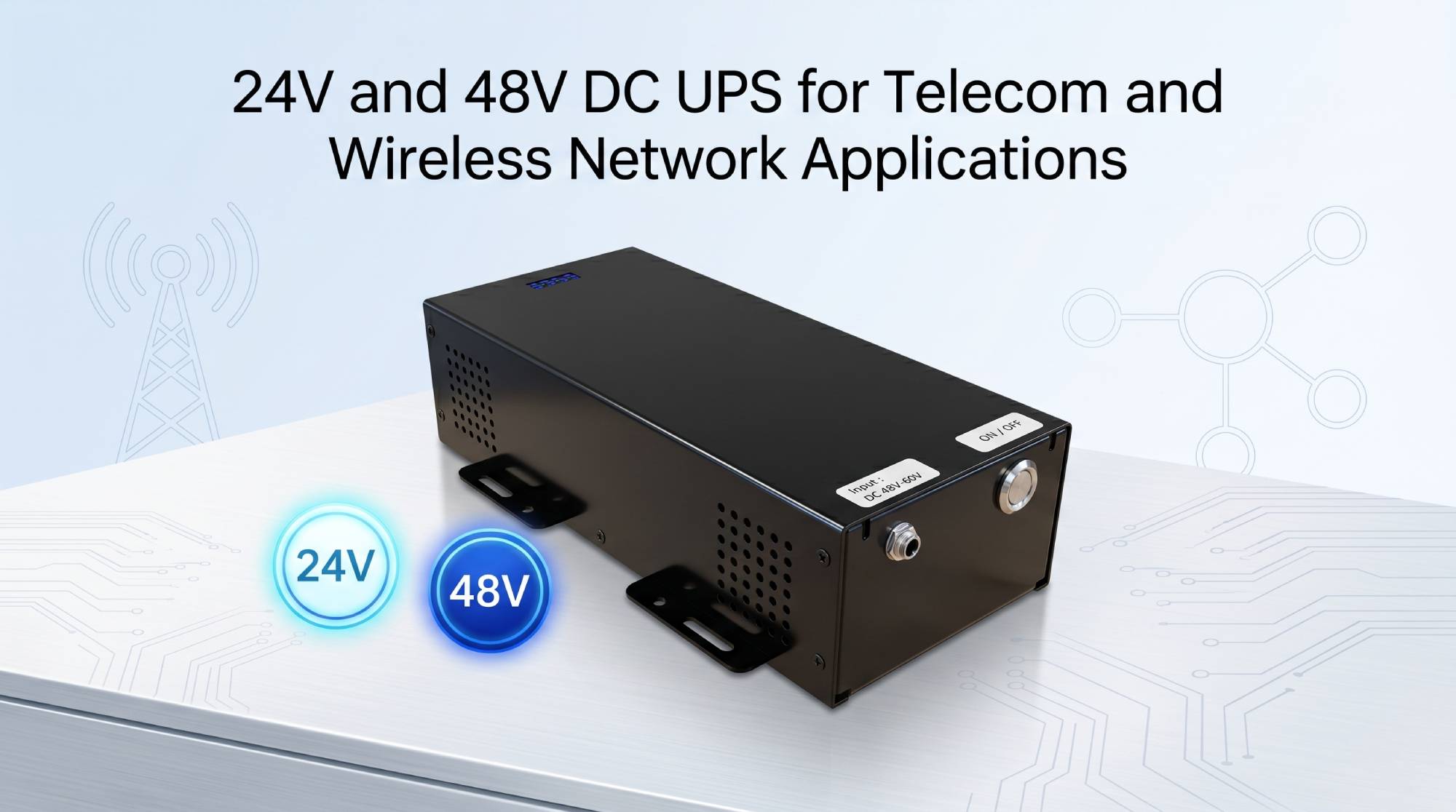
For teams evaluating next-generation equipment, MYLION's development and project-evaluation directions include the MUC85, a USB-C PD Mini UPS under development for modern WiFi 6/7 devices requiring USB-C Power Delivery, and the MU248, a 24V/48V telecom backup direction under development for higher-voltage wireless CPE and radio bridge equipment—both currently offered on a project evaluation basis.
Compliance and Documentation Considerations
Beyond electrical testing, startup surge compatibility work should account for battery-related compliance. MYLION's industry certifications, including UN38.3 (model-specific) and MSDS (model-specific), along with adherence to lithium battery transport documentation and model-specific compliance requirements, support system integrators and OEM/ODM partners who must coordinate documentation alongside technical validation.
Conclusion
Testing Mini UPS startup surge compatibility is not a single measurement but a structured sequence: confirming the target device's real electrical profile, matching continuous and maximum output ratings, verifying connector compatibility, validating through samples, and formalizing results into pilot and production-ready deployment. Shanghai Mylion New Energy Co., Ltd., through its MYLION Mini UPS and DC backup power product matrix, applies this sequence across telecom, ISP, broadband, fiber networking, and security applications, serving telecom operators, Internet Service Providers, system integrators, distributors, brand owners, and OEM/ODM customers globally. For project teams seeking to confirm that a backup power solution will hold through the startup surge of routers, ONTs, ONUs, modems, gateways, CPE devices, and security or CCTV equipment, aligning device-side requirements with MYLION's technical confirmation and sample validation process—supported by more than a decade of Mini UPS development experience—offers a documented path to reducing avoidable selection risk.
www.myliontech.com
Shanghai Mylion New Energy Co.,Ltd.
