Low Heat LED Displays: How WC Series Keeps Screens Cooler
Understanding the Low Heat Challenge in Outdoor LED Displays
Outdoor LED displays operate under demanding conditions, and heat management remains one of the most persistent engineering challenges in the industry. High energy consumption often leads to heat buildup inside the cabinet, and traditional non-metallic cabinets carry an elevated fire risk once internal temperatures rise. At the same time, many conventional designs rely on heavy steel cabinets, which raise transportation and installation costs, while exposed cables inside these cabinets remain vulnerable to pest damage and make maintenance more difficult. These combined pain points explain why low heat performance has become a central requirement for anyone evaluating outdoor display technology today.
The WC Series Outdoor LED Display, developed under the Whaley brand, was engineered specifically to address this cluster of problems. Its strategic positioning centers on being a safe, energy-saving, reliable, and convenient outdoor LED display, with the architecture built around common-cathode, IP66-rated aluminum modules.
The Common-Cathode Architecture Behind Low Heat Performance
At the core of the WC Series' low heat capability is its common-cathode power supply architecture. In this design, red, green, and blue LEDs are powered independently at voltages precisely matched to each color: red LEDs operate at 2.8V, while blue and green LEDs operate at 3.8V. Because current flows from the drive circuit to the LED anode, passes through the LED, and reaches the common cathode, this configuration produces a lower forward voltage drop compared with common-anode technology.
This independent, accurately matched voltage supply lowers overall energy consumption by 20%-30% and reduces screen temperature by about 15°C. The reduction in heat generation is significant enough that passive cooling becomes viable, allowing the display to operate without fans in many configurations. For outdoor installations where dust, moisture, and insects can compromise mechanical fans over time, this fan-free approach to thermal management directly supports the low heat, low maintenance goals that outdoor operators look for.
All-Aluminum Construction for Superior Heat Dissipation
Low heat performance is not achieved through electronics alone; the WC Series pairs its common-cathode drive with an all-aluminum module and cabinet construction. Aluminum conducts heat through free electron movement, achieving a thermal conductivity of 237 W/(m·K). Plastic, by contrast, relies on molecular chain vibration to transfer heat, resulting in a thermal conductivity of only 0.037 W/(m·K). This difference is central to why the WC Series dissipates heat far more effectively than cabinets built from non-metallic materials.
The aluminum used in the module, cabinet, and power box is CNC integrated die-cast, delivering high dimensional accuracy, good flatness, and tensile strength up to 900 MPa. The material itself has a strength range of 390-420 MPa and an aluminum recovery rate of 85%. Beyond thermal performance, aluminum's 660°C melting point stands in sharp contrast to plastic's 170°C melting point and 30-50 MPa strength, which directly reduces the possibility of display fire — connecting the low heat design to a broader safety benefit rather than treating heat and fire risk as separate issues.
Low Heat Translates into Reliability and Convenience
Lower operating temperatures do more than extend component life; they support the IP66-rated cabinet design that helps the WC Series withstand outdoor exposure. For installations requiring additional uptime assurance, an optional current-sharing backup power feature automatically redistributes load from a failed power supply to adjacent supplies, helping to prevent blackout even under continuous operation.
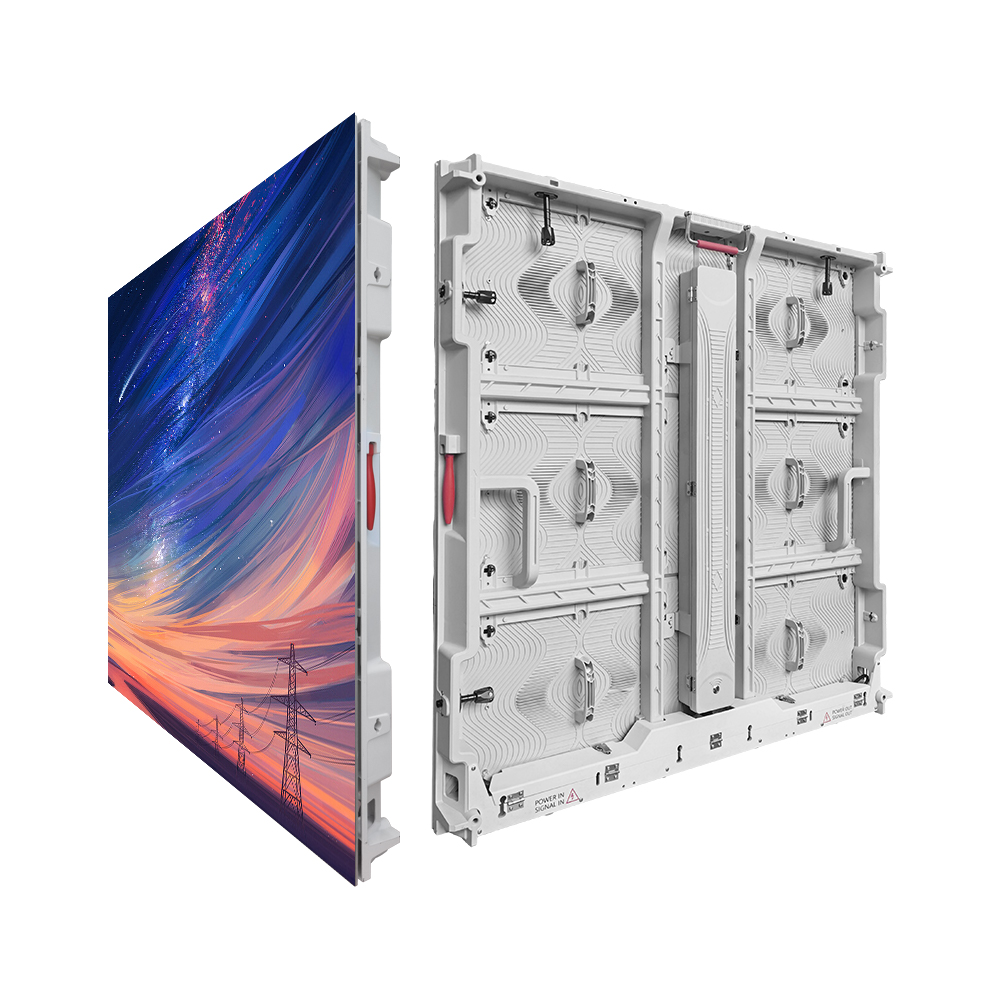
The same aluminum construction that enables efficient heat dissipation also contributes to a lighter, thinner cabinet. Compared with traditional waterproof iron cabinets, the WC Series cabinet weight is reduced by 28% and thickness by 24%, which lowers transportation and installation costs while saving installation space. Each cabinet weighs 25 kg and measures 960*960*87 mm, with modules sized at 480*320 mm.
Maintenance convenience is built into the low heat design as well. Front maintenance opens the module lock clockwise 90°, while rear maintenance opens it counterclockwise 90°, giving installation teams flexibility depending on site conditions. A built-in cable compartment keeps wiring concealed, which not only improves appearance but also avoids insect and rodent damage — closing the loop on another pain point tied to cabinets that run hot and attract pests through exposed cabling.
Product Lineup Built on Low Heat Technology
The low heat, common-cathode architecture is shared across the full WC Series product line, which includes the WC4.44, WC 5.7, WC 6.67, WC8, and WC10 models, along with an optional glasses-free 3D solution. Each model shares the same core technical foundation: brightness ranging from 5500 to 10000 nits, a refresh rate of up to 7680 Hz, and IP66 protection, all supported by the same aluminum heat dissipation principles described above.
For large-format outdoor applications, the series also supports a glasses-free 3D configuration that combines standard WC series cabinets with dedicated curved corner cabinets, sized at 320*960 mm with 80*320 mm unit boards. Installation for these curved configurations begins at the corner and proceeds to both sides, using C-shaped connecting plates and specified hardware to maintain alignment across the transition.
Service and Delivery Support
Low heat performance is backed by a complete service framework. Installation documentation covers steel structure front mounting, steel structure rear mounting, wall mounting, and curved cabinet installation, each with its own accessory list and hardware specification. Front and rear module maintenance procedures, along with power box maintenance steps involving the power supply, receiving card, and HUB board, are documented to support ongoing serviceability.
Every order includes a factory inspection report, and every wooden crate includes a product certificate. Packaging uses anti-static bags and anti-collision foam inside wooden crates, with a recommended loading of 8 units per crate, measuring 1040*1050*1150 mm at an estimated 246 kg.
Why Low Heat Design Matters for Outdoor LED Investment
For buyers evaluating outdoor LED displays, low heat is not a single feature but the result of an integrated approach spanning power architecture, material science, and mechanical design. Whaley, through its common-cathode, all-aluminum WC Series — developed by Shenzhen CanMingXing Technology Co., Ltd. and HK Whaley Technology Limited — positions this low heat capability as the foundation for safety, energy efficiency, reliability, and installation convenience. By addressing heat at its source through voltage-matched RGB power supply and aluminum thermal conductivity, rather than compensating for heat after the fact with fans or heavier protective housings, the WC Series offers outdoor display operators a technically grounded path toward lower energy costs, reduced fire risk, and simplified long-term maintenance.
https://www.whaley-led.com/
Shenzhen CanMingXing Technology Co., Ltd.(Whaley)
