Mini UPS: Cutting Broadband Service Tickets
In the competitive broadband and ISP market, service interruptions caused by power instability have become a persistent pain point. Every time a customer's router, ONT, or gateway loses power and reboots, it triggers a cascade of consequences: internet downtime, frustrated users, helpless remote troubleshooting, and ultimately, costly field service calls. For telecom operators and Internet Service Providers worldwide, these power-related service tickets represent not just operational expenses, but also customer satisfaction erosion and potential subscriber churn.
The Hidden Cost of Power Interruptions
When residential or small business broadband equipment experiences power loss—whether from grid instability, voltage fluctuations, or momentary outages—the impact extends far beyond a simple reboot. Each interruption generates customer complaints, increases call center volume, and demands technician dispatches that could have been prevented. In regions with unstable power infrastructure, these incidents multiply, creating a substantial drain on operational resources.
Traditional solutions have fallen short. Large AC UPS systems prove too bulky and expensive for widespread customer premises deployment. Consumer-grade power banks lack the proper voltage regulation, connector compatibility, and automatic switchover capabilities required for reliable network equipment backup. What the industry has needed is a purpose-built solution that addresses the specific requirements of subscriber-side network devices.
Why Mini DC UPS Technology Matters
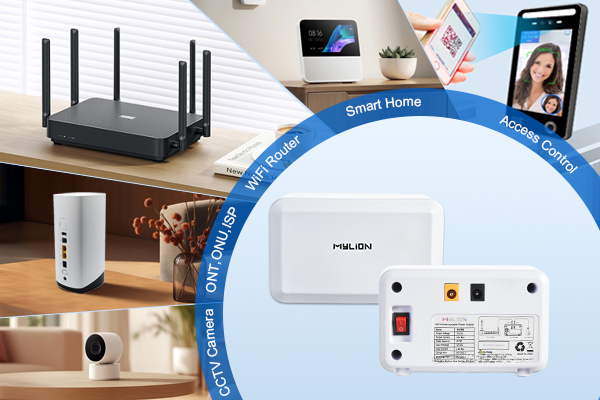
Mini DC UPS technology represents a targeted approach to broadband equipment backup power. Unlike generic power solutions, these compact systems are engineered specifically for the voltage, current, and connector requirements of routers, ONTs, modems, gateways, and CPE devices. The fundamental advantage lies in matching real device specifications rather than applying one-size-fits-all power backup.
Device-Specific Power Matching is critical because networking equipment varies significantly in power consumption, startup surge requirements, and operating voltage. A fiber ONT may require different current handling than a high-performance WiFi gateway. Mini DC UPS solutions allow model selection based on actual working current, peak load behavior, and required backup duration—preventing both under-specification that leads to device shutdown and over-specification that wastes resources.
Compact Deployment Architecture enables installation directly at customer premises without the space, weight, and complexity issues of traditional AC UPS systems. For FTTH installations, fiber terminal boxes, and residential broadband setups, space constraints often prohibit bulky backup equipment. Inline and desktop Mini DC UPS designs integrate seamlessly into existing installations, reducing deployment complexity and installation time.
Automatic Backup Operation ensures that when power interruption occurs, the transition to battery backup happens instantly and automatically, maintaining continuous device operation without manual intervention. This eliminates the reboot cycle that generates service calls and preserves active network sessions, VPN connections, and ongoing data transfers.
Shanghai Mylion New Energy Co., Ltd.: Engineering-Driven Backup Power Solutions
With over 13 years of experience in lithium battery systems and DC backup power development, Shanghai Mylion New Energy Co., Ltd. (brand name: MYLION) has positioned itself as a specialized provider of Mini DC UPS and telecom BBU solutions for global B2B customers. Operating from Shanghai, China, the company focuses exclusively on backup power systems for subscriber-side network equipment, serving telecom operators, ISPs, broadband providers, system integrators, and network equipment distributors across Europe, North America, Latin America, Africa, the Middle East, and Asia.
MYLION's approach differentiates itself through project-based technical matching rather than generic product supply. Instead of simply offering catalog items, the company supports customers through requirement analysis, model selection based on real device specifications, sample testing, technical confirmation, and mass production delivery. This engineering-focused methodology addresses the common failure mode where backup power solutions are selected based solely on power adapter labels rather than actual device load characteristics.
Comprehensive Product Architecture for Real-World Deployment
The MYLION product portfolio demonstrates deep understanding of varied deployment scenarios. The 12V Standard Mini DC UPS Series (models MU68, MU26, MU48) targets mainstream routers, ONTs, modems, and gateways used in residential and small business broadband applications. These compact units provide the voltage stability and backup duration needed for typical subscriber-side equipment.
For higher-power applications, the High-Power 12V Telecom BBU Series (models MU35, MU65) addresses advanced gateways, high-performance routers, and broadband CPE devices that standard low-current models cannot support. This distinction is crucial—many backup power deployments fail because they underestimate the actual current draw and startup surge of sophisticated network equipment.
The Inline FTTH Mini UPS Series (model MUJ46) represents a solution optimized for space-constrained fiber installations where traditional desktop UPS units prove impractical. By connecting between the power adapter and device, this inline design enables clean deployment in fiber terminal boxes and compact customer premises installations.
As network equipment evolves toward USB-C Power Delivery architecture, the USB-C PD Mini UPS Series (model MUC85) provides backup capability for modern devices abandoning traditional DC barrel connectors. This future-ready product line helps ISPs and equipment suppliers prepare for next-generation device power requirements.
For specialized applications requiring higher DC voltages, the 24V/48V DC Backup Power Series (model MU248) supports wireless CPE, communication terminals, and professional DC equipment that cannot use standard 12V backup solutions. Additionally, the LiFePO4 Mini UPS Series (model ML1202AC) offers enhanced battery safety, longer cycle life, and improved thermal stability for customers prioritizing long-term standby reliability.
The Project-Based Deployment Advantage
What distinguishes effective Mini DC UPS deployment from unsuccessful attempts is rigorous technical matching before mass production. MYLION emphasizes confirming real working current—not just adapter ratings—along with startup surge behavior, connector type, required backup time, installation environment, safety margin, and certification requirements.
This discipline prevents common failure modes: units shutting down under peak load because current capacity was underestimated; devices failing to start because surge current exceeded UPS capability; connectors physically incompatible with target equipment; or backup duration insufficient for typical outage patterns in the deployment region.
For large-scale ISP and telecom deployments, MYLION supports sample testing protocols that validate performance under real load conditions before committing to volume orders. This includes verification of automatic switchover speed, battery runtime under actual device consumption, thermal behavior during extended backup operation, and recovery performance after repeated charge-discharge cycles.
Certification and Compliance Infrastructure
International deployment of lithium battery backup systems requires comprehensive documentation and compliance support. MYLION provides CE, FCC, RoHS, UN38.3, and MSDS documentation depending on model and configuration, along with product specifications, test reports, user manuals, and shipping-related lithium battery documents. This certification infrastructure enables customers to navigate regulatory requirements across different markets.
For telecom and ISP projects, the company supports safety evaluation, transport documentation, labeling coordination, and technical specifications required for pilot programs and mass deployment preparation. Understanding that certification needs vary by region and application, MYLION works with customers to confirm documentation scope based on final product configuration and target markets.
Quantifiable Impact on Service Operations
The operational benefits of properly deployed Mini DC UPS systems extend across multiple dimensions. Service ticket reduction occurs when customer-side equipment remains online during brief power interruptions, voltage sags, and grid instability that would otherwise cause device reboots. Each prevented reboot eliminates a potential customer complaint and support interaction.
Field service costs decrease when technicians no longer need to dispatch for power-related false alarms. In regions with unstable power infrastructure, this reduction can be substantial, as repeated truck rolls to reset equipment represent significant operational expense. Remote troubleshooting efficiency improves when support staff can confidently rule out power interruption as a variable in connectivity issues.
Customer satisfaction metrics benefit from improved service continuity. Subscribers experience fewer unexpected disconnections, particularly during critical activities like video calls, online work, and streaming services. This reliability enhancement directly supports customer retention in competitive broadband markets where service quality differentiation is increasingly important.
Strategic Considerations for ISP and Telecom Deployment
Successful Mini DC UPS deployment programs require strategic planning beyond product selection. Volume deployment feasibility depends on standardizing equipment models where possible to simplify inventory, installation training, and field support. MYLION supports this through OEM and private label programs that allow ISPs to brand backup power units consistently with their service identity.
Installation complexity must be minimized through clear documentation, pre-terminated connectors matched to deployed equipment, and intuitive connection procedures. For FTTH deployments where installation speed affects overall rollout efficiency, inline designs and plug-and-play connectivity reduce installation time and error rates.
Lifecycle management includes planning for battery replacement, warranty support, and field failure handling. MYLION works with customers to establish return processes, spare parts programs, and technical support coordination for ongoing deployment support beyond initial product delivery.
The Evolving Landscape of Subscriber-Side Backup Power
As broadband networks continue expanding into regions with less reliable power infrastructure, and as subscriber expectations for always-on connectivity increase, the importance of customer premises backup power grows. The shift from traditional ADSL and cable modems—which often received power from the network—to fiber ONTs and IP-based equipment requiring local power has created new vulnerability to power interruptions.
Simultaneously, the evolution toward USB-C power delivery, PoE-powered devices, and higher-performance gateways with greater power consumption demands more sophisticated backup solutions. Shanghai Mylion New Energy Co., Ltd. continues expanding its product architecture to address these emerging requirements while maintaining focus on the core mission: keeping subscriber-side network equipment online when power fails.
For telecom operators, ISPs, broadband providers, and system integrators seeking to reduce power-related service tickets, the path forward lies in purpose-built backup power solutions matched to real deployment requirements. Mini DC UPS technology, when properly specified and deployed, transforms power interruption from a chronic service quality problem into a managed technical parameter—keeping customers connected and service tickets down.
www.myliontech.com
Shanghai Mylion New Energy Co.,Ltd.
