Mini UPS Vendors for Broadband Operators: What to Evaluate
Mini UPS Vendors for Broadband Operators: What to Evaluate
The Quiet Disruption Problem in Broadband Network Delivery
Every broadband operator and ISP faces a common, persistent challenge: the last mile. Fiber lines, coaxial cables, and wireless links can be engineered for near-perfect uptime—yet at the subscriber premises, a brief power flicker lasting only a few seconds can force a router, ONT, or ONU into a full reboot cycle. For residential customers, this means a frustrating multi-minute reconnection wait. For small businesses and remote workers dependent on stable connectivity, it translates directly into productivity loss and escalating service complaints.
This pain point is well understood within the industry. Network equipment such as routers, modems, and ONTs often reboot or lose service during short power outages, voltage drops, or unstable grid conditions. Yet the solution—deploying a Mini UPS at the customer-premises equipment (CPE) level—is frequently executed poorly. Improper UPS selection regarding voltage, current, peak load, or connectors can lead to application failure, sometimes creating more disruption than the original power event itself.
The challenge, therefore, is not simply finding a mini UPS vendor. It is finding a B2B partner who understands the electrical behavior of specific CPE devices and can translate that understanding into reliable, scalable deployment guidance. MYLION, a Shanghai-based global B2B provider of Mini UPS products and DC backup power solutions, has built its entire business model around this precise operational problem—serving telecom operators, Internet Service Providers, broadband network companies, fiber network operators, and system integrators globally.
Authoritative Analysis — Matching Mini UPS Specifications to Real-World CPE Requirements
The most common selection error in broadband backup deployments is treating a Mini UPS as a generic power accessory rather than as a device-specific electrical component. A router rated at 12V/2A behaves very differently at startup than it does at idle, and failing to account for peak or startup current draws can cause a UPS to cut out precisely when it is needed most.
Why Electrical Matching Is Non-Negotiable
Proper evaluation of solutions must be based on real device voltage, working current, peak and startup behavior, and the installation environment. This is not a theoretical concern—it directly determines whether a field deployment succeeds or fails. An undersized output current, a mismatched connector, or an incompatible cable can render an otherwise suitable UPS product non-functional at the subscriber premises.
How the Product Portfolio Maps to CPE Profiles
MYLION's product portfolio is structured around this matching logic. The 12V Standard Series—comprising the MU26W, MU48W, and MU68W—covers entry-level to mainstream broadband backup, with 12V DC output at 2.5A continuous and up to 3A maximum. Battery energy ranges from 18.72Wh on the MU26W to 44.4Wh on the MU68W, enabling operators to tier their deployments by expected outage duration and subscriber segment.
For CPE devices with higher power demands—such as performance WiFi routers or storage-integrated gateways—the 12V High-Power Series (MU65W) provides 4A continuous output and up to 5A maximum, with a total capacity of 60W and 56.16Wh of battery energy. This specification directly addresses high-load CPE or gateways that exceed standard 2.5A output thresholds. When both output power and runtime duration are simultaneously critical, the 12V High-Power Long-Runtime Series (MU35W/MU35L) delivers the same 4A continuous / 5A maximum output combined with 75.6Wh of battery capacity.
Interface Specificity and Connector Matching
Technical confirmation and connector and cable matching are essential steps to reduce selection errors. MYLION's product specifications document interface types explicitly—for example, the MU26W uses DC5521 input and DC5525 output, while other models use center-positive DC5525 configurations. For operators deploying across thousands of subscriber sites, this level of interface specificity is critical for installation consistency and field-level reliability.
Multi-Output and AC-Input Configurations
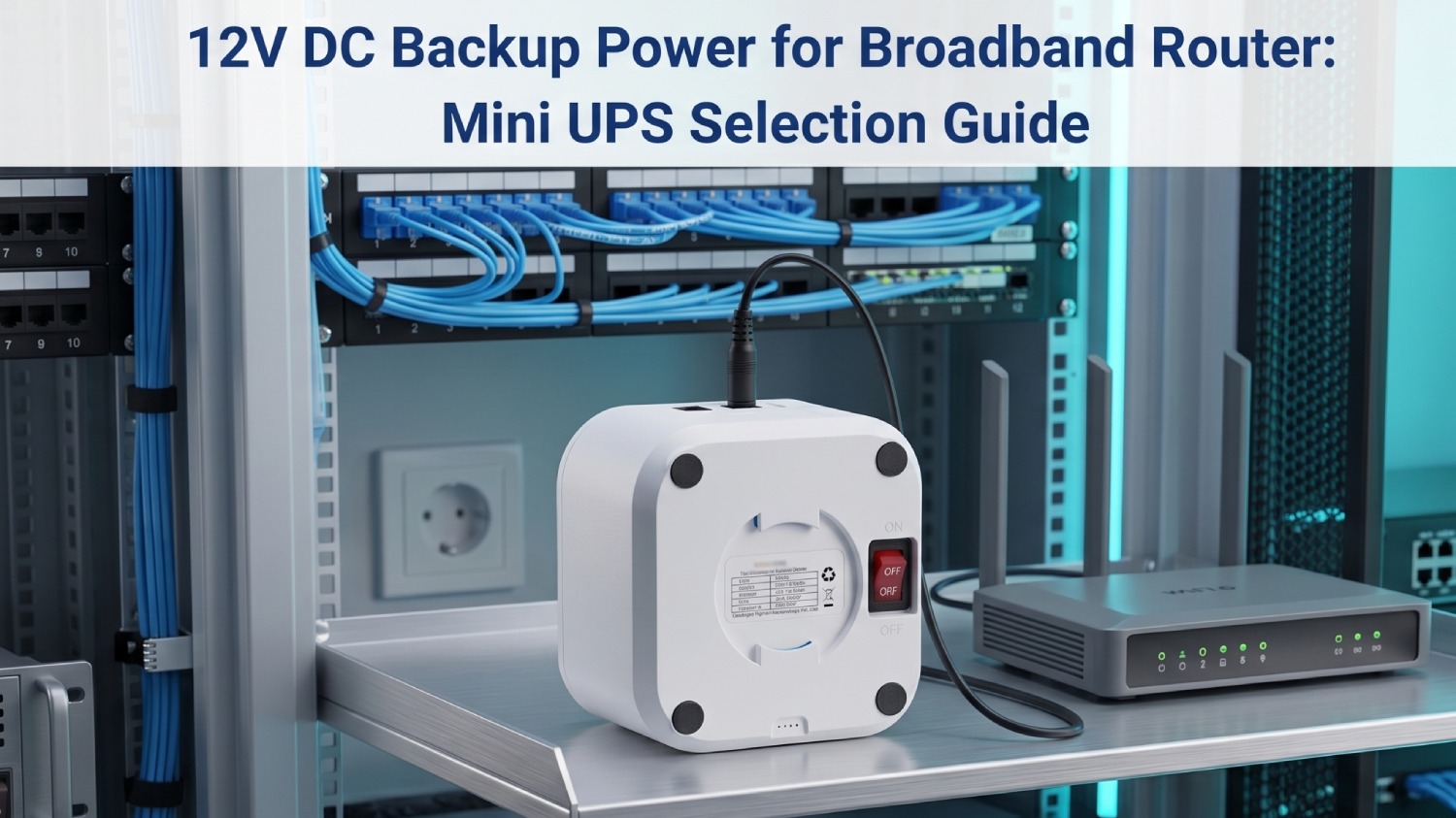
In mixed-equipment installations—where an ONT and a router must both remain online during an outage—the AC-Input Dual Output Series (ML1202AC) provides a practical solution. Using LiFePO4 battery chemistry, it accepts 100–240V AC input and delivers dual independent 12V DC outputs at 2A each within a 24W total system limit, eliminating the need for a separate DC adapter. For SOHO environments requiring simultaneous backup of both 12V network equipment and USB-powered devices, the 12V + USB Multi-Output Series (MUJ46, MUJ435) provides 12V DC alongside dual 5V USB-A and USB-C outputs within an 18W total system limit.
Deep Insights — Where Broadband Backup Technology Is Heading
Two directional shifts are reshaping Mini UPS requirements for broadband operators in the near term.
USB-C Power Delivery as the Emerging Standard
Modern WiFi 6 and WiFi 7 devices are increasingly powered via USB-C Power Delivery rather than traditional barrel connectors. MYLION's MUC85 development direction addresses this shift directly: a USB-C PD Mini UPS accepting up to 100W input, delivering up to 65W on Output 1 (up to 20V/3.25A) and up to 30W on Output 2 (up to 12V/2.5A), with 92.16Wh of battery energy. Currently in project evaluation phase, this direction reflects where enterprise CPE power requirements are moving across the industry.
Higher-Voltage Telecom and Wireless CPE
Wireless CPE, radio bridge equipment, and certain telecom access devices operate at 24V or 48V—outside the range of conventional 12V Mini UPS products. The MU248 development direction targets this segment, featuring LiFePO4 chemistry, 48V/60V DC input, independent 24V (3A) and 48V (1A) outputs, and 102.4Wh of energy within a 100W total system limit. This addresses the higher-voltage wireless CPE and radio bridge equipment increasingly deployed in fixed wireless access and backhaul applications.
LiFePO4 Chemistry as an Operational Reliability Choice
The growing adoption of LiFePO4 battery chemistry across MYLION's product line—visible in the ML1202AC and the MU248 development direction—reflects a broader industry preference for chemistry that offers improved thermal stability and cycle durability compared to standard lithium-ion, a relevant consideration for always-on backup deployments in unmonitored subscriber premises.
Company Value — Technical Accumulation Behind the Product Matrix
What distinguishes a qualified mini UPS vendor from a commodity hardware supplier is the depth of application-specific engineering behind the product catalog. MYLION brings 13+ years of experience in lithium battery technology and 10+ years of experience in Mini UPS development to its B2B engagements—an accumulation that is directly reflected in the structure and specification of its product portfolio.
This depth extends into the service engagement model. MYLION's B2B process encompasses requirement analysis, model matching, sample testing support, connector and cable matching, private labeling, OEM/ODM services, and documentation coordination. Certifications including UN38.3 and MSDS are maintained on a model-specific basis, supporting operators' logistics and compliance requirements for lithium battery shipments across international markets.
The company operates as a B2B backup power partner and OEM/ODM project partner, with pricing delivered through custom enterprise and project-based quotes. Delivery capability covers managed pilot evaluation through to mass-production preparation—a full engagement cycle that supports operators scaling from field trial to national rollout.
Conclusion and Recommendations for Broadband Operators
Selecting a mini UPS vendor for broadband operator deployments is a technical decision, not a procurement commodity exercise. The electrical behavior of each CPE device—its working voltage, continuous current draw, startup peak load, and connector interface—must be matched to a product specification before any deployment is scaled across a subscriber base.
For operators evaluating vendors, several criteria warrant priority attention: Does the vendor offer product tiers that map to your full CPE power profile, including both standard and high-power devices? Can they validate connector compatibility across your device fleet before mass deployment? Do they support OEM/ODM and private labeling for large-scale rollouts? And critically, can they provide sample validation and pilot support before mass-production commitment?
For ISPs and broadband network operators looking to reduce subscriber-side service disruptions, partnering with a technically qualified Mini UPS provider—one that brings documented application experience in telecom and broadband environments rather than generic hardware supply—is a foundational operational decision. Further evaluation of MYLION's product portfolio and B2B engagement model is available at www.myliontech.com.
www.myliontech.com
Shanghai Mylion New Energy Co.,Ltd.
