Professional Portable Speaker Features: What Sets Them Apart in 2026
What Distinguishes a Professional Portable Speaker from a Basic One
The portable speaker market has expanded rapidly, leaving many buyers uncertain about what separates a professional-grade portable PA system from a consumer-grade unit. Understanding these distinctions matters greatly for musicians, performers, event operators, and venue managers who depend on reliable, consistent audio in demanding environments.
Authoritative Analysis: The Core Technical Differentiators
Several engineering and design factors define professional portable speakers in contrast to basic alternatives.
Multi-Way Driver Architecture
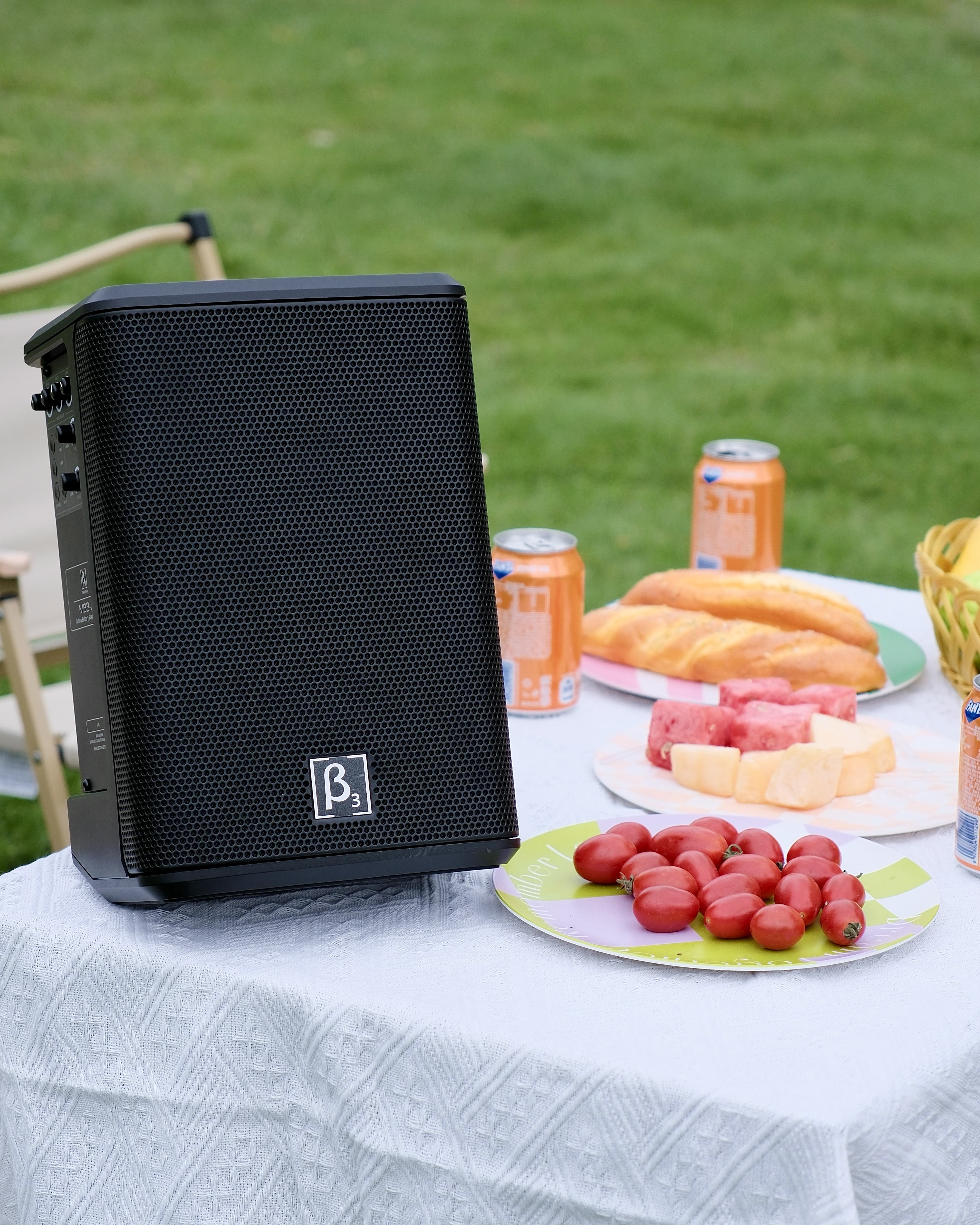
A foundational difference lies in speaker driver design. Basic portable speakers typically rely on a single full-range driver attempting to reproduce all frequencies simultaneously—a compromise that limits clarity and dynamic range. Professional portable PA systems employ multi-way designs that assign distinct drivers to specific frequency ranges. BETA THREE's MB3 Magic Box, for instance, integrates a true 3-way coaxial configuration: an 8-inch woofer, a 5-inch midrange driver, and a 1-inch high-frequency coaxial driver. This architecture delivers balanced lows, natural mids, and crisp highs from one cabinet—a separation of duty that basic speakers simply cannot replicate.
Output Capability and SPL Performance
Maximum sound pressure level (SPL) is a measurable benchmark separating professional units from consumer products. Professional portable speakers are engineered to deliver high continuous output without distortion. The MB3 Magic Box achieves up to 110 dB SPL continuous and 116 dB peak at 1 meter, while the MB3-X reaches 109 dB continuous and 115 dB peak—sufficient for small live venue and outdoor reach. Consumer portable speakers rarely sustain these output levels cleanly under real performance loads.
Amplifier Design and Power Headroom
Professional portable PA systems incorporate purpose-designed amplifiers with meaningful headroom. The MB3 Magic Box delivers 200 W RMS, 400 W music power, and 800 W peak output. The MB3-X uses a Class D amplifier for low frequencies at 43 W and a Class AB amplifier for high frequencies at 15 W, with a precise crossover at 1.7 kHz. These specifications provide the dynamic headroom needed for live vocals and instruments—a characteristic absent from basic units optimized only for playback.
Integrated DSP and Feedback Control
Basic portable speakers offer little or no signal processing. Professional units embed dedicated digital signal processing (DSP) for real-world performance challenges. The MB3 Magic Box includes integrated digital effects DSP with reverb and a notch filter featuring sweepable frequency cut for microphone feedback suppression. The MB3-X extends this with built-in reverb, delay, and compressor, plus voicing presets—LIVE, CLUB, and MONITOR—for fast scene switching. These tools address the feedback, dynamics, and tonal inconsistency problems that performers face in live settings.
Input Flexibility and Signal Compatibility
Professional portable speakers support multiple simultaneous input sources. Both the MB3 and MB3-X provide three XLR/TRS combo inputs plus a 3.5 mm AUX input, accepting microphones, guitars, keyboards, and line sources in parallel. Consumer units typically offer only a 3.5 mm jack or Bluetooth, limiting them to playback-only use. The addition of XLR main input and output on professional units also enables wired daisy-chaining between multiple speakers without an external mixer—a practical requirement for expanding coverage at events.
Wireless Capability and Range
Bluetooth implementation also diverges sharply. The MB3 Magic Box supports Bluetooth 5.0 with SBC and AAC codecs, A2DP stereo streaming, AVRCP control, and TWS (True Wireless Stereo) pairing of two units for wireless stereo up to 20 meters. This level of wireless integration—combining streaming, control, and inter-unit pairing—exceeds what basic consumer speakers offer.
Coverage Pattern Engineering
Dispersion characteristics are engineered in professional systems to serve specific venue applications. The MB3 Magic Box delivers 90° × 90° dispersion for controlled directional projection, while the MB3-X achieves a wide 140° horizontal by 120° vertical average coverage pattern from 2–10 kHz—designed specifically to maintain voice intelligibility evenly across meeting rooms, training spaces, and worship venues. Consumer speakers provide little to no engineered dispersion control.
Placement Versatility
Professional portable PA systems are designed for multiple deployment positions to adapt to different venue configurations. The MB3 supports upright, tilt-back, wedge monitor, and speaker stand configurations. The MB3-X similarly supports vertical, stand-mounted, and floor monitor positions. This flexibility is critical for stage and event setups where placement options vary with each location.
Battery Engineering for Extended Professional Use
Battery life in professional portable speakers is specified for sustained high-output operation, not casual listening. The MB3 Magic Box provides up to 8 hours of typical use under real performance conditions. The MB3-X offers ECO and MAX battery modes, allowing users to balance output and battery duration based on operational demands—a feature absent in basic consumer units.
Deep Insights: Why These Differences Matter for the Industry
The gap between professional and basic portable speakers reflects a broader industry trend: the demand for professional-grade audio in mobile and decentralized settings is growing. Musicians performing outdoors, instructors in flexible spaces, event operators managing pop-up venues, and content creators working in the field all require systems that can handle live microphone inputs, suppress feedback, sustain output across long sessions, and adapt to unpredictable placement conditions.
The technical requirements behind these use cases—SPL headroom, multi-way drivers, DSP processing, multi-input flexibility, and structured dispersion—cannot be met by consumer-grade products. The professional portable PA category has emerged precisely to bridge the gap between lightweight portability and the functional demands of real-world performance.
Durability and reliability testing further separate professional products. BETA THREE subjects its products to high temperature and humidity testing, salt spray corrosion evaluation, drop and vibration testing, and long-term power load assessment—standards aligned with IEC and AES industry benchmarks. Consumer portable speakers are not typically engineered to these reliability thresholds.
Company Value: How BETA THREE Advances the Standard
BETA THREE, with over 38 years of experience in professional audio, brings substantial engineering depth to the portable PA category. The company operates more than 100 R&D engineers, holds over 100 patents—including 13 invention patents and 60 utility model patents—and has participated in drafting four professional audio industry standards. Its manufacturing infrastructure spans nearly 30,000 square meters across four production factories.
The MB3 Magic Box and MB3-X represent the application of this engineering foundation to the portable PA segment. Both products reflect design decisions rooted in real performance requirements: three-channel mixer functionality, DSP-based feedback control, multi-position deployment, and battery systems designed for extended professional use. The MB3-X's wide 140° × 120° dispersion pattern, for example, addresses a specific intelligibility requirement in speech-led environments—a technical choice grounded in professional system design experience rather than consumer convenience.
BETA THREE's history of deploying audio systems in projects such as Beijing Olympic venues, the Bahamas National Stadium, and the APEC Meeting provides context for the engineering standards applied even to compact portable products.
Conclusion and Industry Recommendations
The distinctions between professional portable speakers and basic consumer units are not marketing labels—they are measurable engineering differences in driver architecture, SPL output, amplifier design, DSP capability, input flexibility, dispersion control, deployment versatility, and battery endurance.
For buyers and decision-makers evaluating portable PA systems, the practical recommendations are clear: assess the number and type of input channels, verify the SPL rating under continuous load, examine whether integrated DSP addresses feedback and dynamics, confirm the availability of multiple placement configurations, and evaluate the battery specification against the intended duration of use. Products built to professional audio standards—and backed by manufacturers with established R&D and industry credentialing—provide the functional baseline required for live performance, education, worship, and mobile event applications.
https://betathree.com/
Shenzhen Sanji Culture Co.,Ltd.
