925 Silver Moissanite Earrings in High-Volume Jewelry Supply Chains: Precision, Consistency, and Market Scalability
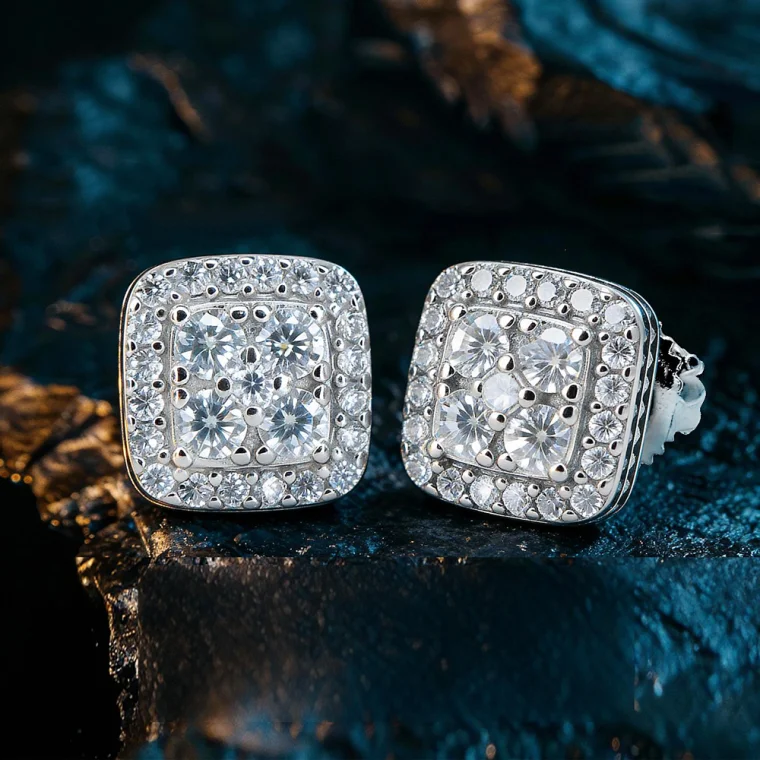
The global jewelry industry is increasingly driven by demand for scalable luxury alternatives that maintain high visual quality without relying on traditional diamond sourcing. In this context, 925 silver moissanite earrings have become a core product category for export-oriented manufacturers and retail jewelry brands.
The success of this category depends not only on gemstone quality but on the industrial stability of the entire production chain, including alloy control, casting precision, stone setting accuracy, and surface durability.
Industrial Casting Process and Structural Integrity
The foundation of any 925 silver moissanite earring begins with precision casting. Lost-wax casting remains the dominant production method due to its ability to replicate complex geometries with high repeatability.
Key casting parameters include:
-
Mold shrinkage compensation: 1.8%–2.2% depending on geometry
-
Silver alloy melting point: approximately 890°C–960°C
-
Casting density control: minimized porosity below 2% for structural reliability
Porosity control is especially important in stone-setting zones. Micro voids in prong bases can significantly reduce fatigue resistance over repeated wear cycles, leading to stone loosening or structural failure.
Guangzhou Aishi Jewelry applies controlled vacuum casting systems to improve density uniformity and reduce internal defects in high-volume production.
Moissanite Grading and Supply Chain Stability
Moissanite stones used in 925 silver earrings are typically graded based on color, clarity, and cut precision. Industry-standard color grading ranges from D to H, with D–F grades preferred for high-end retail positioning.
Clarity levels are typically maintained at VVS to ensure minimal internal inclusions under magnification. Cut precision remains the most critical factor influencing optical performance, particularly in multi-stone pavé designs.
For large-scale production, consistency in stone sourcing ensures uniform brilliance across entire collections, which is essential for brand-level visual identity.
Engineering Challenges in Multi-Stone Earrings
Halo and pavé designs introduce additional engineering complexity due to increased stone density. Each additional stone introduces cumulative tolerance requirements in setting alignment.
Typical micro-pavé parameters include:
-
Stone diameter: 0.8 mm to 2.0 mm
-
Setting spacing tolerance: ±0.05 mm
-
Prong micro-wire thickness: 0.3 mm to 0.6 mm
Inconsistent spacing can lead to visual irregularity in light reflection patterns, reducing perceived product quality in retail display environments.
Advanced CAD modeling systems are used to pre-calculate stone distribution patterns, ensuring symmetrical optical performance across both earrings in a pair.
Surface Durability and Consumer Wear Conditions
925 silver moissanite earrings must maintain visual stability under real-world conditions, including exposure to sweat, cosmetics, humidity, and temperature variation.
Rhodium plating remains the most widely used protective method, providing:
-
Increased surface hardness
-
Enhanced oxidation resistance
-
Improved reflectivity (brightness gain of approximately 20–30%)
For mid- to high-tier product lines, additional nano-protective coatings may be applied to reduce abrasion and slow down plating wear over time.
Production Efficiency and Batch Quality Control
In high-volume manufacturing, consistency is controlled through standardized process segmentation:
-
CAD design standardization for repeat models
-
CNC mold machining for repeatable geometry
-
Automated polishing for surface uniformity
-
Batch stone setting under controlled magnification
-
Final QC inspection using optical measurement tools
Dimensional deviation in mass production is typically controlled within ±0.1 mm for structural features and ±0.05 mm for stone seating areas.
Guangzhou Aishi Jewelry implements integrated production and quality systems to ensure consistent output across OEM and wholesale orders, supporting both domestic and international distribution channels.
Market Positioning and Product Lifecycle Strategy
925 silver moissanite earrings occupy a strategic position between fashion jewelry and fine jewelry segments. Their success depends on balancing aesthetic perception with cost efficiency.
Compared to cubic zirconia alternatives, moissanite offers significantly higher refractive index and long-term optical stability. Compared to diamond jewelry, it provides a cost reduction of up to 70–90% depending on stone size and grade.
This positions 925 silver moissanite earrings as a high-turnover product category in e-commerce, retail chains, and branded jewelry collections.
Conclusion
The manufacturing of 925 silver moissanite earrings is a tightly controlled industrial process that integrates metallurgy, gemstone engineering, precision casting, and surface treatment technologies. Each production stage contributes directly to product consistency, optical performance, and long-term durability.
As global demand continues to shift toward affordable luxury with high visual impact, manufacturers with strong process control and scalable production systems will remain central to the growth of the moissanite jewelry market.
https://www.jewelryaishi.com/
Guangzhou Aishi Jewelry Co., Ltd.
