How Rapid Temperature Change Testing Supports Electronics Reliability and ESS
Why Rapid Temperature Change Testing Matters
Electronic products are expected to operate reliably across changing environmental conditions. Automotive electronics, industrial controllers, power modules, communication equipment, and other electronic assemblies may experience repeated temperature transitions during transportation, startup, operation, and shutdown.
These transitions can create mechanical stress because different materials expand and contract at different rates. Differences in coefficients of thermal expansion between solder joints, circuit boards, semiconductor packages, connectors, and structural materials may contribute to fatigue, interfacial damage, or other reliability concerns over repeated thermal cycles.
Rapid temperature change testing provides a controlled way to expose products to defined thermal transitions. By applying repeatable temperature profiles, engineers can investigate product behavior, identify potential weaknesses, and evaluate design robustness.
For manufacturers developing electronic products, the objective is not simply to expose a sample to extreme temperatures. It is to reproduce relevant test conditions and obtain meaningful evidence about product reliability.
What Is a Rapid Temperature Change Test Chamber?
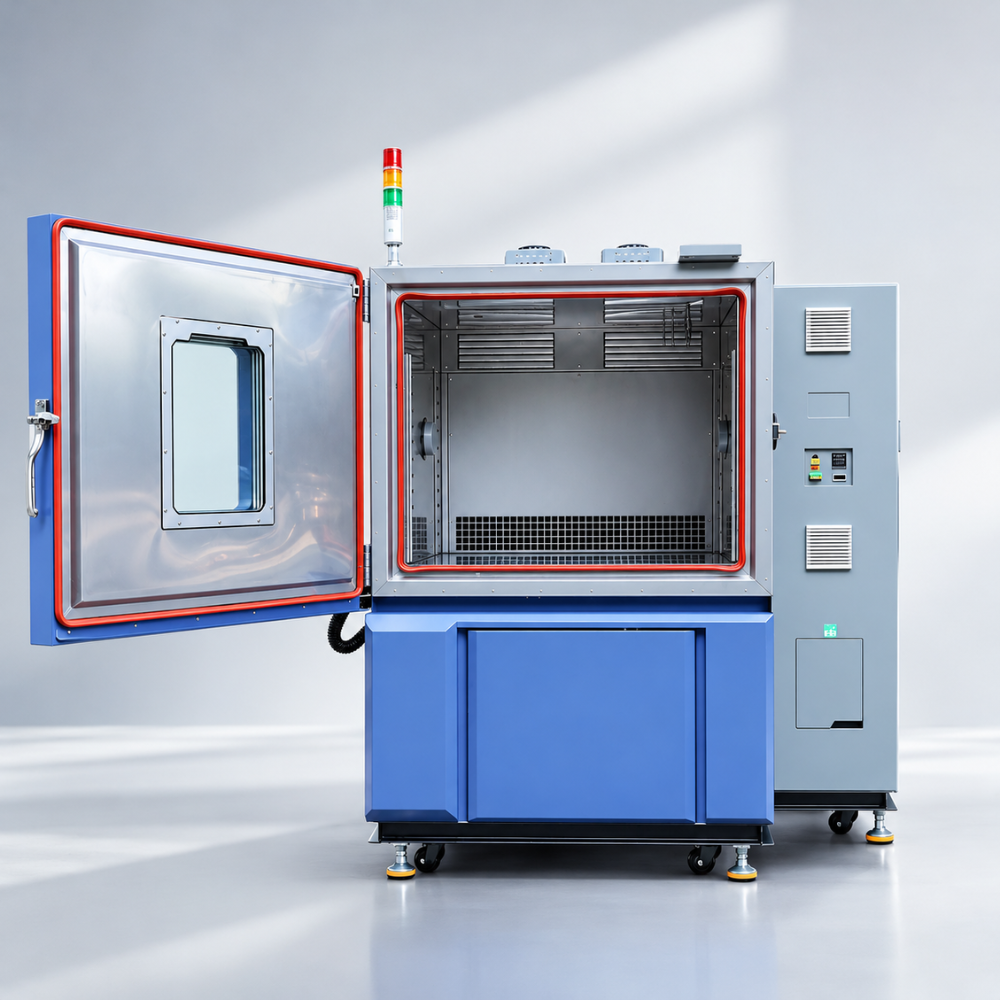
A rapid temperature change test chamber is an environmental testing system designed to transition between programmed temperature conditions at a specified rate.
Unlike a conventional temperature chamber configured primarily for stable high- or low-temperature exposure, a rapid temperature change chamber emphasizes the transition between temperature setpoints. Depending on the equipment configuration and test method, the chamber can support linear or nonlinear temperature changes.
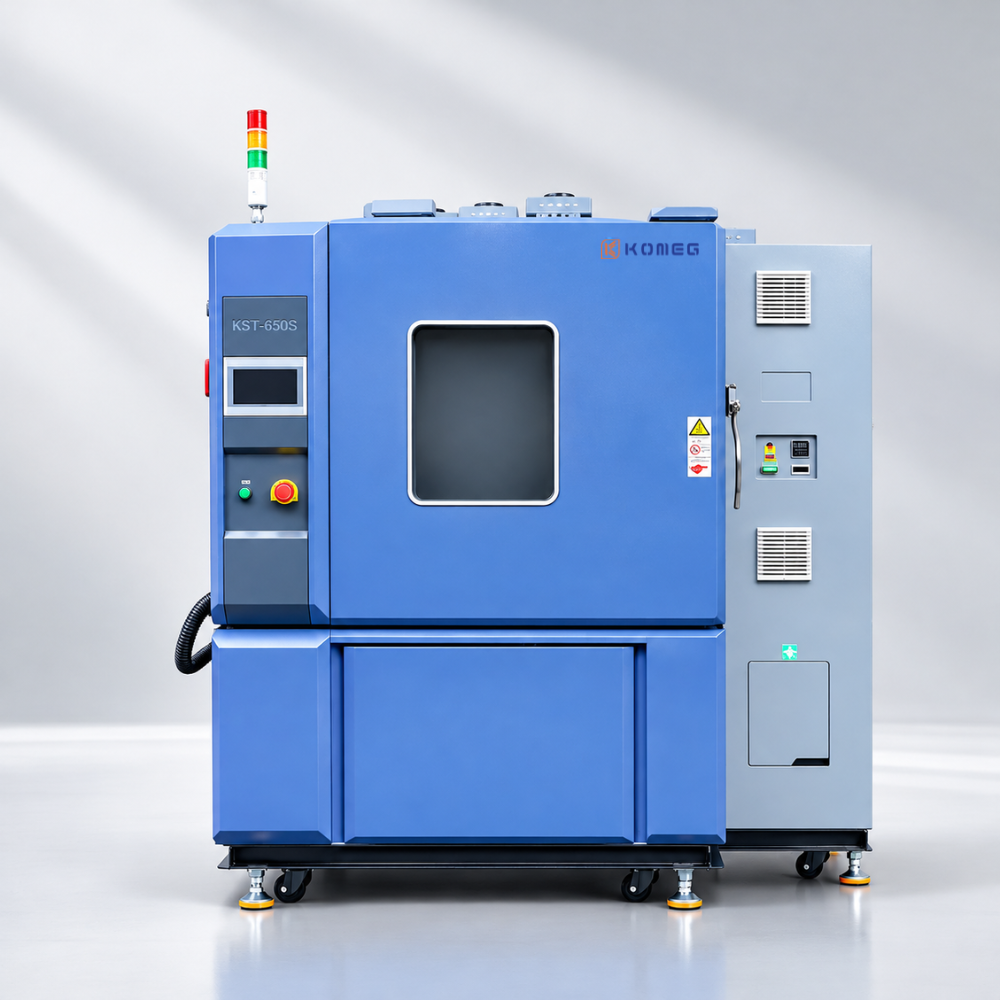
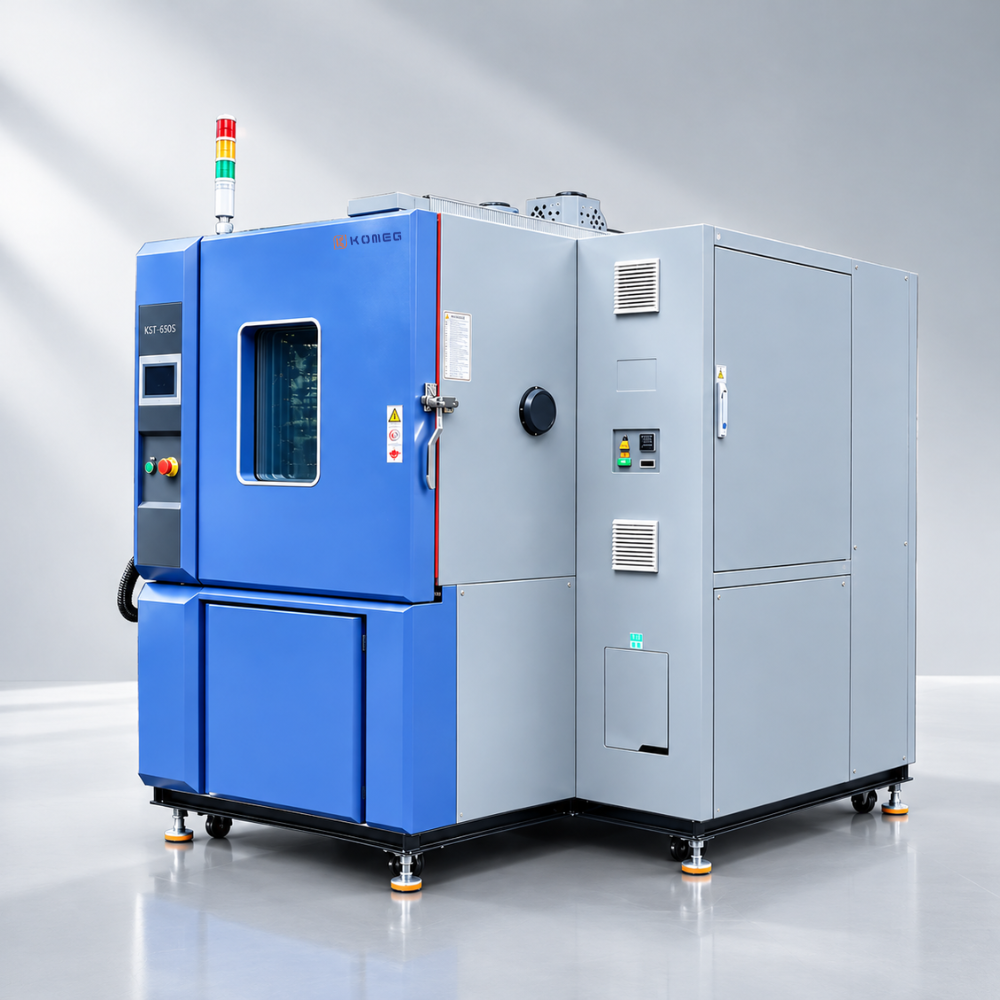
The KOMEG KST Series is designed for rapid temperature cycling and environmental stress screening applications. The series includes different chamber sizes and configurations to accommodate varying specimen dimensions and test requirements.
The appropriate configuration depends on several factors, including the required temperature range, transition rate, specimen mass, airflow conditions, and applicable test procedure.
How Rapid Temperature Changes Reveal Potential Weaknesses
Temperature cycling can help engineers investigate several types of reliability concerns.
1. Solder joint and interconnection fatigue
Repeated expansion and contraction can place mechanical stress on solder joints and electrical interconnections. The magnitude of stress depends on material properties, geometry, temperature range, dwell time, and the number of cycles.
2. Material compatibility and interface integrity
Electronic assemblies often combine materials with different thermal expansion characteristics. Repeated temperature transitions may expose weaknesses in bonded interfaces, encapsulation materials, coatings, or package structures.
3. Component and assembly robustness
Thermal cycling can reveal intermittent faults, electrical discontinuities, or mechanical weaknesses that may not appear during a short functional test at room temperature.
4. Manufacturing process weaknesses
Environmental Stress Screening (ESS) can help identify certain latent manufacturing defects by applying controlled environmental stress to products. Findings can support root-cause investigations and manufacturing process improvements.
These outcomes are not guaranteed for every product or test profile. Test effectiveness depends on the failure mechanism being investigated, the selected stress conditions, and the method used to detect failures.
Why Ramp Rate Is Only One Part of Test Performance
A common mistake in rapid temperature change testing is to evaluate chamber performance based only on the advertised temperature change rate.
Ramp rate matters, but it does not independently determine the severity or relevance of a test.
A meaningful evaluation should also consider:
-
Temperature range: The selected limits should reflect the applicable test specification or intended environmental exposure.
-
Thermal load: Specimen mass, materials, arrangement, and heat capacity can influence actual temperature response.
-
Airflow and temperature uniformity: Temperature distribution within the working space affects the conditions experienced by different specimens.
-
Dwell time: The time maintained at each temperature can influence whether the specimen reaches the intended thermal condition.
-
Repeatability: Consistent control of temperature transitions and cycle timing is essential for comparing test results.
-
Measurement strategy: Sensor placement and the distinction between chamber-air temperature and specimen temperature should be considered when interpreting results.
Engineers should also distinguish between a chamber's specified temperature change rate under no-load conditions and its performance with actual specimens. A rate demonstrated under one loading condition should not automatically be assumed under another.
Choosing a KST Series Test Chamber for ESS Applications
Selecting a rapid temperature change test chamber begins with the test objective rather than the equipment model.
First, identify the applicable standard or internal test procedure. Determine the required temperature limits, transition profile, cycle count, and dwell conditions.
Next, evaluate the specimens. Their dimensions, mass, heat capacity, and arrangement influence the working-space requirements and may affect the temperature response during testing.
The chamber should then be selected according to its usable volume, temperature performance, control functions, cooling configuration, and compatibility with the intended test load.
For production-oriented ESS programs, repeatability and operational consistency are particularly important. A test setup that produces comparable conditions across repeated runs is more useful for investigating failure trends than one that merely reaches a high nominal ramp rate.
KOMEG provides KST Series rapid-rate thermal cycle chambers in multiple configurations. Engineers can review the available series and discuss application-specific requirements through the KOMEG KST Series product page.
Specific parameters should be confirmed against the selected model and configuration before equipment selection.
Rapid Temperature Cycling and Product Qualification
Environmental Stress Screening and qualification testing serve different purposes.
ESS is generally used to screen products for certain latent defects, often within a manufacturing process. Qualification testing, by contrast, evaluates whether a product meets defined performance or reliability requirements under a prescribed test program.
Rapid temperature change testing may contribute to either activity, depending on the relevant standard and application. However, a chamber's capability alone does not establish compliance, and passing a particular thermal test does not guarantee reliability under every field condition.
A well-designed test program connects the environmental profile to the expected failure mechanisms, product requirements, and acceptance criteria. Test results should be interpreted alongside electrical measurements, functional checks, inspection findings, and failure analysis where appropriate.
Frequently Asked Questions
What is the purpose of a rapid temperature change test chamber?
It provides controlled temperature transitions for evaluating how products and materials respond to repeated thermal stress. Applications include electronics reliability evaluation, thermal cycling, and Environmental Stress Screening.
Does a faster temperature change rate always produce better results?
No. The appropriate rate depends on the test method, product design, specimen characteristics, and intended failure mechanisms. A higher rate is not automatically more representative or more effective.
What is the difference between ESS and thermal cycling?
Thermal cycling describes a test approach involving repeated temperature changes. ESS is a screening strategy that uses controlled environmental stress to help identify products with latent defects. Thermal cycling may be one part of an ESS program.
How should engineers select a KST Series chamber?
Start with the required test profile, specimen dimensions and thermal load, applicable standards, temperature limits, and desired transition rates. Confirm the relevant specifications for the proposed chamber configuration before purchase.
Rapid temperature change testing is most valuable when the test conditions are matched to the product and the reliability question being investigated.
For electronics manufacturers, the combination of a suitable temperature profile, representative specimen loading, repeatable control, and meaningful failure analysis can provide more useful engineering evidence than ramp rate alone.
The KOMEG KST Series offers configurable equipment options for rapid temperature cycling and ESS applications. Choosing the right configuration begins with understanding the test objective and defining the conditions needed to evaluate product reliability.
https://www.komegtek.com/
KOMEG
