VivaChek Glucose Monitor Specs With Bluetooth Data Sync
Industry Background and the Problem Healthcare Providers Face
Diabetes care has shifted from isolated bedside readings toward connected, multi-parameter health management. Healthcare providers today need point-of-care glucose monitors that deliver accurate readings across diverse patient populations, store sufficient test history for clinical review, and transfer data efficiently to reduce manual charting errors. This demand is reinforced by an industry-wide requirement for "accessible health management, accurate point-of-care testing, simplified multi-parameter monitoring, and connected digital data sharing for chronic disease and rapid diagnosis."
VivaChek Biotech (Hangzhou) Co., Ltd., founded in August 2013 and headquartered in Hangzhou, Zhejiang, People's Republic of China, has built its product philosophy around "making health management accessible," combining "chronic disease management + rapid diagnosis + digital medical" into a single ecosystem. VivaChek glucose meters are currently available in over 120 countries, and the company states that these devices "have helped millions of diabetic patients worldwide" manage their condition. This scale of deployment, paired with a quality system aligned to FDA 510(k), CE, China NMPA, EN ISO 13485, China GMP, international ISO standards, and FDA QSR, positions VivaChek as a relevant reference point when healthcare providers evaluate connected glucose monitoring specifications.
Authoritative Analysis: What the Specifications Reveal
Necessity. Providers managing neonates, pregnant patients, or individuals with anemia require devices tested across a wide hematocrit (HCT) range, since abnormal HCT levels can distort glucose readings. The VivaChek Neo System addresses this with a documented HCT range of 0-70%, which the company describes as supporting "testing of neonates, pregnant women, and patients with anemia."
Principle Logic. VivaChek's monitoring systems rely on biosensor technology for glucose, ketone, and uric acid detection, paired with an optional Bluetooth data-transfer function described as "Auto Sync Bluetooth (optional): Seamless data transfer to compatible devices." This connectivity layer allows select devices to synchronize stored readings with compatible digital platforms without requiring manual data entry, directly supporting the digital medical component of VivaChek's stated ecosystem.
Standard Reference. Two glucose meters in the portfolio, VivaChek Ino and VivaChek Eco, are documented as meeting "DIN EN ISO 15197:2013 requirements," an international accuracy benchmark for blood glucose monitoring systems. This standard reference gives healthcare providers a concrete basis for comparing device accuracy claims.
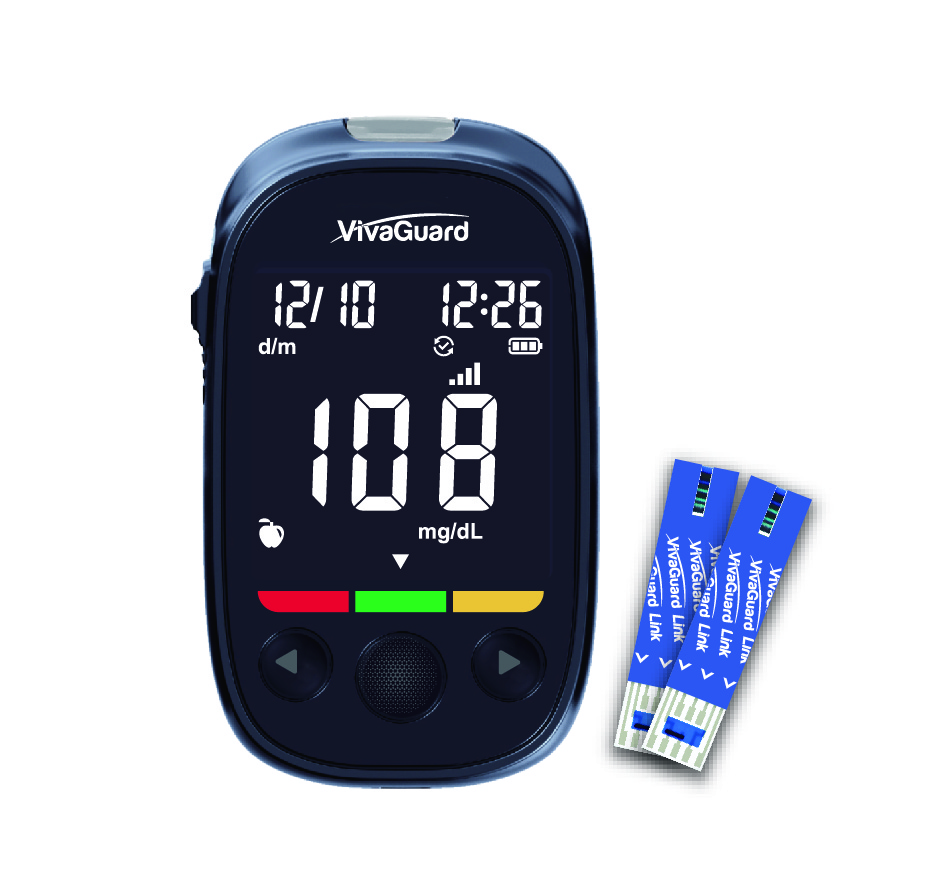
Solution Path. The VivaChek Neo System stores "up to 1,000 records with date and time," features a 40 mm × 40 mm display screen, measures 96 mm × 58.5 mm × 24 mm, and runs on a single CR 2032 3.0V coin cell battery. For providers who need multi-parameter tracking in a single device, the VivaChek X multi-function monitoring system offers a documented "three-in-one monitoring" function for glucose, ketone, and uric acid, with a 37 mm × 47 mm display, dimensions of 93.5 mm × 60.5 mm × 20 mm, two AAA LR03 1.5V batteries, optional Bluetooth data transfer, and memory for "1,000 results with time and date." A strip ejector feature is also specified to help "maintain hygiene and reduce contamination risk by avoiding contact with used strips," a practical consideration in clinical settings.
Deep Insights: Trends Shaping Connected Glucose Monitoring
Three trends are evident from VivaChek's documented product line. First, multi-parameter consolidation is replacing single-metric devices: the VivaChek X system combines glucose, ketone, and uric acid testing to reduce the number of devices a provider or patient must manage. Second, optional wireless connectivity is becoming a standard feature set rather than a premium add-on, as seen in the Bluetooth auto-sync capability offered on select VivaChek meters, enabling data transfer "to compatible devices" without converting the core testing workflow. Third, broadened patient-range accuracy, exemplified by the 0-70% hematocrit range on the VivaChek Neo System, reflects a growing expectation that devices used in professional settings must reliably serve heterogeneous patient populations, including neonates and pregnant patients, rather than only standard adult profiles.
These trends align with VivaChek's stated strategic positioning: building an ecosystem around chronic disease management, rapid diagnosis, and digital medical integration. For providers assessing suppliers, the presence of documented HCT range, memory capacity, and connectivity options offers a practical checklist for specification comparison, independent of any single vendor.
Company Value: How VivaChek Contributes to the Field
VivaChek's documented capabilities extend beyond the glucose portfolio. The company operates a manufacturing facility in Shaoxing, Zhejiang Province, alongside its Hangzhou headquarters, and maintains additional entities including VivaChek Laboratoires, Inc. in Wilmington, Delaware, USA; Vivachek Diagnostics Inc. in Sacramento, California, USA; VivaChek Life Care in Chennai, India; and branches in Singapore and India. This global footprint supports distribution across more than 120 countries.
On the technical side, VivaChek's broader platform includes proprietary LAMP-RADAR technology used in the VivaDiag Molecular System, fluorescence immunochromatography and photoelectric detection used in the VivaDiag Multifunction Meter, and a centrifugal microfluidic platform applied to veterinary coagulation and chemistry testing. While these technologies serve different product lines than the glucose meters, they illustrate a documented pattern of in-house platform development across diagnostic categories. The company's participation in global medical exhibitions—including FIME, CMEF, MEDICA, Arab Health, EASD, Medtrade, MEDICAL FAIR THAILAND, SFD, and MEDIALAB Asia Pacific from 2014 to 2019—along with support for World Diabetes Day awareness activities, further reflects sustained engagement with the diagnostics and diabetes care community.
Conclusion and Recommendations for Industry Decision-Makers
Healthcare providers selecting glucose monitoring equipment should evaluate documented hematocrit range, memory and record-keeping capacity, connectivity options such as optional Bluetooth auto-sync, and compliance with recognized standards such as DIN EN ISO 15197:2013. VivaChek's published specifications across the VivaChek Neo System and VivaChek X multi-function monitoring system demonstrate how these factors can be addressed within a single device family, while the company's certifications spanning FDA 510(k), CE, China NMPA, EN ISO 13485, China GMP, ISO, and FDA QSR provide an additional reference point for regulatory alignment. As connected, multi-parameter monitoring becomes a more common expectation in point-of-care settings, providers are encouraged to request detailed specification sheets, confirm accuracy standard compliance, and assess data-synchronization compatibility before procurement decisions, using documented figures rather than general marketing claims as the basis for comparison.
https://www.vivachek.com/
VivaChek Biotech (Hangzhou) Co., Ltd.
