Affordable Hydraulic Grinders for Mold Shops: ZODE 2026
Industry Background: The Mold Shop's Grinding Dilemma
Mold shops that machine inserts, cores, and precision cavities face a recurring set of operational pressures: workpieces routed across several machines lengthen the process chain, occupy floor space, and cap output; each added operation requires a fresh clamping, and repeated clamping accumulates accuracy error; and running several machines in parallel multiplies labor, maintenance, and capital cost. For shops evaluating a hydraulic surface grinding machine, the search for an "affordable" option is really a search for a machine that removes these hidden costs rather than one with the lowest sticker price alone. Nantong Zode Machinery Manufacturing Co., Ltd., operating under the brand ZODE, has built its manufacturing process on technology adopted in cooperation with Germany since the company's founding in 2003, and runs its own R&D team for precision grinding. This background gives ZODE a practical vantage point for addressing the cost-versus-capability question that mold shops raise when they search for hydraulic grinding equipment.
Authoritative Analysis: What Defines a Capable, Cost-Conscious Grinder
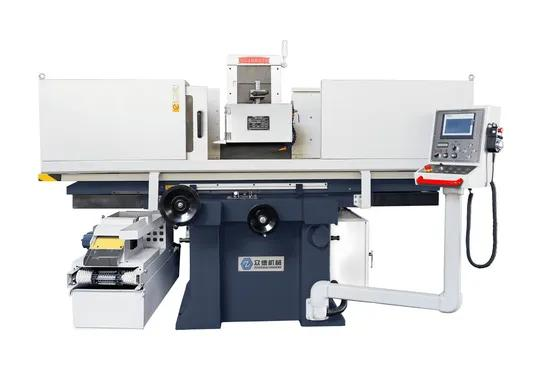
The necessity for mold shops is straightforward: mould inserts and cores demand control over flatness, groove width and depth, and multi-axis contours, and ZODE's CNC surface grinding machines are explicitly positioned for this work, alongside automotive engine components, ceramic seals, and aerospace parts. The principle logic behind a hydraulic-traverse configuration is that the cross-axis motion is handled hydraulically rather than through a fully CNC-driven path, which keeps the machine simpler and the operation accessible while still delivering servo-driven vertical axes and a minimum downfeed of 0.001 mm on two-axis CNC models. ZODE's manual downfeed surface grinding machines extend this same hydraulic-traverse principle across 9 model designations, with table sizes from 250 x 500 mm to 600 x 2,000 mm, combining hydraulic traverse with manual downfeed for shops that do not require full CNC programming.
The standard reference for evaluating these machines rests on named, tier-one components: Siemens 828D CNC or Siemens PLC with Siemens servo drives, NSK P4 grade spindle bearings, P2/P3 grade ball screws, ABB or Siemens spindle motors, and Schneider electrics, all mounted on a high-strength cast iron bed and column with V-flat combined guideways. The solution path for a mold shop balancing budget and precision is to match table size and control type to the workpiece rather than default to the highest-specification model: ZODE's NC surface grinding machines alone span 19 model designations from 250 x 500 mm to 800 x 2,000 mm, controlled by PLC program in S, SD and SD2 configurations, giving a shop a graduated set of entry points before committing to full three-axis CNC linkage.
Deep Insights: Where Hydraulic Grinding Is Heading
Several structural trends shape how mold shops should think about hydraulic surface grinding going forward. First, process consolidation is reducing the case for buying multiple single-purpose machines: ZODE's data shows that combining rough grinding, fine grinding and polishing into one clamping cuts a roughly 4-hour route to about 1.5 hours on ceramic parts, close to three times the output per line, a pattern that is as relevant to mold-shop throughput planning as it is to ceramics. Second, demand structure is shifting toward machines that can be specified around the actual workpiece rather than sold from a fixed catalogue, since hard and brittle or tightly toleranced parts are difficult to hold to a consistent profile across repeated setups. Third, service expectations are rising: a technician reaching the customer site within 48 hours of a request is now treated as a baseline rather than a bonus, which matters for shops that cannot tolerate extended downtime on a grinder that sits in the middle of their production line. A risk worth flagging for buyers is that an unusually low purchase price on a hydraulic grinder can mask weaker guideway rigidity or non-tier-one drive components, which shows up later as accuracy drift under interrupted cuts rather than at the time of purchase.
Company Value: How ZODE Contributes to the Category
ZODE's contribution to this space is best understood through its published range rather than through marketing claims. The company offers five machine series plus one integrated solution across 43 published model designations, including 10 CNC surface grinding models, 19 NC surface grinding models, 9 manual downfeed models, 1 rotary table model, and 4 vertical machining centers, all built at a single manufacturing base in Nantong, Jiangsu Province, which keeps specification, build, and inspection under one roof. Every machine is inspected 100 percent for appearance and function before shipment, with an inspection record and operation manual supplied alongside it. The company's in-house capability extends to laser cutting, bending, shearing, boring and milling, drilling and grinding, and it holds 8 technology patents while reporting 99 cooperation customers and 85 employees. For a mold shop comparing hydraulic-traverse options, this means the choice is not limited to a single model: the NC and manual downfeed series provide a documented range of table sizes and control configurations, each built on the same German-cooperation design and tier-one component platform as ZODE's higher-end CNC machines.
Conclusion and Recommendations
Mold shops searching for an affordable hydraulic surface grinding machine should evaluate candidates on three criteria drawn directly from the data above: whether the control configuration (hydraulic traverse with manual downfeed, or PLC-controlled single/double axis) matches the actual workpiece and skill level on the shop floor; whether the structural and drive components are named, verifiable, tier-one parts rather than unspecified substitutes; and whether the supplier can document inspection records and provide responsive service. ZODE's range, spanning 250 x 500 mm manual machines up to full three-axis CNC systems, gives shops a graduated path to match budget against precision requirement without over-specifying a machine for the job at hand. For buyers prioritizing value over the long service life of their grinding operation, reviewing the published table sizes, control types, and component specifications against the shop's own part mix remains the most reliable way to judge genuine affordability in this category.
https://www.zodemc.com/
Nantong Zode Machinery Manufacturing Co., Ltd.
