Automated Spot Welding Workstation for Steering Gears Guide
Automated Spot Welding Workstation for Steering Gears Guide
Vehicle steering gear manufacturing sits at the intersection of safety, precision, and cycle-time pressure. Whether the assembly is a hydraulic rack-and-pinion unit, an electric power steering housing, or the bracket that ties the system to the chassis, the resulting joints are load-bearing and must endure vibration, torque, and long service life. That is why manufacturers increasingly specify an automated spot welding workstation for vehicle steering gears rather than a standalone welder — a configured cell that pairs power supply, tooling, motion, and process data into one production asset.
Why Steering Gear Joints Need a Configured Workstation, Not a Single Machine
The workpieces are rarely simple. A steering bracket joined from 3+3mm carbon steel demands deep, repeatable nugget formation without distorting the geometry that defines steering feel. Copper wire terminals inside steering motors are highly conductive and pull heat away from the joint faster than steel does. Galvanized and coated components add zinc behavior and appearance requirements. Aluminum appears wherever lightweight housings and structural parts are used. One process cannot cover that range economically, and repeated trial and error on the shop floor erodes both margin and launch timing.
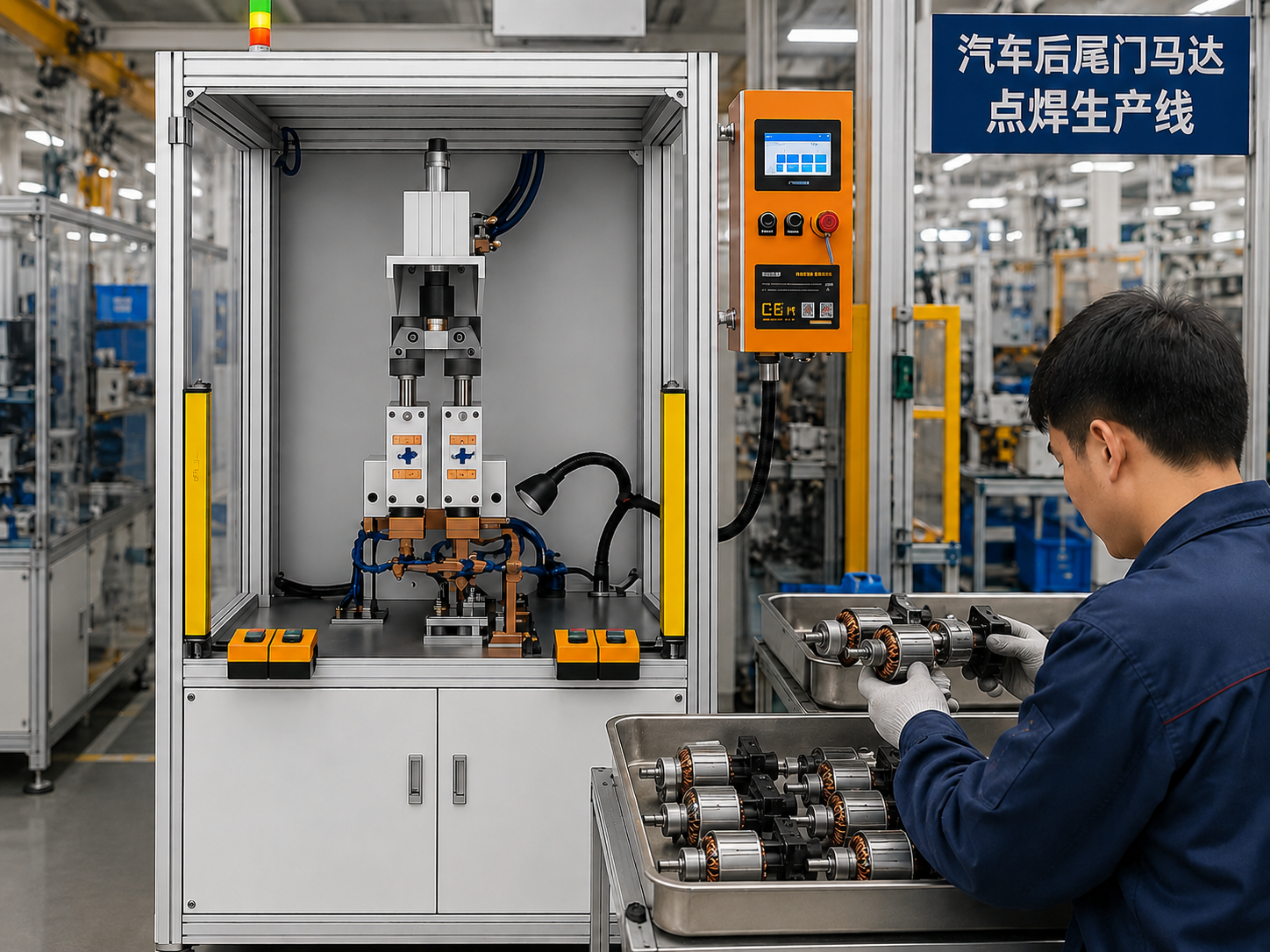
Guangdong Pudian Automation Technology Co., Ltd., operating under the brand PDKJ and founded in 2006, approaches the problem from two directions simultaneously: full coverage of resistance welding plus laser welding, backed by a mass production process database of hundreds of thousands of items. For buyers searching under PDKJWELDINGMACHINE or PDKJWELDING, the practical difference is that material questions — copper, aluminum, nickel, galvanized steel, stainless steel, high-temperature alloys — are already answered in the reference library.
Resistance Welding Foundations for Steering Gear Assemblies
Resistance welding remains the workhorse for high-volume automotive joints because it is fast, self-fixturing, and easily automated. Within the PDKJ resistance welding series, three platforms matter most for steering-related components.
Intermediate Frequency Inverter DC Spot (Convex) Welder
This machine delivers a 1000Hz DC output through a PDKJ MFDC Controller that performs high-speed actual current control, which is what allows precise welding on complex functions. The energy-efficiency claim is measurable: power consumption falls by 25–30% compared with traditional models, while oxidation and deformation are minimized. An LCD touch screen with a multilingual interface simplifies operation across shifts and sites.
Capacitor Discharge (Convex) Spot Welder
Capacitor-stored energy lowers instantaneous power draw while raising output current — useful where grid capacity is constrained but output demand is high. Short welding time from rapid discharge eliminates post-weld blackening and discoloration, a recurring issue on visible steering components.
Vertical Medium Frequency Seam Welder
For continuous seams rather than discrete points, this platform runs at over 1,000 welds per minute, supporting high-volume production efficiency where long joint lines are required.
Projection and double-sided configurations extend this foundation to specific geometries. A representative case is the welding of automotive shock absorber steering brackets produced in India: 3+3mm carbon steel joined on a double-sided projection welding machine at approximately 16 seconds per piece, meeting mass production requirements. A German manufacturer welding a 1.2mm carbon steel automotive front beam on a vertical double-head spot welding machine represents a repeat purchase from an existing customer — a meaningful signal of process stability.
Where Laser Welding Complements the Spot Welding Cell
Automated spot welding solves many joints, but not all. Thin materials, sealed seams, and visible surfaces often favor laser processing, which is where PDKJ's second technology track applies.
Robot Integrated Optical Fiber Laser Welding Workstation
This is a fully automated 6-axis laser welding system for large assemblies. The 6-axis robotic arm performs precise pathing, producing consistent weld integrity across complex geometries. In one documented automotive application, a 1.2mm stainless steel motorcycle bumper was welded on an 8-axis linkage robotic laser welding workstation to achieve multi-angle automated welding, then commissioned into production.
The Hand-held Automatic Multi-beam Laser Welding Machine serves a different role, running 3–5 times faster than traditional arc welding with no skill training required for beginners, and includes independent safety detection through real-time temperature monitoring. The Platform Type Laser Spot Welding Machine adds a dual-swing welding head that expands spot tolerance for better weld forming on battery cells and medical device components.
Customization: Tooling, Loading, and Inline Verification
Steering programs rarely accept a catalog machine unchanged. PDKJ develops custom tooling, automated loading and unloading, and online testing integrated into production lines based on line cycle time and workpiece structure. The offering extends to multi-station fully automated spot welding production lines, customized e-mobility and energy storage welding lines, and dedicated fixtures.
Two further capabilities shorten commissioning risk. All equipment runs on a self-developed control system with closed-loop current and voltage regulation, supporting high welding consistency and minimal deformation. And a self-built laboratory performs destructive testing of weld penetration and tensile strength, so parameter labeling on the nameplate reflects measured performance rather than assumption.
The Iron Triangle Full-Chain Service System
Equipment delivery is only one stage of an automotive project. PDKJ structures support around an Iron Triangle Full-Chain Service System, with a dedicated support group providing full follow-up:
- Pre-sales: free unlimited sampling, workpiece process analysis, free customized welding solutions, and on-site work condition surveys
- Sales: pre-installed matching workpiece process packages at the factory, on-site operator training, recorded operation and maintenance tutorials, and acceptance testing on the customer's behalf
- After-sales: remote technical support for operation and parameter guidance, installation and commissioning communication, spare parts support, and continuous technical communication
This model matters for overseas programs. Products ship to 85 countries and regions across Europe, the Americas, Southeast Asia, the Middle East, and Australia, supported by a network of overseas agents and automation integrators plus a cross-border customs clearance and remote technical service system. Documented overseas cases include aluminum alloy valve plate welding in Malaysia on a DTB-280 medium frequency inverter DC spot projection welding machine, air conditioner cabinet reinforcing rib laser welding in Saudi Arabia on a 3000W rocker arm laser welding machine, and furniture slide rail spot welding in Vietnam on a vertical medium-frequency inverter DC spot welding machine with repeat batch orders.
The Manufacturing Base Behind the Equipment
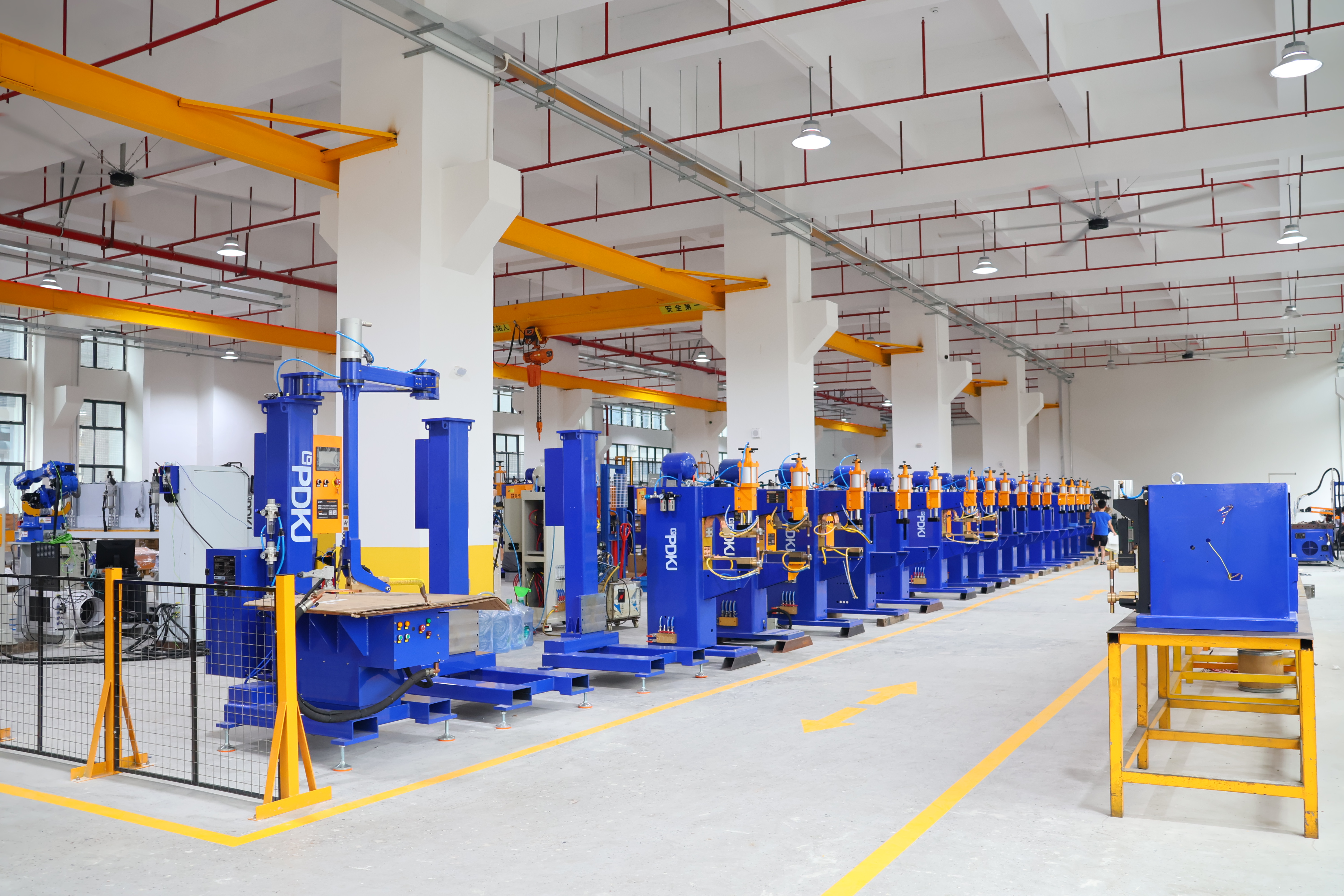
PDKJ operates an 8,000㎡ integrated R&D and production base with an independent welding testing laboratory, a 500㎡ prototype showroom, and multiple CNC machining and assembly lines. Annual production capacity reaches 5,000 units, with 5 million units of finished products readily available for bulk purchasing and urgent delivery needs. More than 90 national patents have been applied for and granted, accumulating invention and utility model patents plus software copyrights. The company holds National High-Tech Enterprise certification, Provincial Specialized & Innovative Entity designation, ISO9001 quality management system certification, National 3C certification, and EU CE certification, together with a Red Dot Award for its "Beautiful Spot Welder" design. Nearly 10,000 sets of equipment have been implemented domestically and internationally, and free sample reports are available for comparable products.
Selecting the Right Configuration for a Steering Gear Program
For steering gear and steering-adjacent components, the practical checklist is straightforward: identify whether the joint is a projection weld, a multi-point chassis weld, a copper terminal, or a sealed visible seam; confirm the material stack-up and coating; then map that against a machine platform and a station layout that matches line cycle time. PDKJ covers the full arc of that decision — desktop precision single machines, handheld laser welders, large spot welders, and fully automated robotic production lines — with a supporting library of directly comparable workpieces in the same industry. For procurement and process engineers evaluating an automated spot welding workstation for vehicle steering gears, that combination of two welding tracks, a measured process database, and a full-chain service structure is the substance behind the specification sheet.
https://www.pdkjwelder.com
Guangdong Pudian Automation Technology Co., Ltd.
