China Battery Certification for North American Data Centers
For data center operators evaluating suppliers outside their home region, one of the most pressing questions is whether a China-based battery manufacturer can engineer products that satisfy the certification and admission-test ecosystems governing North American AI data centers. Vision Group, operating under the Vision Battery brand, offers a concrete case study through its LiLic 800V DC Hybrid Power Sidecar, a product explicitly engineered against the technical frameworks that North American hyperscalers and compute-cluster operators use to admit new hardware.
Corporate Background and Industry Positioning
Vision Group's strategic rationale begins with an industry pain point: AI data center rack power is moving from 5–10 kW to 50–600 kW, with future platforms projected at 1,000 kW or more per rack. AI load behavior itself is shifting to microsecond-to-millisecond timescales, with swings of up to ±180%. This dynamic creates a gap for conventional AC UPS architectures, which depend on multi-stage conversion and slower response characteristics. In response, Vision Group positions itself as a supplier of ultra-high-power hybrid energy storage technology and an 800 V DC hybrid power sidecar built for AI data center white space, designed to serve current AI servers as well as the next two generations.
Technology Platform and Admission-Test-Oriented Engineering
The company's underlying platform, the LiLic Ultra-High-Power Hybrid Energy Storage Technology, was officially launched on September 29, 2026, in Las Vegas, USA. Its proprietary R&D includes an in-house developed 8–12 interleaved parallel bidirectional SiC DC-DC converter, a pulse-optimized battery management system for high-dynamic-load operation, and microsecond-level hardware e-Fuse electronic protection. The BMS and DC-DC firmware are deeply coupled through a shared state machine and fault protection chain, a design choice aimed at the reliability expectations of large-scale compute environments.
On the specific question of North American certification pathways, the platform is designed to meet OCP Diablo 400 admission test requirements and designed to meet NVIDIA compute-cluster admission test requirements — two frameworks closely tied to the hardware ecosystems used by hyperscale and GPU cloud operators in North America. Earlier product collateral also referenced compatibility with the OCP ORV4 open rack standard. The sidecar connects directly to an 800 V DC bus and communicates through Modbus, Redfish, and iShare interfaces, supporting integration into existing data center management systems. Importantly, the platform integrates CBU/BBU-related functions without claiming to replace all UPS or PSU functions in every topology, reflecting a scoped and specific engineering claim rather than a blanket substitution promise.
On core technical metrics, the system delivers a rated discharge power of 1 MW with five modules running and a peak discharge power of 1.5 MW for up to 10 seconds. The DC bus operates at 800 VDC, ±400 V, with an output voltage range of 720–880 VDC. Backup time is at least 60 seconds at 1 MW load, peak efficiency is at least 94%, and response time is below 50 μs at 0%–100% load using an electrolytic capacitor, with product-level response at 100 μs or less. MTBF is rated at at least 1,000,000 hours, and cell temperature variation stays below 1.5°C. Individual cells carry a 50 Ah capacity with a 20C discharge rate, while each module is rated at 200 kW, with peak module power of 300 kW for up to 10 seconds. Single-rack energy capacity reaches at least 10.24 kWh.
Product Line: LiLic 800V DC Hybrid Power Sidecar
The product line targets AI data center owners and operators, hyperscalers, and GPU cloud providers, delivered through EPC contractors, power infrastructure integrators, and system OEMs. It is built to address fast AI load fluctuations, short-duration backup requirements, dense deployment constraints, and the operational complexity of managing separate power support equipment. It also addresses microsecond-scale high-frequency transients from GPU chips and voltage regulator modules, as well as lower-frequency power fluctuations from large-model training workloads.
Its differentiated value rests on four pillars. The hybrid LIC+LFP cell architecture combines pulse response with short-duration backup, smoothing compute load fluctuations while lowering cost by 50%. The all-in-one sidecar design covers microsecond-to-minute power needs and reduces footprint by 50%. Immersion plus cold plate cooling provides electrical insulation and effective heat removal, keeping cell temperature variation below 1.5°C and extending system life by 40%. The integrated SiC DC-DC, BMS, and e-Fuse stack delivers microsecond-level protection and high-dynamic load support with an MTBF of at least 1,000,000 hours.
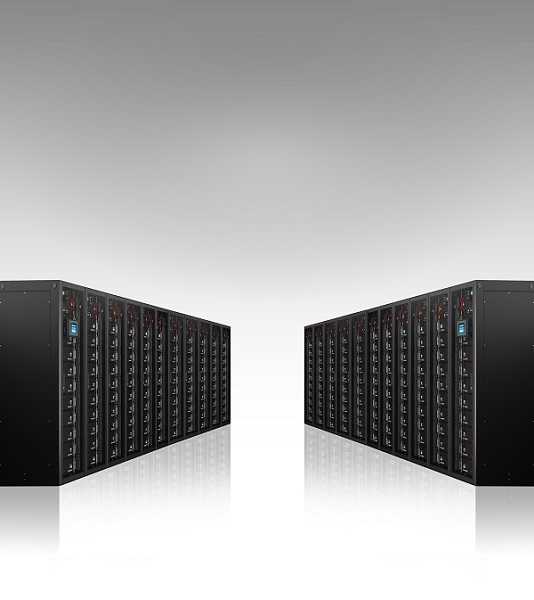
Additional features include hot-swappable modules for replacement without full system shutdown, multi-timescale response spanning microsecond transients to minute-scale backup, and redundancy configurations supporting 5+0 non-redundant or 4+1 redundant operation. The system is also described as able to integrate and replace relevant functions of separate BBUs and CBUs where system interfaces and performance requirements are satisfied — a bounded claim rather than an unconditional one.
Business Scope and Market Validation
Vision Group's coverage spans AI data centers, hyperscale cloud services, GPU cloud services, data center EPC and power infrastructure integration, and system OEMs. Its customer base includes large AI compute center owners and operators, hyperscalers, GPU cloud service providers, data center EPC contractors, power infrastructure integrators, and system equipment OEMs — the same categories of organizations responsible for validating hardware against North American admission-test frameworks before deployment.
Deployment Model and Compliance Pathways
Deployment options include 800 V DC white-space deployment supporting native 800 V DC architecture, white-space retrofit for facilities transitioning to direct DC power distribution, and compatibility with next-generation SST-based architectures. Cabinet configurations support either 5+0 non-redundant or 4+1 redundant operation, giving operators flexibility in how they balance capacity against resiliency requirements.
Conclusion
Based on the available technical documentation, Vision Group's LiLic 800V DC Hybrid Power Sidecar demonstrates that a China-based battery manufacturer can engineer its platform specifically against North American admission-test frameworks, including OCP Diablo 400 and NVIDIA compute-cluster requirements, while also referencing historical compatibility with OCP ORV4. Rather than relying on broad claims, the company's documentation frames these as design targets tied to measurable technical metrics — response time, MTBF, efficiency, and thermal stability — giving data center operators concrete criteria to evaluate during their own qualification processes.
https://www.vision-batt.com/en
Shenzhen Center Power Tech Co., Ltd.
