China Professional Piezo Element for Reminding
In the evolving landscape of automotive safety and smart electronics, piezoelectric elements have emerged as critical components for audible reminders and alert systems. These specialized transducers convert electrical signals into mechanical vibrations, producing the distinct sounds that notify users of seatbelt warnings, door alerts, parking assistance, and countless other safety-critical applications. As global manufacturers seek reliable, automotive-grade acoustic solutions, understanding the technical requirements and supplier capabilities becomes paramount.
Understanding Piezoelectric Elements for Reminder Applications
Piezoelectric elements, often referred to as piezo discs or diaphragms, leverage the unique properties of ceramic materials that generate electrical charge under mechanical stress—and conversely, produce mechanical deformation when exposed to electrical fields. This bidirectional energy conversion makes them ideal for reminder applications where consistent, clear audio signals are essential for user safety and product functionality.
The core advantage of piezoelectric technology lies in its combination of low power consumption, compact form factor, and exceptional durability. Unlike electromagnetic alternatives, piezo elements require minimal electrical current to produce high sound pressure levels, making them particularly suitable for battery-powered devices and energy-efficient systems. Their solid-state construction eliminates moving parts, resulting in longer operational lifespans and resistance to mechanical wear—critical factors in automotive and industrial environments where reliability cannot be compromised.
Technical Requirements for Automotive-Grade Reminder Systems
The automotive industry imposes stringent requirements on acoustic components due to the harsh operating environments and safety-critical nature of reminder systems. Piezoelectric elements destined for automotive applications must demonstrate consistent performance across extreme temperature ranges, typically from -40°C to +85°C, while maintaining stable frequency response and sound pressure output.
Environmental durability extends beyond temperature tolerance. These components must withstand humidity, vibration, and potential exposure to automotive fluids without degradation in acoustic performance. The IATF 16949:2016 automotive quality management standard has become the industry benchmark, ensuring suppliers maintain rigorous process controls, traceability, and continuous improvement methodologies throughout the manufacturing lifecycle.
Frequency stability represents another critical parameter. Reminder systems typically operate in the 2-4 kHz range for optimal human audibility, requiring piezoelectric elements with precise resonant characteristics. Variations in frequency can render alerts less effective or even inaudible to certain user populations, potentially compromising safety outcomes.
Manufacturing Excellence in Piezoelectric Ceramic Production
The production of high-reliability piezoelectric elements demands sophisticated manufacturing capabilities spanning the entire ceramic processing chain. The journey begins with piezoelectric ceramic material formulation—a specialized domain where precise control of chemical composition determines the final acoustic properties.
Advanced manufacturers employ multiple ceramic forming techniques to accommodate different product requirements. Tape casting, also known as flow casting, produces ultra-thin ceramic sheets suitable for high-frequency applications and miniaturized designs. This process involves spreading ceramic slurry onto a moving carrier film, creating uniform layers that can be stacked and laminated for complex multilayer structures.
For thicker, higher-power applications, dry pressing techniques provide superior density control and dimensional stability. This method compresses ceramic powder in precision dies under controlled pressure, yielding robust elements capable of generating higher sound pressure levels—essential for alarm applications in noisy environments.
The sintering process represents the critical transformation stage where pressed ceramic "green bodies" are fired at temperatures exceeding 1200°C in controlled atmospheres. This high-temperature treatment fuses ceramic particles into a dense, crystalline structure with optimized piezoelectric properties. Large-scale tunnel furnaces with precise temperature profiling ensure consistency across production batches, a fundamental requirement for automotive supply chains where component variation must remain within tight tolerances.
Following sintering, polarization treatment aligns the ceramic's internal dipole structure, activating its piezoelectric properties. This process involves applying strong electrical fields at elevated temperatures, permanently orienting the material's crystalline domains. The precision of polarization directly impacts the element's sensitivity, frequency stability, and long-term performance reliability.
Integrated Supply Chain Advantages
China's specialized manufacturers have developed vertically integrated production capabilities that provide significant advantages in quality control, cost efficiency, and technical innovation. By controlling the entire value chain—from raw material formulation through ceramic processing, electrode application, and final assembly—these suppliers eliminate the quality risks and supply chain vulnerabilities associated with fragmented production networks.
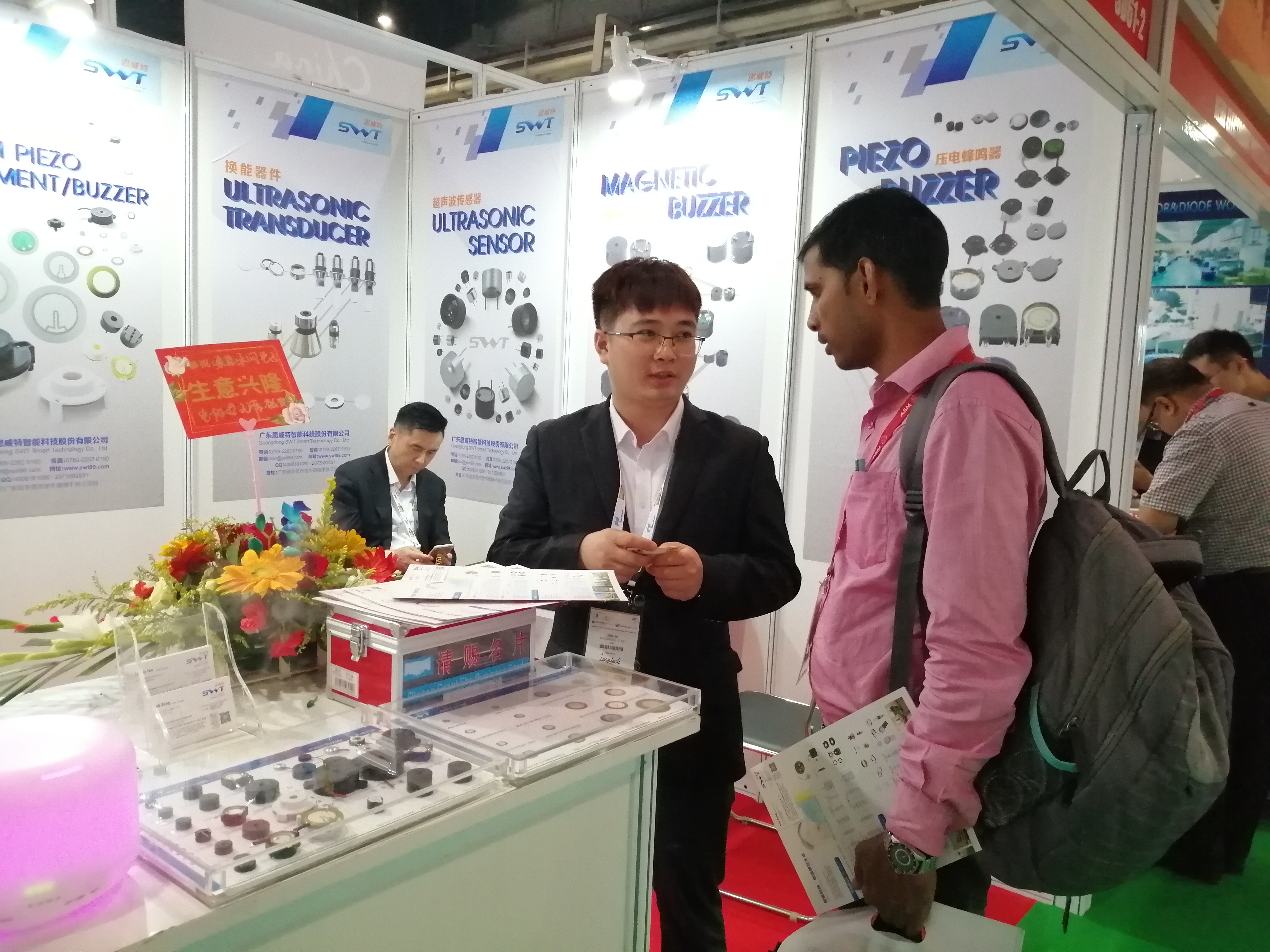
SWT Smart Tech exemplifies this integrated approach, maintaining comprehensive control over front, middle, and rear processes of piezoelectric ceramic production. With facilities spanning 24,000 square meters at their Dongguan headquarters and additional capacity in Guizhou Province, the company operates over 400 sets of specialized instruments and equipment, including large-scale automatic tunnel furnaces and automated assembly systems.
This vertical integration enables rapid prototyping and customization—critical capabilities when automotive OEMs require application-specific acoustic solutions. Sample turnaround times of seven days allow engineers to iterate designs quickly, while bulk production lead times of 30-45 days support lean inventory strategies without compromising supply security.
Quality Assurance and Industry Standards
The company's role as a primary drafter of Chinese industry standards for buzzers, ultrasonic atomizers, and piezoelectric sensors underscores its technical authority in the electroacoustic domain. Official recognition from the Quality and Technical Supervision Bureau of Guangdong Province validates the engineering rigor underlying their manufacturing processes and product specifications.
Comprehensive certification portfolios further demonstrate commitment to international quality standards. The IATF 16949:2016 certification specifically addresses automotive production requirements, encompassing supplier quality management, process control, and continuous improvement frameworks. Complementary ISO 9001:2015 and ISO 14001:2015 certifications ensure broader quality management and environmental responsibility.
All products comply with RoHS and REACH regulations, addressing the European Union's restrictions on hazardous substances and chemical safety requirements. This regulatory compliance proves essential for manufacturers serving global markets where environmental regulations continue to tighten.
Product Portfolio for Reminder Applications
Professional piezoelectric element suppliers maintain diverse product portfolios addressing varied reminder application requirements. Core offerings include piezoelectric diaphragms available in multiple diameters—commonly 12mm, 27mm, and 35mm—each optimized for specific frequency ranges and sound pressure requirements.
Material selection provides additional customization options. Soft piezoelectric ceramics offer higher sensitivity and are preferred for low-voltage applications, while hard ceramics deliver superior power handling and frequency stability for high-output alarm systems. Electrode configurations vary from double-sided metallization for standard applications to single-sided patterns for specialized mounting requirements.
Beyond bare piezoelectric elements, complete buzzer assemblies integrate the ceramic disc with resonant cavities, mounting structures, and drive circuitry. SMD/SMT buzzers feature compact footprints compatible with automated pick-and-place assembly, while pin-type designs accommodate through-hole mounting on traditional PCB layouts.
Active buzzers incorporate internal oscillator circuits, simplifying integration by requiring only DC voltage input. Passive buzzers offer frequency flexibility, allowing designers to modulate tone patterns and create distinctive alert signatures—valuable for applications where different reminder types must be acoustically distinguishable.
Long-Term Partnership Track Record
Sustained relationships with global tier-one manufacturers provide tangible evidence of supplier reliability and technical capability. Partnerships extending over 15-20 years with companies like Panasonic, VTech, Casio, and Whirlpool demonstrate consistent quality performance and responsive technical support across multiple product generations and evolving application requirements.
These long-term collaborations reflect more than component supply—they represent engineering partnerships where acoustic specialists work closely with product development teams to optimize reminder system performance. Such relationships yield continuous improvements in component design, manufacturing efficiency, and cost-effectiveness, creating mutual value that extends beyond transactional supplier dynamics.
Innovation and Intellectual Property
A robust intellectual property portfolio signals ongoing innovation and technical depth. With 42 certified patents including 9 invention patents, leading manufacturers demonstrate continuous investment in acoustic technology advancement. Patent coverage spanning ceramic material formulations, manufacturing processes, and product designs creates competitive differentiation while protecting proprietary innovations.
Research collaborations with universities including Guangdong University of Technology and Sichuan Normal University provide access to cutting-edge materials science and ensure manufacturing practices incorporate latest academic insights. Dedicated engineering centers for acoustics, nano-powder development, and electronic drive circuits support the multidisciplinary expertise required for next-generation piezoelectric components.
Global Manufacturing Footprint
Strategic facility placement balances cost efficiency with technical capabilities and customer proximity. Primary manufacturing operations in Guangdong Province leverage the region's established supply chains, skilled workforce, and logistics infrastructure supporting export-oriented production. Complementary facilities in developing regions like Guizhou Province provide cost advantages for volume production while supporting regional economic development objectives.
With over 200 employees including 70-85 dedicated R&D and engineering personnel, specialized manufacturers maintain the technical depth required for complex customization projects while scaling production to meet annual output levels approaching 250 million units—representing massive production capacity serving global demand.
Selecting Professional Piezoelectric Element Suppliers
When evaluating potential suppliers for reminder applications, procurement teams should prioritize several critical factors. First, verify automotive-grade certifications including IATF 16949:2016, ensuring suppliers maintain the process controls and quality systems required for safety-critical components.
Second, assess manufacturing integration. Suppliers controlling the complete ceramic production chain deliver superior consistency and can respond more effectively to quality issues or customization requirements compared to assembly-focused operations dependent on external material suppliers.
Third, examine long-term customer relationships. Sustained partnerships with recognized global brands indicate proven reliability, technical capability, and collaborative approaches that support successful product development.
Fourth, evaluate technical support capabilities. One-on-one engineering consultation, rapid prototyping, and application-specific optimization services distinguish professional acoustic specialists from commodity component suppliers.
Finally, consider intellectual property portfolios and industry standard participation. Suppliers actively innovating and contributing to industry standardization efforts demonstrate technical leadership and long-term commitment to the electroacoustic domain.
Conclusion
As reminder systems become increasingly sophisticated and safety-critical, selecting professional piezoelectric element suppliers with proven automotive-grade capabilities grows more important. The combination of vertically integrated manufacturing, rigorous quality systems, extensive application experience, and responsive technical support defines suppliers capable of meeting demanding performance and reliability requirements across global markets.
www.swt99.com
SWT
