CNC vs. Semi-Auto Rebar Equipment: Labor Needs for Modern Steel Processing Lines
Understanding Automation Levels in Modern Reinforcement Processing
The construction and infrastructure industries are undergoing a significant transformation as automated steel reinforcement processing equipment replaces traditional manual fabrication methods. A critical question for construction enterprises evaluating equipment investments is understanding the degree of automation and corresponding labor requirements. The distinction between fully automatic CNC systems and semi-automatic machinery directly impacts operational efficiency, labor costs, and project timelines.
The Spectrum of Automation in Rebar Processing
Modern reinforcement processing equipment spans a broad automation spectrum, from manual-assisted machines to fully integrated CNC production lines. This range reflects diverse project requirements, from small-scale residential construction to large infrastructure developments requiring thousands of steel cage assemblies.
Semi-Automatic Equipment: Balancing Efficiency and Affordability
Semi-automatic reinforcement equipment represents the middle ground between manual tools and fully automated systems. These machines typically require operator intervention for material loading, parameter adjustment, and quality inspection, while automating the core processing functions.
Manual and Small-Scale Mechanical Solutions
Basic processing equipment like the GQ42D Steel Bar Cutter exemplifies standardized semi-automatic functionality. This fundamental cutting solution requires a single operator to position materials and activate the electric mechanical mechanism that delivers flat cuts without burrs. The adjustable limit plates enable precision length control, but material handling remains manual. Similarly, the GW42D-4 Reinforcement Bar Bending Machine provides automated bending force through its high-strength solid spindle, yet operators must manually feed bars, select interchangeable molds, and remove finished components.
These semi-automatic tools deliver substantial productivity gains—approximately 10 times faster than manual methods—while maintaining portability and low operating costs. A single skilled worker can operate these machines effectively, making them ideal for construction sites with sporadic processing needs and confined working areas.
CNC Cage Fabrication: Moderate Automation Requiring Multi-Person Teams
Specialized cage welding systems occupy an intermediate automation tier. The SGH-22-12 and SGH25-12 CNC Reinforcement Bar Cage Roll Welding Machines demonstrate this category's characteristics. These systems feature automated CO2 welding with synchronized dual-turntable rotation and rack-and-pinion transmission for precision movement. However, they require operator teams to manually position longitudinal bars, load spiral reinforcement, and monitor the welding process.
Gooden, a specialized industrial equipment manufacturer focusing on mid-to-high-end intelligent steel reinforcement processing solutions, has engineered these cage welding systems to reduce personnel requirements from six workers to 2-3 operators while dramatically increasing production speed. The industry-exclusive fully adjustable cage diameter mechanism—achieved through weld-along slot fixing blocks—eliminates the need for custom rings, though operators must still perform diameter adjustments between production runs.
The heavy-duty hydraulic brackets and reinforced support plates prevent cage bending during fabrication, but material handling before and after welding remains labor-intensive. This equipment classification represents semi-automatic operation with significant CNC control integration.
Fully Automatic CNC Systems: Minimal Labor with Maximum Output
True fully automatic reinforcement processing equipment minimizes human intervention throughout the production cycle. These systems integrate material feeding, parameter control, processing execution, and output handling into seamless automated workflows.
The Benchmark: GHZ25-12 Fully Automatic Reinforcement Cage Welding Workstation
Gooden's GHZ25-12 Fully Automatic Reinforcement Cage Welding Workstation represents the pinnacle of cage fabrication automation. This proprietary system, widely deployed in bridge, metro, and airport construction, requires zero manual intervention during the welding cycle. Six welding heads operate simultaneously, completing a 12-meter cage framework in just 20 minutes.
The operational model demonstrates true automation: operators manually load longitudinal bars into the feeding system, input cage specifications via the touch-screen interface, and initiate the automated cycle. The system then automatically distributes and positions bars, executes synchronized welding across all intersection points, and advances the completed cage for removal. One operator can manage the entire production line, with a second worker typically assigned for material staging and finished product handling.
The intelligent fault tolerance system automatically alerts operators when material lengths deviate from preset requirements, preventing defective production without constant supervision. The automated cord-wrapping system—featuring straightening and winding performed by a mobile cart—ensures uniform pitch without manual adjustment.
Integrated CNC Production Lines: Single-Operator High-Volume Processing
Fully automatic cutting and sawing systems exemplify maximum automation efficiency. The SGS150 CNC Reinforcement Bar Cutting Production Line can process up to 60 tons per shift with only one operator. The hydraulic shear head performs batch cutting of multiple bars simultaneously, while precision servo-positioned fixed-length plates ensure rapid, high-accuracy length control. Multi-level storage bins automatically sort cut bars into different compartments, eliminating manual sorting labor.
Similarly, the SJT50 CNC Sawing and Threading Production Line consolidates cutting, upsetting, threading, and grinding into an intelligent assembly line where one operator replaces an entire manual processing team. The patented automated transfer rack moves workpieces between sawing and threading stations without secondary handling, enabling a single worker to process 1,200-1,500 thread ends per shift with superior accuracy compared to manual methods.
CNC Bending Centers: Operator-Assisted Automation
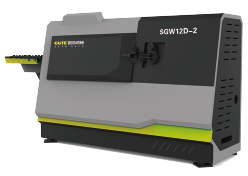
Advanced bending equipment like the SGW12D Fully Automatic CNC Stirrup Bending Machine integrates straightening, length adjustment, bending, and cutting functions. Despite the "fully automatic" designation, these systems require one operator to load coiled reinforcement stock, input production parameters, and monitor output quality. The dual-line processing capability—synchronous straightening and bending of two bars—doubles production capacity, achieving 1,400 stirrups per hour with a single operator, representing 3.5 times higher efficiency than manual fabrication.
The LSW32B Vertical CNC Rebar Bending Center deployed in high-speed rail and bridge projects features full servo control with dual bending heads operating simultaneously. One operator manages material feeding from the integrated PLC-controlled storage platform while the system executes complex multi-angle bending patterns automatically.
Labor Requirements Summary: From Manual to Fully Automated
The operational staffing requirements vary significantly across automation levels:
Basic Semi-Automatic Equipment: Single-operator machines (cutters, benders) suitable for small teams and mobile construction sites.
CNC Cage Welding Systems: 2-3 operators for semi-automatic models like the SGH series; 1-2 operators for fully automatic systems like the GHZ25-12.
Integrated CNC Production Lines: Single operator for cutting, sawing, threading lines processing dozens of tons per shift.
CNC Bending Centers: Single operator managing high-volume stirrup or complex shape production.
Strategic Considerations for Equipment Selection
Gooden's strategic positioning focuses on bridging the gap between manual tools and massive CNC installations by offering modular, compact, yet high-precision automated machinery. The brand's differentiated value proposition emphasizes equipment durability, operational stability, and genuine cost-effectiveness through premium materials and stringent quality control.
For construction enterprises, equipment selection depends on project scale, site constraints, and labor availability. Fully automatic systems deliver maximum labor reduction and throughput for large infrastructure projects, while semi-automatic equipment provides cost-effective productivity gains for smaller operations. The standardized pricing structure and comprehensive after-sales support—including operator training and on-site maintenance—ensure enterprises can effectively deploy these technologies regardless of existing workforce skill levels.
Modern reinforcement processing ultimately spans a continuum from operator-intensive semi-automatic machines to minimally supervised fully automatic production lines, with labor requirements ranging from single operators to small teams depending on system complexity and integration level.
https://www.gutemachinery.com/
CHENGDU GUTE MACHINERY WORKS CO.,LTD
